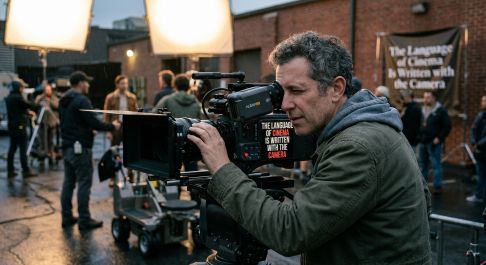
The camera, therefore, becomes the instrument through which the filmmaker writes. Its language is constructed through framing, movement, lighting, composition, editing, rhythm, and the relationship between one image and another.
Souad Khalil | Libya
The transition from silent cinema to sound cinema marked a decisive turning point in the history of the cinematic art. Yet the introduction of sound did not simply replace silence or diminish the role of the image; rather, it opened a new field of possibilities and raised fundamental questions about the nature of cinematic expression. The relationship between image and sound consequently became one of the most significant issues in film theory and aesthetics.
This second part examines the expressive possibilities created by sound and its relationship with the image, while considering the views of a number of major film theorists and directors. It explores the role of dialogue, music, silence, dubbing, subtitles, and montage, and questions the extent to which these elements can contribute to the construction of cinematic meaning without overwhelming the visual language of the film.
The discussion also considers the tension between cinematic realism and artistic representation. Sound may enhance the spectator’s sense of reality, but it does not constitute reality itself; like the image, it is subject to artistic selection, composition, rhythm, and montage. The essential question, therefore, is not whether cinema should be silent or talking, but rather how sound can be employed artistically in dialogue with the image.
From this perspective, the discussion returns to a fundamental principle that has accompanied cinema since its earliest beginnings: the image remains at the heart of cinematic expression. Sound can enrich, deepen, and extend what the image conveys, but it cannot replace its unique expressive power. The camera ultimately remains the instrument through which the filmmaker writes the language of cinema.
Marcel Martin’s view, however, would contradict itself if he were referring specifically to the transition from silent cinema to talking cinema. It is clear, nevertheless, that he is addressing a broader question concerning the value of art.
When a film producer realizes that audiences have become saturated with a particular type of film, the conscious and knowledgeable producer searches for new forms and experiments capable of developing the art of cinema.
In the early days of silent cinema, audiences embraced it enthusiastically. But eventually a point was reached when they felt that the actors had to speak; otherwise, their dissatisfaction would undermine the entire experience.
Spectators had grown tired of gestures and movements, however amusing they might be and however brilliant the actor might have been in silent expression. They began to feel that what they were seeing no longer corresponded to the reality in which they lived.
Cinema is an art that is realistic to the greatest possible degree. More precisely, it is the art that gives us the sensation of reality in the most effective manner and surpasses other arts in this respect.
Marcel Martin, defending the presence of sound on the film strip, argues that sound is also an important component of the cinematic image because it adds another dimension to the depiction of the atmosphere surrounding people and objects—the atmosphere that we perceive in real life.
But art is not reality itself; it is an artistic recreation of reality. There is therefore a distinction between reality and art, and nothing requires every element in a film to be a literal copy of reality.
The image is not exactly as we see it in everyday life, and sound is not exactly as we hear it in everyday life.
The image adopts a particular angle, while lighting plays a fundamental role. The composition of the people and objects within the frame acquires a specific meaning, far removed from the disorder and randomness that characterize ordinary life.
Likewise, sound in cinema must be an artistic sound: it should give us a sensation of reality without being reality itself. Indeed, artistic sound may sometimes convey reality to us more intensely and effectively than reality itself.
Despite the importance of sound in cinema, however, it would be a mistake to regard it as a more important means of expression than the other expressive elements of film.
René Clair argues that filmmakers should first seek events that can be fully understood through the image, and that words should possess no more than an emotional value.
Cinema, he maintains, should remain a universal form of expression through images, while the language of each people should simply give it a particular musical coloration.
From René Clair’s statement, we can understand that he regards the language of the image as a universal language, one that can be understood by people throughout the world, whereas spoken language is particular to each community and differs from one people to another.
This may indeed be one of the difficulties confronting the talking film.
The language used in the dialogue may be unfamiliar to many spectators in other countries. Sometimes, even within the country where the film was produced, particular dialects may be unfamiliar to viewers.
Producers may attempt to overcome this difficulty through dubbing the film into the language appropriate to each country in which it is distributed.
Yet dubbing deprives spectators of the actor’s authentic voice and manner of delivery, regardless of how skillfully the dubbing itself may be performed.
This is especially important because audiences may know the voices of certain famous stars almost as intimately as they know the voices of the people around them.
As for subtitles, they may sometimes constitute an obstacle that prevents the spectator from becoming fully immersed in the viewing experience.
They may also distract the viewer from the aesthetic dimensions of the cinematic frame and, to some extent, from the actor’s performance.
Sound as a Cinematic Element
Eisenstein, Pudovkin, and Alexandrov, in their famous manifesto of 1930 concerning sound film, argued that the talking film was a double-edged weapon.
According to them, there was a strong possibility that, under the principle of least effort, sound would be used merely to satisfy the curiosity of the audience.
The fundamental problem of sound in cinema, therefore, lies in how it can be used artistically so that it complements the image according to the needs and requirements of the film.
Yet in many films we find filmmakers resorting to dialogue in order to explain everything, thereby neglecting the fundamental function of cinema.
John Ford’s The Informer illustrates what Ford meant when he urged filmmakers to “let the picture do the talking.”
Although sound is used effectively in this film, it never overwhelms the image.
In fact, much of its effectiveness derives precisely from the film’s refusal to exceed its cinematic boundaries and from the director’s understanding of the nature of cinematic language.
Sound depends upon the image rather than the reverse.
In another film, such as The Naked City, we notice that cinematic narration depends heavily upon sound, to such an extent that the spectator could follow the film without looking at the image at all.
By contrast, if we were to strip John Ford’s The Informer of its images and retain only its soundtrack, much of its meaning would disappear.
Dialogue and Egyptian Cinema
If we examine most Egyptian films, we find that many of them can be described as literary films.
They depend heavily upon dialogue and have therefore become, as we mentioned earlier, merely illustrated stories. They remain, to a considerable extent, under the influence of theatrical traditions.
Perhaps this results from a failure to understand the true function of cinema.
At the same time, however, it ultimately derives from the inability of filmmakers to express themselves through cinema’s fundamental language: the image.
Sound, Silence, and Montage
With regard to montage, no one can deny that editing creates a particular flow of images, especially because it conceals the intervention produced by cutting between the spectator and the continuity and movement of the image.
However, once cinema entered the sound era, the editor had to make a considerable effort to achieve the continuity required by the medium.
For this reason, many French films turned to other techniques, such as the use of soft music, particularly when moving between an interior and an exterior scene, or cutting on a silent action.
Silence in a talking film can become a positive expressive force when it is used effectively.
We know the major dramatic role silence can play when it becomes a symbol of death or absence, a representation of danger, or a source of anxiety and a sense of isolation.
Sound itself can also acquire dramatic significance.
A particular sentence may point toward a mysterious character. A recurring tone may be associated with a particular person and express something about that person’s character.
Incomplete words may also be used to represent a character suffering from memory loss, with the completion of those words signaling the return of memory.
In such cases, sound fulfills an essential function and becomes an inseparable part of the film’s structure.
Fulton, in his book translated into Arabic under the title Cinema: An Art and a Craft, argues that cinema’s entry into the sound era expanded its possibilities.
The addition of sound to the image broadened the possibilities available to montage.
It was not merely the use of sound to record dialogue that made the screen a competitor to theatre. Rather, the integration of sound created new expressive possibilities and expanded what could be conveyed through the cinematic image.
The definition that a film tells its story primarily through images does not mean that sound must be excluded.
Images can incorporate sound, provided that sound is used cinematically and is capable of being shaped through montage.
Furthermore, sound should not be understood merely as an unlimited collection of noises. It also includes speech and dialogue intended to communicate something specific.
The Legacy of Silent Cinema
Although the age of silence in cinema has ended, that era has left a profound mark on the medium.
Indeed, silent cinema constitutes a lasting artistic legacy to which filmmakers return whenever they wish to demonstrate their ability to express themselves through purely cinematic means.
The greater the filmmaker’s reliance on the image, the more clearly their artistic mastery is revealed.
This is what led John Ford to state that he uses as little dialogue as possible in his films because he believes that cinema is fundamentally composed of images.
For this reason, he seeks to make the images themselves do the talking.
The statement does not mean that images literally speak. Rather, it expresses a fundamental principle of cinematic language: the image should be capable of conveying meaning, emotion, atmosphere, action, and ideas without having to rely constantly on verbal explanation.
The camera, therefore, becomes the instrument through which the filmmaker writes.
Its language is constructed through framing, movement, lighting, composition, editing, rhythm, and the relationship between one image and another.
Thus, the history of cinema can also be understood as a continuous search for the possibilities of the image: how an image can narrate, suggest, evoke, conceal, reveal, and ultimately speak without words.
This is perhaps the essence of cinematic language: not the elimination of sound or dialogue, but the recognition that the image remains the fundamental source of cinematic expression.
Read: Cinema’s language is written with Camera-1
______________
 Souad Khalil, hailing from Benghazi Libya, is a writer, poet, and translator. She has been writing on culture, literature and other general topics.