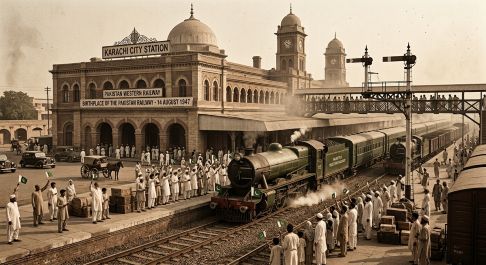
On 14 August 1947, Pakistan inherited one of the most extensive railway systems in South Asia. The network connected Karachi Port with Lahore, Rawalpindi and Peshawar, while branch and strategic lines penetrated Sindh, southern Punjab, the Khyber frontier and Balochistan.
By Ramesh Raja
British-Era Railways of Pakistan
The railway was one of the most transformative British engineering works in the territory that became Pakistan. Its development began in Sindh in the 1850s, driven by Karachi’s emergence as a seaport and by the British need to connect the Arabian Sea with the agricultural and strategic regions of the Indus Valley and the north-western frontier.
The first public railway in present-day Pakistan opened on 13 May 1861, connecting Karachi City with Kotri over 105 miles, approximately 169 km. Sir Bartle Frere, Commissioner of Sindh, had promoted the railway surveys and the connection between Karachi, the Indus river system and the Punjab.
Part A: Sindh and the Karachi-Rohri Railway
- Karachi-Kotri Railway: 169 km
The Karachi-Kotri line was the first railway constructed in present-day Pakistan. It connected the port with the Indus navigation system at Kotri and became the starting point of the later Karachi-Peshawar railway corridor.
- Kotri-Rohri and Indus Valley Railway
The British progressively extended the railway northward through Sindh. The railway eventually reached Rohri, establishing a vital connection between Karachi, the lower Indus Valley and Punjab. This route became part of the great north-south railway artery.
- Hyderabad-Badin Railway: about 109 km
A branch railway connected Hyderabad with Badin and the irrigated agricultural areas of lower Sindh. It was principally an agricultural and commercial railway, carrying agricultural produce towards the main railway system.
- Sindh Branches
Numerous branch lines were constructed to connect important towns and agricultural centers, including routes towards Dadu, Larkana, Jacobabad, Shikarpur, Nawabshah, Mirpur Khas and other districts. These lines integrated the newly developed irrigation and agricultural economy with Karachi’s port.

Part B: Punjab Railways
- Lahore-Amritsar Railway and Lahore-Multan System
The British developed Lahore into one of the principal railway centers of northern India. Lines radiating from Lahore connected the city with Amritsar, Multan, Rawalpindi and other important centers. The railway network was designed to move agricultural produce, passengers and military supplies.
- Lahore-Rawalpindi-Peshawar Main Line
The great northern railway corridor eventually connected Karachi with Peshawar, following the Indus plains and crossing the major rivers of Punjab. Different sections were constructed during the last quarter of the nineteenth century and early twentieth century.
This became the backbone of the railway system inherited by Pakistan.
- Lahore-Peshawar Railway
The line from Lahore through Gujranwala, Wazirabad, Gujrat, Rawalpindi, Attock and Nowshera to Peshawar provided the principal railway connection to the North-West Frontier.
- Lahore-Multan Railway
The Lahore-Multan corridor connected the agricultural heartland of Punjab with the Indus system and subsequently with Sindh and Karachi.
- Lala Musa-Kundian Railway: about 252 km
The Lala Musa-Kundian line ran along the eastern side of the Indus and became an important component of the Sind-Sagar railway system. The historical railway records identify the route as approximately 157 miles, or about 253 km.
Part C: Frontier Railways
- Peshawar-Jamrud Railway: 18 km
The Peshawar-Jamrud branch opened in 1901 and was approximately 11 miles, or 18 km, long. It was the beginning of the railway extension towards the Khyber Pass.
- Khyber Railway: approximately 60 km
The railway was subsequently extended through the Khyber Pass towards Landi Khana. The Peshawar Cantonment-Landi Khana mainline was approximately 37 miles, or 60 km. It contained numerous tunnels and bridges and was one of the most strategically important railway projects of the British Empire.
- Nowshera-Durgai Railway: 64 km
The Nowshera-Durgai Railway, originally opened as a narrow-gauge railway in 1901, was approximately 40 miles, or 64 km, and was later converted to broad gauge. It provided strategic access towards Malakand and the northern frontier.
Part D: Balochistan Railways
- Sibi-Quetta Railway
The British faced some of their greatest railway engineering challenges in Balochistan. The route from Sibi through the Bolan Pass to Quetta crossed rugged mountains, steep gradients, floods and unstable terrain. The railway eventually provided the principal connection between the Indus plains and Quetta.
- Bolan Pass Railway
The Bolan route incorporated approximately 17 tunnels, together with numerous bridges and difficult cuttings. It was primarily a strategic railway, enabling the British to move troops and supplies towards Quetta and the Afghan frontier.
- Sindh-Pishin Railway
The British constructed the Sind-Pishin Railway as another strategic route towards Quetta and the Afghan frontier. It formed part of the network later incorporated into the North Western Railway.
- Chaman Railway
The railway was subsequently extended from Quetta towards Chaman, close to the Afghan border. The Khojak Tunnel, approximately 3.912 km long, was the outstanding engineering work on this route. It was completed in 1891 and carried the railway through the Khojak Pass.

Part E: North Western Railway
The separate railway companies and state railways were gradually amalgamated. The Scinde Railway, Punjab Railway, Delhi Railway and Indus Steam Flotilla were brought together, while further state railways were subsequently incorporated. In 1886, the system became the North Western State Railway, renamed the North Western Railway in 1905.
By partition, the North Western Railway was the principal railway system serving the territory that became Pakistan.
Pakistan Railways records that at partition approximately 5,048 route miles of the North Western Railway passed to Pakistan, while 1,847 route miles went to India. Other historical compilations give approximately 8,122 route km inherited by Pakistan, comprising about 6,880 km broad gauge, 506 km meter gauge and 736 km narrow gauge.
The Railway Legacy of 1947
On 14 August 1947, Pakistan inherited one of the most extensive railway systems in South Asia. The network connected Karachi Port with Lahore, Rawalpindi and Peshawar, while branch and strategic lines penetrated Sindh, southern Punjab, the Khyber frontier and Balochistan.
The British railway system included major bridges over the Indus and Punjab rivers, numerous smaller bridges and culverts, tunnels through the Khyber, Bolan and Khojak mountains, railway stations, workshops, signalling systems and extensive railway colonies.
Its purposes were mixed: military mobility, administrative control, agricultural development, movement of commodities and connection of the interior with Karachi’s port. Yet whatever its colonial objectives, the physical network became one of the most important assets inherited by Pakistan.
The railway therefore stands alongside roads, bridges, irrigation canals, ports and tunnels as one of the principal infrastructure legacies of the British period. The Pakistan of 1947 inherited not merely railway tracks, but an integrated transportation system that connected the Arabian Sea with the Indus Valley, Punjab, the North-West Frontier and the strategic mountains of Balochistan. (Continues)
Click here to read Part-1, Part-2,
_______________
 The author of this article, Engr. Ramesh Raja, is a Civil Engineer, visionary planner, PMP certified and literary enthusiast with a passion for art and recreation. He can be reached at engineer.raja@gmail.com