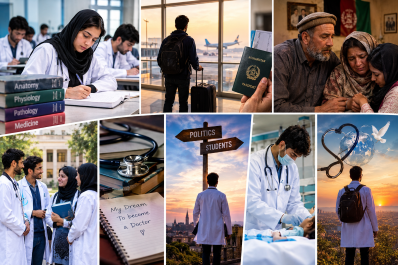
Let politics deal with politics. Let governments deal with governments. Let conflicts be resolved through diplomacy, dialogue, and law. Do not let politics break Afghan students’ dreams.
By Abdullah Usman Morai | Sweden
There are some pieces of news that make you stop for a moment, not because you know whether they are completely true, but because of what they could mean for ordinary human beings.
Recently, I came across reports suggesting that Afghan medical students studying in Pakistan could face expulsion from the country. I do not know whether these reports are entirely accurate, and I sincerely hope that the situation is either misunderstood or reconsidered before any decision is taken that could permanently damage the lives of young students.
But even the possibility is deeply disturbing.
Behind every medical student is a dream. Behind every dream is a family. And behind every family are years of sacrifice.
Imagine a young Afghan student arriving in Pakistan with a suitcase full of clothes, books, and perhaps a few carefully preserved photographs from home. Somewhere in that suitcase is a much heavier thing: the dream of becoming a doctor.
Perhaps that student spent years preparing for medical school. Perhaps parents sold land, borrowed money, reduced household expenses, or sacrificed their own comforts to pay tuition and living costs. Perhaps a mother prayed every night that her son or daughter would one day wear a white coat. Perhaps a father repeatedly told relatives, with pride in his eyes, “My child is studying medicine.”
Medical education is not an overnight journey. It takes years of study, examinations, sleepless nights, financial sacrifice, and enormous emotional pressure.
Read: Pakistan Moves to Expel Afghan Medical Students
And then, when a student is already deep into that journey, perhaps close to completing it, to suddenly hear, “You may have to leave the country,” must feel like the ground has disappeared beneath their feet.
What happens to those years? What happens to the examinations they have passed? What happens to the friendships they have built? What happens to their unfinished clinical training?
And, most importantly, what happens to the dream?
I write this not as a politician, nor as someone wishing to enter the complicated disputes between countries. I write it from the perspective of someone who understands what it means to be an international student.
When you leave your homeland to study in another country, you do not simply cross a geographical border. You enter an entirely different world.
You learn how to live away from your family. You learn new systems, new rules, new academic expectations, and often a new language or culture. You learn to cook for yourself, manage money, deal with loneliness and continue studying even when you desperately miss home.
International students become experts at adapting.
I know something of that feeling myself. When you are far from your homeland, your education becomes more than a degree. It becomes a bridge between the life you left behind and the future you are trying to build.
That is why I find it particularly painful to imagine an international student being forced to abandon an education after investing years of life in it.
Of course, every country has the right to protect its borders and address legitimate security or legal concerns. No one is arguing against that. Governments have responsibilities, and those responsibilities should not be ignored.
But there is also something called proportionality.
If there are genuine concerns about the movement or status of Afghan students, could there not be a more humane solution?
Could their movement be temporarily restricted? Could travel outside particular areas be limited? Could they be required to remain in their educational institutions until their studies are completed? Could special permits be issued allowing them to finish their degrees and then return to their homeland?
There are usually more than two choices between “do nothing” and “send everyone away.”
A mature society searches for the third option, the one that protects legitimate national interests without unnecessarily destroying innocent people’s futures.
And this is where we should ask ourselves another question.
What would happen if Pakistani students studying abroad were suddenly told that they must leave before completing their education?
Imagine a Pakistani medical student studying in Europe, North America, Australia, the Middle East, or anywhere else. Imagine that student is in the final year of medical school. Imagine the family back home has spent years paying tuition and living expenses.
Then, suddenly, the student receives a message:
“You have to leave.”
No final examinations. No completed degree. No opportunity to finish clinical training. No certainty about whether another university will accept the credits.
How would Pakistani parents react?
They would be devastated. We would call it unfair. We would ask for compassion. We would appeal to the authorities. We would say: “Let our children complete their education.”
That is precisely why empathy matters.
The nationality of a student should not determine the value of their dream.
An Afghan medical student and a Pakistani medical student may come from different countries, but when they sit at a desk studying anatomy at two in the morning, their exhaustion is probably the same.
When they receive good examination results, their happiness is probably the same. When they call their parents and say, “I passed,” the pride in their parents’ voices is the same.
And when they fear that everything they have worked for could suddenly disappear, their anxiety is also the same.
Education should be one of the few spaces where politics and conflict are allowed to step aside.
Wars have borders. Political disagreements have borders. Governments change. Policies change.
But a student’s education is a once-in-a-lifetime journey.
You cannot easily give a young person back the three, four, five, or six years they lost.
You cannot return the money their parents sacrificed. You cannot restore the nights they spent studying. And you cannot simply repair a dream once it has been shattered.
There is another reason why this matters.
Afghanistan needs doctors. Pakistan needs doctors. South Asia needs doctors. The world needs doctors.
A young person studying medicine is not an enemy. A medical student carrying textbooks is not a security threat merely because of their nationality. These are young people preparing themselves to save lives.
One day, that Afghan student might return home and treat a child in Kabul, Herat, Kandahar, or another distant village.
Perhaps that doctor will save the life of a mother. Perhaps he or she will work in a rural hospital where there are very few qualified physicians. Perhaps that doctor will become a teacher and train another generation of medical students.
That is what education can produce when we allow it to reach its destination.
So, if there are genuine concerns, address those concerns.
If there are legal requirements, enforce them fairly. If there are security considerations, manage them carefully.
But please do not make students the battlefield.
Let them study. Let them complete their examinations. Let them graduate. Let them return home with a degree in their hands instead of a broken dream in their hearts.
There is an old humorous expression people sometimes use when someone suddenly says something that makes absolutely no sense: “What have you been smoking last night?”
Perhaps before making decisions that can change many young lives, decision-makers should ask themselves a similar question, not literally, of course, but metaphorically.
Please do not smoke something toxic before making decisions about other people’s futures.
Because behind every file on a government desk is a human being. Behind every student visa is a family. Behind every university admission is a dream.
And behind every medical student is perhaps a future doctor who could one day save your life or mine.
Let politics deal with politics. Let governments deal with governments. Let conflicts be resolved through diplomacy, dialogue, and law.
But let students remain students.
Let them open their books. Let them sit their examinations. Let them wear the white coat they dreamed about.
And, above all, do not let the conflicts of adults become the funeral of a young person’s dream.
Read: Nepal’s Floods: South Asia’s Warning Bell
________________
 Abdullah Soomro, penname Abdullah Usman Morai, hailing from Moro town of Sindh, province of Pakistan, is based in Stockholm Sweden. Currently he is working as Groundwater Engineer in Stockholm Sweden. He did BE (Agriculture) from Sindh Agriculture University Tando Jam and MSc water systems technology from KTH Stockholm Sweden as well as MSc Management from Stockholm University. Beside this he also did masters in journalism and economics from Shah Abdul Latif University Khairpur Mirs, Sindh. He is author of a travelogue book named ‘Musafatoon’. His second book is in process. He writes articles from time to time. A frequent traveler, he also does podcast on YouTube with channel name: VASJE Podcast.