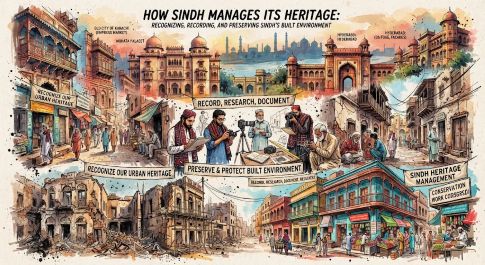
The Significance of Our Revered Urban Centers, the Importance of Recognizing, Recording, and Preserving Sindh’s Built Environment
Many of Sindh’s urban architectural landmarks are either not well-documented, neglected, or under risk of destruction or inappropriate change, in contrast to the widespread interest in the region’s important archaeological sites.
By Ali K. Lashari & Ayaz Ahmed Mugheri
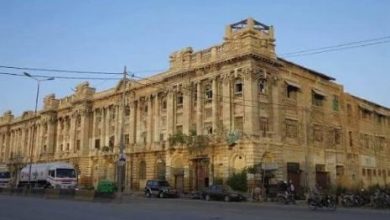
The cultural and architectural environment of Sindh is unparalleled in South Asia. Not only can one see its history in the world-renowned Mohenjo-Daro and Makli archaeological sites, but one can also see it in the ancient neighborhoods, public buildings, markets, schools, houses of worship, and traditional streets of its cities.
Many of Sindh’s urban architectural landmarks are either not well-documented, neglected, or under risk of destruction or inappropriate change, in contrast to the widespread interest in the region’s important archaeological sites.
Old buildings aren’t necessarily historic. Their preservation exemplifies the cultural, social, economic, and architectural evolution of a community through the years. Architectural features such as doors, courtyards, balconies, ornamental details, building materials, and spatial layouts record essential information about people’s daily lives, including their occupations, trades, and interactions.
Consequently, Sindh’s heritage management efforts going forward need to do more than only safeguard archaeological sites; they need also acknowledge the significance of historic cities to the cultural identity of the province.
Moving Beyond Historical Sites
Major archaeological sites and famous structures in Sindh have always been associated with heritage conservation. These and other significant sites—including Mohenjo-Daro, Kot Diji, Makli, and Ranikot—represent priceless eras in the history of the area.
The cultural importance of Sindh, however, cannot be deduced from its archaeological artefacts alone.
Hyderabad, Larkana, Khairpur, Sukkur, Rohri, Shikarpur, Thatta, Karachi, Sehwan, and Umerkot are just a few of the cities in Pakistan that showcase architectural traditions that span multiple eras and cultures.
Houses of worship, shops, schools, libraries, government offices, and public plazas are all part of their historic districts.
A building’s architectural merit is one thing, but its historical or social importance can be far greater than its outward appearance would indicate.
An important example of traditional craftsmanship may be preserved in a small residential building. An ancient school might stand for the progress of contemporary education. The business ties and planning traditions that molded the city may be laid bare in an old marketplace.
Such locations should be carefully examined, recorded, and, when necessary, protected by law.
Cityscapes Losing Their Architectural Character
Historic structures in Sindh are slowly vanishing, which is a major threat to the region’s urban history.
Older urban districts are under a lot of stress from things like commercial development, public ignorance, changing property prices, lack of maintenance, and rapid urbanization.
It is not uncommon for traditional homes to undergo renovations in order to meet contemporary standards. The removal or replacement of historically significant elements, such as wooden doors, balconies, original windows, plasterwork, and traditional building materials, may proceed without proper documentation.
Historic buildings can also fall into disrepair when its owners do not have the means, knowledge, or motivation to keep them in good repair.
There is more to the disappearance of a historic building than meets the eye. It might also stand for the erasure of historical artefacts, community memories, traditional handicraft, and architectural know-how.
Reconstructing a historically significant structure after its demolition will compromise its original character.
Urban heritage management should not wait for structures to become severely damaged before identifying them and taking preventative conservation measures.
Making Sense of Urban History
More than just historically important structures are considered part of urban heritage.
Everything from old streets and traditional communities to public squares, business districts, houses of worship, gardens, and ancient infrastructure are all part of it.
The layout of a historic city’s buildings, more so than any one landmark, can reveal its character.
Various aspects of Sindh’s urban evolution are shown by sites such as Shikarpur’s old commercial avenues, Khairpur’s architectural legacy, Hyderabad’s traditional urban fabric, and Sukkur and Rohri’s historic riverbank settlements.
Cultural landscapes in these regions should be researched in a holistic way.
The cultural importance of preserving a single structure at the expense of its historic context is questionable.
As a result, heritage management should focus on areas rather than individual buildings, acknowledging the importance of historic streetscapes, neighborhoods, and urban contexts.
Why Every Province Should Have Its Own Urban Heritage Inventory?
Creating a thorough Provincial Urban Heritage Inventory is a crucial initial step in safeguarding the historic cities of Sindh.
The purpose of this inventory is to catalogue and record all of the province’s historically important structures and neighborhoods.
Please ensure that all necessary details are documented regarding the building, such as its location, ownership (if known), approximate construction time, architectural features, historical associations, physical condition, photographs, and current use.
Methods such as standardized field survey forms, digital photography, and geographic information systems (GIS) can facilitate this procedure.
A competent evaluation of the social, cultural, architectural, and historical importance of each property should be conducted.
There should be a clear differentiation in the inventory between structures that are already protected by law, those that were surveyed before but not officially recognized, and properties that have been recently discovered and need additional assessment.
It is important to note that being included in an inventory does not imply being officially designated.
For conservation planning, expert review, and potential legal protection in the future, documentation is essential.
Preservation of Cultural Artefacts and Legal Designation
The Sindh Cultural Heritage (Preservation) Act, 1994 is one piece of legislation that has long served to safeguard Sindh’s rich history and artefacts.
Nevertheless, appropriately identifying, documenting, implementing, monitoring, and raising public awareness are crucial to the efficacy of heritage legislation.
A professional evaluation should be conducted on buildings with proven architectural, historical, or cultural significance in order to determine if they are eligible for historic designation within the relevant legal framework.
Accurate recording, evaluation of relevance, confirmation of current legal status, and adherence to established protocols are all essential components of this process.
You shouldn’t take a designation as just another administrative notice. Conservation, allowable changes, maintenance, and the control of development pressures are all made more complex as a result.
Property owners need access to suitable professional advice and a clear mechanism to help them comprehend the ramifications of heritage protection.
Instead of viewing historic properties as restricted assets, conservation strategies should be put in place to make preservation possible, which will support heritage legislation.
The Role of Historic Structures in Community Identity
The significance of historic structures goes far beyond their physical appearance.
Generations of pupils may have fond memories of a long-gone institution. The memories of business partnerships and community gatherings may be better preserved in a more conventional environment. The social history of a neighborhood can be reflected in a historic home.
What makes a city unique are the associations that people have with it.
That is why, when possible, it is important to incorporate local viewpoints, traditional knowledge, oral histories, and memories into heritage documentation.
Contributions to heritage surveys can be made by residents, property owners, architects, scholars, historians, and community organizations.
Buildings that have gone unnoticed by authorities can be located with the aid of public involvement.
Conservation efforts tend to receive more support from communities when they acknowledge historic buildings as an integral part of their collective cultural heritage.
Expertise from professionals and active participation from the public are so essential in heritage management.
Sustainable Development and Creative Reuse
Preserving historic structures for future generations calls for conservation strategies that are both practically and economically viable.
A museum isn’t the right fit for every old building.
Through well-thought-out adaptive reuse, many buildings can keep performing their original tasks while others can accept new, suitable uses.
Cultural, educational, or community-oriented adaptations of historic homes are possible when the circumstances warrant it.
It is possible to house libraries, archives, interpretive centers, or other related activities in buildings that were formerly used for administrative or commercial purposes.
Nevertheless, it is imperative that adaptive reuse adheres to the property’s cultural relevance, original materials, structural features, and architectural integrity.
Appropriate technical approaches and expert evaluations of the situation should form the basis of any conservation initiatives.
Substituting modern materials for older ones in the sake of convenience can dilute the building’s original character.
The goal should be to ensure historic structures last as long as possible while keeping their important features.
Collaboration between Institutions and the Obligation of Professionals
No one organization can make a dent in the field of urban heritage management.
Various stakeholders, including local communities, universities, development agencies, planning departments, heritage authorities, and municipal administrations, must work together to ensure effective conservation.
Historic structures and streetscapes should be adequately protected by urban planning standards that identify heritage-sensitive regions.
It is important for municipalities to take into account the possible effects on heritage properties when planning road, drainage, utility, or commercial redevelopment projects.
Equally crucial is technical capacity.
Professionals in Sindh who are qualified to undertake thorough assessments and create conservation plans include architectural historians, archaeologists, conservation architects, structural engineers, documentation experts, and heritage managers.
When making judgements on renovations, alterations, demolition hazards, or future growth, expert evaluations are necessary.
A Conservation Strategy Implemented City by City
Creating separate Urban Heritage Management Plans for each of Sindh’s important cities and historic towns is a sensible course of action.
The unique architectural features and preservation needs of Larkana, Khairpur, Hyderabad, Sukkur, Rohri, Shikarpur, Thatta, Karachi, Umerkot, and Sehwan, among other ancient towns, should be taken into consideration during such assessments.
Priority buildings, historic avenues, at-risk areas, and conservation-led revitalization potential should all be included in the city’s master plan.
Possible uses for the data collected include public education campaigns, responsible heritage tourism, heritage designation proposals, and maintenance preventive programs.
By using this route, we may priorities the properties most at danger of permanent damage with the little resources we have.
Final Thoughts: Preserving Sindh’s Heritage
The protection of Sindh’s cultural legacy should extend beyond the country’s most well-known archaeological sites.
Equally significant as records of social change, architectural innovation, commercial growth, and community identity are the historic structures and neighborhoods of its cities.
To preserve this neglected history, a thorough program of recording, identification, expert assessment, legal designation, and conservation is required.
There should be no tension between the goals of urban growth and those of preserving cultural assets. Historic structures can continue to be an integral feature of modern cities with careful planning.
Sindh has to understand that maintaining its historic cities is about more than just preserving old structures. It’s about ensuring that future generations can continue to draw inspiration from these architectural treasures and experience their rich cultural heritage.
We must now determine what is left, record what is vulnerable, and safeguard what cannot be restored.
Read: Building a Stronger Future for Archaeology
________________________________________
 Ali K. Lashari is an Assistant Director (Excavation & Exploration) & Cultural Heritage Advocate, Directorate of Archaeology & Antiquities Wing, Culture, Tourism, Antiquities & Archives Department, Government.
Ayaz Ahmed Mugheri is an Assistant Chief Warden, Directorate of Antiquities & Archaeology.