Sindh’s urban forests and living heritage are in danger of extinction. It is not acceptable to cut down an old tree just because it is in the path of a construction site.
Ali K. Lashari
Sindh’s urban forests and living heritage are in danger of extinction, and a new development strategy is needed to save Karachi’s dwindling mature trees.
Karachi is undergoing transformation, growth, and expansion. New infrastructure projects are changing the city by widening roads, erecting buildings, and broadening commercial centers.
There must be progress.
However, we can no longer sidestep the following disturbing inquiry:
The loss of older trees is an inevitable cost of development, but why is this the case?
Trees, both young and old, are falling victim to the clearing of land for new roads, businesses, and other infrastructure projects all around Karachi. Many times, before deciding to chop down those trees, the public is left to wonder if all conceivable measures were done to preserve them.
Here is where we need to rethink how we approach city planning.
It is not appropriate to ask:
“In order to finish the project, how can we cut down the tree?”
It ought to read:
“How can we rethink the project in a way that doesn’t harm the tree?”
That shift in perspective may decide Karachi’s (and Sindh’s) fate.
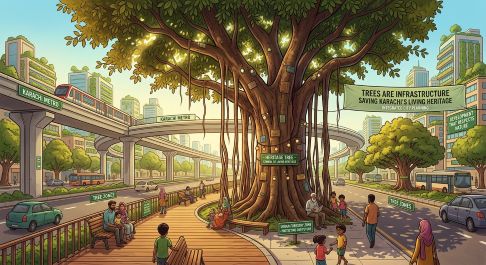
An essential part of every infrastructure should be trees.
Common examples of infrastructure include buildings, roads, bridges, flyovers, water, power, and transportation networks. But trees are seldom given the same weight.
That was incorrect.
Trees are vital urban infrastructure in Karachi, a metropolis that experiences high temperatures, environmental stress, fast urbanization, and diminishing open areas.
Shadows are cast by them. They lower the effect of the urban heat island. They make cities better places to live by enhancing public areas, bolstering biodiversity, housing birds and other animals, and reducing air pollution and dust.
A mature tree, above all else, cannot be cut down and replaced in a single day.
Constructing a road could take up to two years. Growing a fully grown tree could take decades.
Even while it’s probably necessary to plant a new sapling after cutting down a tree that’s many decades old, doing so won’t make up for the loss right away.
This is why it’s crucial to priorities tree protection with tree planting.
Sowing seeds is insufficient
Over the years, Pakistan has been the site of numerous plantation efforts. We should keep planting trees because it’s important.
However, an additional inquiry is required:
Who is looking out for the existing trees?
Planting more saplings is not the only way to improve the environment.
It ought to be evaluated in addition by:
The number of fruit trees that were spared;
How many trees were spared from being cut down when they weren’t needed?
What percentage of newly planted trees made it through the winter?
To what extent was the urban forest cover restored?
The number of development projects that were reworked to ensure the preservation of preexisting trees.
Karachi requires initiatives that go beyond mere symbolic planting.
A science-based, legally-backed urban forestry policy is necessary for the long haul.
Refrain from slashing without justification
It is not acceptable to cut down an old tree just because it is in the path of a construction site.
The government should have to prove that cutting down a tree is absolutely necessary before they can do it.
Only in extreme cases, such as when the tree is unhealthy beyond repair, there is no viable engineering solution, or the tree is essential to a public improvement project can its removal be contemplated.
Authorities should think about reworking the project before giving the go-ahead to cut down significant trees.
A Tree Impact Assessment ought to be a part of each substantial development project.
The purpose of this evaluation is to pinpoint the trees that are most at risk, determine their age and ecological significance, brainstorm potential alternatives to cutting them down, and finally, devise a solid strategy for protecting and replacing them.
The goal is not to halt progress.
Making development more responsible is the goal.
Trees are a valuable part of our natural history.
Read: How Trees Help in Maintaining Local Heritage
Historic sites, monuments, and archaeology abound in Sindh. Cultural landscapes, old communities, temples, shrines, traditional villages, and sites with profound historical memory can all be found there as well.
Certain trees are associated with certain locations.
For many years, they may have stood by a sacred site. Some examples of places they might be linked to include ancient settlements, roads, or archaeological sites. Some of them might be very ancient, uncommon, or significant culturally.
Extraordinary care is required for these trees.
Heritage Trees or Living Heritage designations would be appropriate for them.
Sindh ought to think about creating a Heritage Tree Register to catalogue and save trees that are nationally significant due to their religious, cultural, ecological, historical, or community significance.
Not all heritage is indestructible.
Heritage can be vibrant at times.
On occasion, it develops farther.
On occasion, it remains motionless, observing the passage of time while its surroundings undergo transformation.
Tree protection legislation in Sindh
Now is the moment for Sindh’s government to think about a complete tree protection and urban forestry legislative framework.
This kind of law could be drafted as a:
Statute for the Preservation of Trees in Urban Areas and Historic Sites in Sindh
A unified front for public engagement, historic preservation, urban planning, forestry, and environmental protection might emerge from the new legislation.
Ideally, it would cover:
- Preserving significant and old trees;
- Unambiguous protocols for tree cutting;
- Thorough evaluation by experts prior to cutting;
- For large-scale construction projects, we conduct tree impact assessments;
- A tree officer or authority from a municipality;
- Digital databases of tree species;
- Reforesting city areas;
- Heritage Tree Protection;
- Methods for the general public to report instances of unlawful tree cutting;
- Honest repercussions and responsibility;
- Planting replacements and monitoring their survival over the long term.
- Above all else, legislation should make sure that reforestation isn’t just lip service.
- Until the replacement trees have taken root and grown, the duty should remain.
A scientific tree strategy is necessary for Karachi.
Trees may not always thrive in certain environments.
Planning ahead is essential in Karachi due to the city’s coastal setting, soil type, water difficulties, salinity, and extreme weather.
Foresters, ecologists, environmental scientists, and city planners in Karachi should compile a tree species manual for the city.
Various domains call for distinct approaches.
Planting regulations should be based on scientific evidence and applied to all public spaces, including roads, parks, communities, schools, industrial zones, coastlines, historic districts, and archaeological sites.
Rather than focusing just on the quantity of trees planted during a campaign, urban forestry should priorities ecology and long-term planning.
Trees and development are compatible.
Sustainability and progress do not contradict one another.
It is not the cities that construct the most concrete structures that end up being the most successful. These urban areas seamlessly integrate people, public spaces, infrastructure, and the natural environment.
There is no reason for Karachi to priorities highways over trees.
Improved preparation is required.
Development and environmental protection are not mutually exclusive.
Development should be more intelligent.
Sindh may take action now, rather than waiting for the last of its mature trees to die out.
An encouraging suggestion
People in Karachi shouldn’t just be worried and critical about the worrying deforestation there.
A response is expected.
Environmentalists, forestry experts, urban planners, heritage specialists, civil society members, and representatives from the Sindh Assembly and the provincial and municipal administrations can all collaborate on this.
Development should not be halted as the goal.
The goal should be to prevent development from needlessly destroying irreplaceable things.
Consequently, we strongly recommend that the Sindh Assembly and the Sindh government begin to seriously examine a comprehensive
Statute for the Preservation of Trees in Urban Areas and Historic Sites in Sindh
Legislation like this needs the backing of civil society and regular people.
Professionals in the field should share their insights.
It would be beneficial for government agencies to collaborate.
The public also has a responsibility to do its part to preserve the parks and trees that are common to all residents.
Sindh can adopt a simple but powerful principle:
No Tree without Protection.
No Cutting without Permission.
No Removal without Scientific Justification.
No Removal without Verified Replacement.
Trees are not obstacles to development.
They are part of the infrastructure that makes development worth having.
They are our shade during extreme heat.
They are homes for biodiversity.
They are part of our environmental security.
And some of them are part of our history and cultural heritage.
A mature tree may take decades to grow.
Once it is gone, it cannot be replaced by tomorrow.
The time has come to treat Karachi’s trees—and the trees of Sindh—not as disposable objects standing in the way of progress, but as assets that deserve protection.
Because true development should allow us to build for the future without destroying everything that connects us to it.
Read: The Crisis of Governance in Pakistan
___________________
 Ali Lashari is an Assistant Director (Excavation & Exploration) & Cultural Heritage Advocate, Directorate of Archaeology & Antiquities Wing, Culture, Tourism, Antiquities & Archives Department, Government of Sindh.