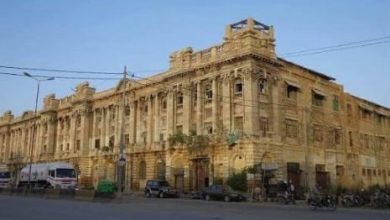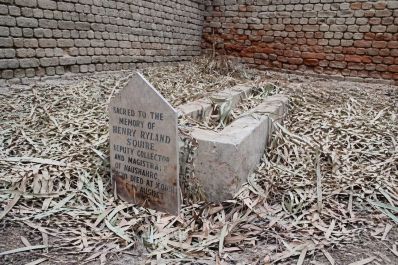
Hidden amidst encroachments, dust, and neglect is the grave of a man who once held immense authority in this very land: Henry Ryland Squire.
By Abdullah Usman Morai | Sweden
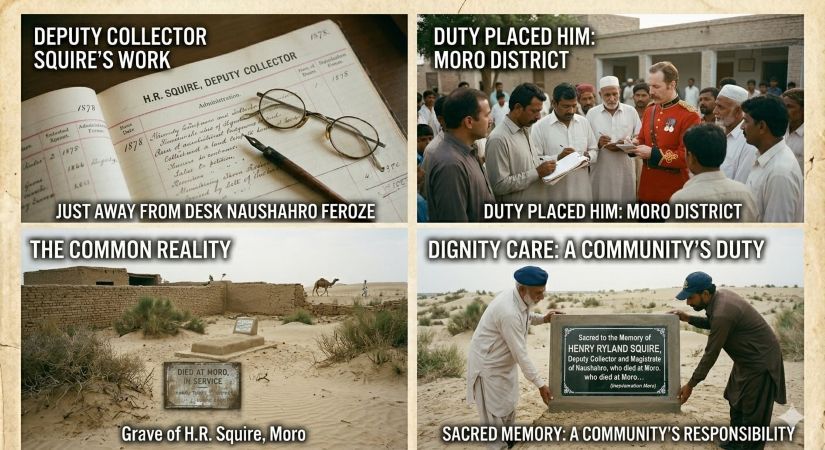
In the heart of Moro, a bustling taluka of Naushahro Feroze in Sindh, lies a quiet, almost forgotten fragment of history, one that most people pass without a second glance. Hidden amidst encroachments, dust, and neglect is the grave of a man who once held immense authority in this very land: Henry Ryland Squire.
His grave is not merely a burial site. It is a silent witness to a layered past, a story that connects Moro to distant England, to colonial administration, and to the human reality of life and death far from home.
Who Was Henry Ryland Squire?
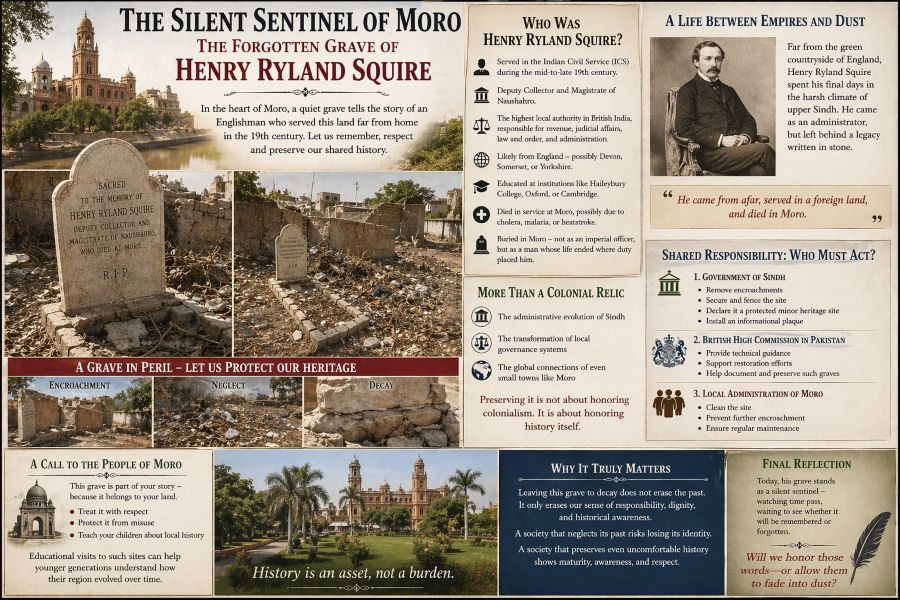
Henry Ryland Squire served during the mid-to-late 19th century in the Indian Civil Service (ICS), the most powerful administrative machinery of British India.
In that era, the Collector and District Magistrate were the ultimate authority at the local level. Such officers controlled:
- Land revenue systems
- Judicial administration
- Law and order
- General governance of the district
Squire served as a Deputy Collector and Magistrate of Naushahro, and his presence in Moro suggests that he was either stationed here or died while on an official tour of his district.
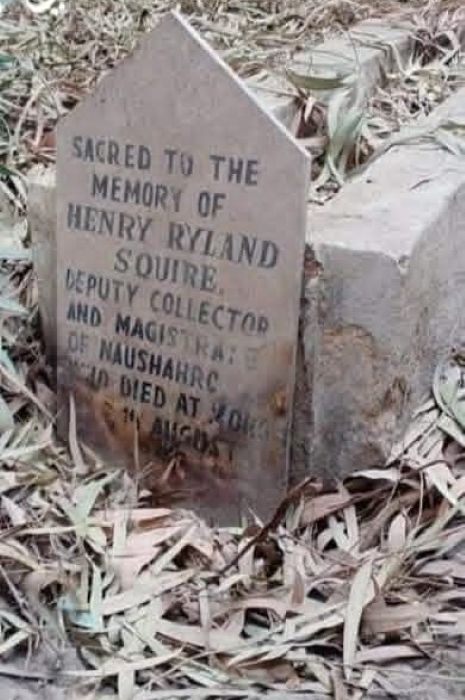
An inscription on his grave still echoes through time:
“Sacred to the memory of Henry Ryland Squire, Deputy Collector and Magistrate of Naushahro, who died at Moro…”
 A Life Between Empires and Dust
The name Squire is distinctly English, historically associated with regions such as:
- Devon
- Somerset
- Yorkshire
His middle name, Ryland, suggests a family of educated or professional background, possibly clerical or administrative.
Like many ICS officers, he was likely educated at:
- Haileybury College
- Or prestigious institutions such as Oxford or Cambridge
These men were trained not just to govern, but to represent the British Empire in distant lands.
Yet, beneath the authority and title lies a more human story.
Far from the green countryside of England, Squire spent his final days in the harsh climate of Sindh, where many British officers succumbed to:
- Cholera
- Malaria
- Heatstroke
To die in service, far from home, was a common but somber reality.
And so, he was buried in Moro, not as an imperial officer, but as a man whose life ended where duty placed him.
A Grave in Peril
Today, that “sacred memory” stands on the brink of disappearance.
The condition of the site is deeply troubling:
- Encroachment: What was once likely a designated burial ground is now surrounded by informal structures and boundary walls.
- Neglect: Dry leaves, debris, and waste litter the grave, turning it into a dumping space rather than a place of dignity.
- Decay: The masonry is weakening, and the inscription, one of the last links to his identity, faces erosion.
This is not just neglect of a grave.
It is the slow erasure of Moro’s historical memory.
More Than a Colonial Relic
It is easy to dismiss this grave as a remnant of colonial rule but that would be a mistake.
History is not selective.
It is not a story where we keep what we like and discard what we don’t.
Henry Ryland Squire’s grave represents:
- The administrative evolution of Sindh
- The transformation of local governance systems
- The global connections of even small towns like Moro
Preserving it is not about honoring colonialism.
It is about honoring history itself.
Shared Responsibility: Who Must Act?
The preservation of this site is not the responsibility of a single entity, but it is a shared duty.
- Government of Sindh
Through the Culture, Tourism, Antiquities, and Archives Department, the provincial government has a legal and moral obligation to protect such sites.
Immediate steps should include:
- Removal of encroachments
- Securing and fencing the site
- Declaring it a protected minor heritage site
- Installing an informational plaque
- British High Commission in Pakistan
While primary responsibility lies locally, the British High Commission, along with organizations like the British Association for Cemeteries in South Asia (BACSA) can:
- Provide technical guidance
- Support restoration efforts
- Help document and preserve such graves
There is a historical and moral connection that cannot be ignored.
- Local Administration of Moro
The Assistant Commissioner and Municipal Committee of Moro hold the most immediate power.
With minimal resources, they can:
- Clean the site
- Prevent further encroachment
- Ensure regular maintenance
Small actions can prevent permanent loss.
A Call to the People of Moro
To the people of Moro:
This grave is part of your story.
Not because it belongs to a British officer, but because it belongs to your land.
- Treat it with respect
- Protect it from misuse
- Teach your children about local history
Educational visits to such sites can help younger generations understand how their region evolved over time.
Why It Truly Matters
Leaving this grave to decay does not erase the past.
It only erases our sense of responsibility, dignity, and historical awareness.
A society that neglects its past, no matter how complex, risks losing its identity.
But a society that preserves even uncomfortable history shows maturity, awareness, and respect.
Final Reflection
Henry Ryland Squire came from afar, served in a foreign land, and died in Moro.
Today, his grave stands as a silent sentinel, watching time pass, waiting to see whether it will be remembered or forgotten.
The inscription says:
“Sacred to the Memory…”
The question is:
Will we honor those words or allow them to fade into dust?
Read: Bridging Hearts: Balkan Stories of Healing
_________________
 Abdullah Soomro, penname Abdullah Usman Morai, hailing from Moro town of Sindh, province of Pakistan, is based in Stockholm Sweden. Currently he is working as Groundwater Engineer in Stockholm Sweden. He did BE (Agriculture) from Sindh Agriculture University Tando Jam and MSc water systems technology from KTH Stockholm Sweden as well as MSc Management from Stockholm University. Beside this he also did masters in journalism and economics from Shah Abdul Latif University Khairpur Mirs, Sindh. He is author of a travelogue book named ‘Musafatoon’. His second book is in process. He writes articles from time to time. A frequent traveler, he also does podcast on YouTube with channel name: VASJE Podcast.