Fragmentation empowers feudal dominance
Rural Sindh cab be reconfigured by middle-class

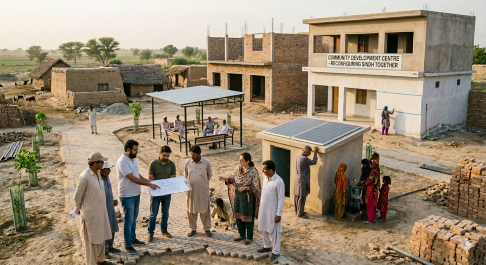
The migration of the middle class from villages to urban centers did not merely alter demographics, it reshaped the balance of power.
Noor Muhammad Marri, Advocate | Islamabad
The discussion on Sindh’s feudal structure often ends in despair, as if it is a permanent condition rooted in history and culture. Yet this conclusion overlooks an important possibility: the present arrangement is not fixed, but dependent on the absence of countervailing forces. Among these, the most significant is the rural middle class—its departure, and more importantly, its potential return.
The migration of the middle class from villages to urban centers such as Karachi, Hyderabad, and Sukkur did not merely alter demographics, it reshaped the balance of power. When teachers, small landowners, traders, and educated youth left, they took with them the capacity to question, to organize, and to mediate between the people and the state. What remained behind was not simply a poorer village—it was a quieter one.
In that quietness, authority consolidated itself. The feudal structure did not need to expand through force alone; it grew stronger through the absence of resistance. The ordinary villager, deprived of alternative voices, found himself with limited options. Coexistence became necessity, and necessity gradually turned into acceptance.
It is important to understand that the dysfunction of rural institutions is often not due to the absence of resources. In many villages, school buildings exist, hospitals have been constructed, budgets are allocated, and staff is formally appointed. Yet these institutions remain inactive or ineffective. The missing element is not material—it is social pressure.
A single petition, a persistent follow-up, or even a phone call from someone who understands the system can bring a dormant institution to life. A hospital that exists only on paper can begin functioning. A school that has long been neglected can reopen its doors in reality. Municipal services, long ignored, can resume their role. These are not extraordinary transformations; they are simple administrative activations. But they require individuals who possess awareness, confidence, and access—qualities that the middle class carries.
Read: The emerging, assertive middle class
If the middle class were to rebuild its connection with its rural origins, even without permanent relocation, the effect would be significant. Their presence would introduce a new dynamic, not of confrontation but of balance. They would not need to displace the feudal structure immediately; their mere engagement would begin to limit its unchecked influence.
A functioning school changes more than literacy rates; it alters perception. A working hospital does more than treat illness; it reduces dependence. Roads, sanitation, and municipal activity are not merely technical achievements—they represent dignity and inclusion. When these begin to function, the villager starts to see the state not as a distant abstraction, but as something accessible without mediation.
Equally significant is the social interaction that accompanies such a return. When members of the middle class participate in local gatherings, attend communal events, and engage in everyday discussions, they restore a sense of shared space. The villager no longer feels isolated. He observes people from his own background who have navigated the world differently, who possess knowledge and confidence, and who can interact with authority without submission.
This presence creates equilibrium. It introduces an alternative center of influence in a space that had become singular in its power structure. The feudal is no longer the only reference point; he becomes one among several.
However, to fully grasp this transformation, one must also reconsider the position of the feudal elite itself. It is often depicted as an all-powerful force, operating without constraint. This perception, while not entirely false, ignores a more layered reality. The feudal elite does not exist in isolation; it is embedded within a broader system of power and limitation.
On one side are state institutions—the bureaucracy, judiciary, and administrative machinery—which define formal authority. On the other side are political structures, including parties such as the Pakistan Peoples Party, which both empower and regulate feudal actors. Within this framework, the feudal exercises local dominance, but remains dependent on higher structures for legitimacy, continuity, and protection.
This creates a condition that can be described as a constrained dominance. The feudal is powerful in relation to the villager, but limited in relation to the state. He commands influence within his locality, yet must negotiate his position within the broader political and institutional order. He is not entirely free; he operates within boundaries, even as he enforces boundaries upon others.
Recognizing this is important because it reveals that feudalism persists not only due to its own strength, but also due to the absence of effective intermediaries. When the middle class withdraws, the connection between the state and the rural population weakens. The feudal then becomes the primary, and often the only, mediator. His role expands not merely because of his power, but because of the vacuum around him.
The return or reconnection of the middle class changes this arrangement. It restores the link between the individual and the institution. It allows rights to be translated into action. It transforms abstract legal frameworks into practical tools. In doing so, it does not eliminate the feudal, but it redefines his role. He is no longer the sole gateway to power; he becomes one actor within a more complex system.
The change that follows is gradual, almost imperceptible at first. A complaint is filed and pursued. A public service begins to function. A local issue is addressed without reliance on patronage. These small developments accumulate, creating a shift in perception. The villager begins to realize that authority is not singular, that it can be accessed through multiple channels.
Hope emerges from this realization. It is not a dramatic or emotional hope, but a practical one. It is rooted in experience—the experience of seeing a system respond, however slowly, to one’s effort. This is the beginning of empowerment.
At the same time, the responsibility of the middle class must be clearly understood. Their return must not replicate the distance they developed in urban settings. If they remain detached, if they engage only superficially, or if they seek to establish their own forms of informal dominance, the existing imbalance will persist in a different form.
The task is not merely to return, but to reconnect in a meaningful way. It requires participation, patience, and a willingness to engage with the complexities of rural life. It demands that the middle class act not as rulers, but as facilitators—strengthening institutions rather than replacing them.
In the broader perspective, the future of Sindh depends not on the elimination of one class or the triumph of another, but on the restoration of interaction. Between the middle class and the rural population, between local society and state institutions, and even between the feudal elite and the structures that contain it, a new balance must emerge.
Feudal dominance thrives in fragmentation. It weakens in the presence of connection.
Read: The Social Soul of Verse
__________________
 Noor Muhammad Marri is an Advocate and Mediator, based in Islamabad