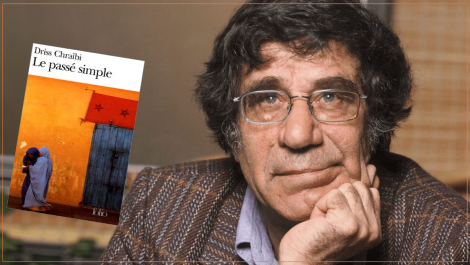
Chraïbi voices the cry of a rebellious adolescent aiming for change that challenges prevailing attitudes, an act of literary commitment that says no to a sterile society, suffocated by rigid laws where the sacred and ritual intertwine to oppress the weak.
Chaimae Blilete
Emerging from the same period of publication, Sefrioui’s novel weaves a “realistic description in which the assertion of identity blends with ethnographic testimony,” whereas in Chraïbi’s novel, reality is shaped by a rhythm of refusal and protest, the rebellious outcry of a son against all forms of deprivation of dignity, his revolt against the family and against the father, the very source of authority and power. What, then, are the marks of contestation in this writer’s work?
Chraïbi voices the cry of a rebellious adolescent aiming for change that challenges prevailing attitudes, an act of literary commitment that says no to a sterile society, suffocated by rigid laws where the sacred and ritual intertwine to oppress the weak.
Le Passé simple appears as a “literary bomb,” “a capital distanced in space and time,” as Marc Gontard describes it. The novel addresses diverse themes: family, religion, politics, the representation of women, the condition of children, and more.
Abdelhak Serhane affirms that “our past is never simple and our present is uncertain.” This reflects a complexity on historical, socio-political, economic, and cultural levels, a complexity that requires critical distance in order to better understand the situation and mend the fractures of both power and the people: “We must reread Le Passé simple; this past is not simple at all, especially the last page. On the plane carrying him far away, Driss locks himself in the toilet and urinates, saying: ‘I urinate in the hope that every drop will fall on the heads of those I know well, who know me well, and who disgust me.’ This sentence remains relevant today.” Through this, the author expresses a violent cry against those who fail to contribute to meaningful change in the country.
The problems are complex and varied. Among them is the issue of “imposed” Francophonie by the colonizer: “As a preliminary, it is necessary to revisit the very term ‘Francophonie,’ which does not possess the transparency suggested by media discourse. It is a political or geopolitical concept from which one must distance oneself due to its ideological ambiguity, already highlighted in 1970, at the time of the establishment of the first Francophone institutions, in an article from the Moroccan journal Souffles: ‘Francophonie for us naturally goes hand in hand with the Peace Pact and the Common Market; together, they signify the resurrection of the French Empire.’” This represents a transitional and disruptive phase in which the people must position themselves in relation to their own identity and to the other, where “shared French” symbolizes “an ideological metaphor that erases significant inequalities in the relationship to the French language,” as Marc Gontard confirms. The issue of bilingualism is closely tied to the historical context and to the “Francophone space,” placing the French language “in competition with other languages.” It is thus both a bilingual and cultural malaise.
Le Passé simple demonstrates that “this experience of disorientation concretely illustrates the vertigo of bilingualism, a verbal space of in-betweenness where the subject discovers, through the constant shifting from one language to another, the very principle of an androgynous pleasure.” This linguistic hybridity, resulting from “the friction of languages, becomes a space of intimacy where the desire for otherness is inscribed in the vertigo of a nomadic identity.” This encounter between two languages creates a tension between identity and alterity.
The question of “mixing” and “hybridity” interrogates culture through three stages: pre-modernity, modernity, and postmodernity, as Gontard explains: “This approach to Francophone Maghrebi literature through the lens of the dialectic of the same and the other allows for a better understanding of its functioning, from the premodern stage, where entropic mixing is the dominant form of acculturation, through modernity, which brings the violent confrontation between self and other to its peak, to the current postmodernity, where creolizing hybridity becomes a major force in the generation of forms and cultures.” The issue of language thus appears as an endless struggle.
Le Passé simple is a novel marked by contradictory themes and a multidimensional writing style. Chraïbi deploys complexity in both form and narrative structure to highlight the stakes of modernity and intertextuality.
The father, Haj Ferdi (revolver), is authoritarian, crushing his wife and child in the name of religion and customs, two forces that serve him well. The mother, on the other hand, appears as a slave to her husband and to these traditions. This oppression transforms her into a totemic figure whose personality fades in favor of taboos and hchouma (shame), as she cannot rebel against her submission in order to preserve her social image and protect her household.
The child appears as both observer of paternal actions and witness to this marital dilemma. He shows deep love for his mother and rejects the authoritarian power of both father and society. For this reason, he raises a rebellious cry, blending irony, naivety, and subversion in his speech: “, Wait for what? , Wait for what? I repeated. Wait for Camel or what?” The use of short interrogative sentences and repetition reflects a disrespectful rebellion against the father, who embodies a severe and dominant authority.
Chraïbi’s work highlights “how spatial meanings serve as a revealer of other meanings […] bringing to light the descriptive grasp of space as well as the various descriptive techniques that imply multiple observer-describers, creating a descriptive polyphony within narrative unity.” Le Passé simple by Chraïbi and Le Désordre des choses by Rachid Boudjedra are works “of horror and innocence, where memory and present reality intertwine, where childhood and History merge, and where the past resurfaces to shape and give meaning to the present […] It is humanity in its mud and its splendor.” For both writers, “literature is a long-term endeavor requiring not only sustained effort but also a deepening of vision, order, and ascetic discipline, a discipline that is both a source of suffering and a measure of beauty.” It is a struggle to weave the threads of cultural commitment toward one’s country.
Returning to the trajectory of the Moroccan French-language novel, Sefrioui depicts lived experience by creating interpretive sensitivity, whereas Chraïbi narrates it through chiasmus, bipolarity, and the tearing of the social fabric, reflected in the crisis within the family. Le Passé simple is an invitation to question religion, politics, society, the family, and the relationship between man and woman.
The points of convergence between these two authors lie in the importance each gives to the impact of religion on the psycho-social sphere; however, Fez as a shared setting and the Moroccan family are portrayed differently.
This perspective gives rise to a transition toward a new period, a new spirit, and a purely contestatory project. A new intellectual elite emerges, engaging in and generating a discourse of resistance. What, then, are the main elements of this discourse?
Read: Dreams of Suffering – Poetry from Morocco
_______________
 Chaimae Blilete is a poet and a secondary-school teacher, born in 1989 in the city of Fez, Morocco, and of Tazi origin. She earned her PhD in French Literature in 2025 from Sidi Mohamed Ben Abdellah University. Her doctoral dissertation examines the theme of rebellion in Maghrebi literature through the works of Abdellatif Laâbi, Mohammed Khaïr-Eddine, and Abdelhak Serhane. In 2017, she obtained a Master’s degree in Literature, Francophonie, and the Mediterranean Imaginary from the same university. Blilete has published several critical and academic articles within her field of specialization, as well as translated works. Her poetry collections include Diary of a Rebel Poet (2022), Ask the Jasmine What Hands Have Done to Her (2023), and Nothing is Truly Near but Taza – Arabic (2024), Shama’s Tattoo – Arabic (2025), Shama’s Tattoo – English (2026).