Sindh’s Forgotten Railways – its Journey from Lifeline to Decline
Abdullah Usman Morai | Sweden
There was a time when the sound of a train whistle was not just noise; it was life itself. Across Sindh, from the fertile plains of Sukkur to the quiet towns of Tharparkar, railway tracks stitched together communities, economies, and dreams. Trains carried farmers and traders, students and laborers, families and friendships. They were affordable, reliable, and, above all, inclusive.
 For some of us, railways are not just infrastructure; they are memories.
I still remember one hot afternoon, around 2 p.m., during my tenth class of Sain late Ahmad Khan Langah. Sitting at my desk beside my childhood friends Maroof Chandio, Sikandar Soomro, and Nadeem Memon, we glanced out of the classroom window. In the distance, a train was passing, raising a cloud of dust as it moved steadily across the barren land. It was likely to travel from Mehrabpur or Paddidan towards Tando Adam along what used to be a loop-line track.
Something was mesmerizing about that moment the rhythm of the train, the dust in the air, and the quiet realization that this was more than just a machine passing by. It was a moving connection between places, people, and possibilities.
My fondness for railways only grew with time, especially for small railway stations, the ones often overlooked but deeply alive with stories. Those childhood journeys from Dadu Railway Station to Quetta remain etched in memory. The long ride into Balochistan was not just travel; it was an unfolding experience.
Stations like Sibi, Bhag Nari, Aab-e-Gum, Machh, Kolpur, Mashkaf, and Spezand were not just stops; they were pauses in a journey filled with wonder. Each had its own character, its own silence, its own sense of belonging. Similarly, other stations like Lala Musa, Nawabshah, and Rohri Junction’s quieter platforms, and countless others, reflect the same charm, places where life moves slowly but meaningfully.
These memories remind us of what railways once meant and what they still can.
 A Network That Once Connected a Province
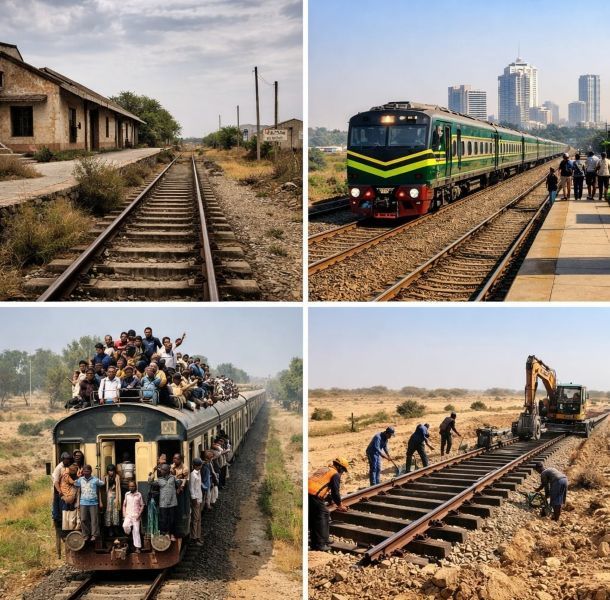
Sindh’s railway system was originally developed during the colonial era with a clear vision: to connect agricultural hinterlands with urban markets and ports. Over time, it evolved into a dense and efficient network.
The main railway corridor linking Karachi to the rest of the country through Hyderabad and Rohri formed the backbone of the system. But what truly made Sindh’s railways effective were the branch lines and loop routes that extended deep into rural areas. Lines such as Tando Adam to Mirpurkhas, Hyderabad to Badin, and Nawabshah to Mehrabpur, and in between Moro, Sakrand, connected small towns and villages, ensuring that even remote communities were not left behind.
Another crucial route, the right bank railway line, ran through Sindh, linking Dadu, Larkana, and Jacobabad towards Balochistan and KPK. This line not only facilitated passenger movement but also supported trade and regional integration.
Together, these routes created a web of connectivity that allowed people and goods to move efficiently across the province and beyond.
 The Gradual Decline
The decline of Sindh’s railway network did not happen overnight. It was a slow erosion caused by years of neglect, underinvestment, and shifting policy priorities.
One of the most visible signs of this decline has been the closure of branch lines. Routes that once connected rural towns have either been dismantled or left to decay. Entire regions have effectively been cut off from the railway system.
At the same time, train services on several routes have been reduced or suspended, forcing people to rely on road transport, which is often more expensive and less safe. Infrastructure has also deteriorated significantly, with aging tracks, outdated signaling systems, and encroachments on railway land further weakening the system.
Perhaps the most critical factor behind this decline has been the shift in focus toward road transport. While highways and motorways have expanded rapidly, railways have been left behind, resulting in an imbalance that has hurt both the economy and the public.
 A Story of Community and Resistance
Railways are not only built by governments, but they are sustained by people.
I recall another powerful memory. Once, I was traveling with my dear friends Pir Hamadullah Khiarvi, Late Professor Abdul Aziz Magsi, and Professor Mumtaz Soomro. During the journey toward his village, Sobho Magsi, near Radhan and Chowdagi, Professor Abdul Aziz Magsi pointed toward Shah Panjo Railway Station.
He shared an interesting and inspiring story.
There had been talk that authorities were planning to close the station or reduce train stops due to low usage. The local people, however, refused to let that happen. In a quiet yet clever act of resistance, they began visiting the station regularly and purchasing tickets for different destinations, even when they had no urgent need to travel.
Their intention was simple: to show activity, to generate statistics, and to prove that the station was still relevant.
It was a small act, but a powerful one. And for some time, it worked; the station remained alive.
I do not know what its condition is today, but that moment revealed something profound: when people value a public service, they find ways to protect it.
What Remains and Why It Is Not Enough
Despite these challenges, parts of the railway system are still operational. The main line connecting Karachi to the rest of the country continues to function and remains vital for long-distance travel and freight movement.
However, this single corridor cannot replace the extensive network that once existed. Without branch lines and regional connectivity, the railway system loses its inclusiveness and efficiency. What remains today is a skeleton of a once robust system, functional, but far from sufficient.
Why Railways Still Matter
In an age of rapid urbanization and environmental challenges, railways are more relevant than ever.
They offer one of the most cost-effective means of transporting goods, particularly bulk commodities such as agricultural produce and coal. For passengers, they provide an affordable alternative to road travel, especially for low-income communities.
Railways also promote regional equality by connecting smaller towns to major cities, reducing the economic gap between urban and rural areas. Moreover, they are environmentally sustainable, producing significantly lower emissions compared to road transport.
A diversified railway network with multiple routes and connections is essential for resilience. It ensures that the system can continue to function even during disruptions such as floods or road blockages.
The Case for Revival
Reviving Sindh’s railway network is not just desirable, it is necessary.
The first step is modernization. Aging tracks must be replaced, signaling systems upgraded, and stations rehabilitated. This will not only improve safety but also enhance efficiency and reliability.
Equally important is the restoration of suspended routes. Reviving key branch lines can reconnect rural communities and stimulate local economies. Priority should be given to routes that link agricultural areas with markets and ports.
Public-private partnerships can also play a significant role. By involving the private sector in operations and investment, the burden on the government can be reduced while improving service quality.
Encroachments on railway land must be addressed through strict enforcement, ensuring that existing infrastructure is protected and utilized effectively.
 Expanding Toward the Future
Beyond revival, there is a need for expansion.
New railway lines should be developed in strategic areas. The Tharparkar region, with its vast coal reserves, requires strong rail connectivity to support energy production. The coastal belt, including Thatta and Badin, can benefit from improved links to Karachi, boosting trade and tourism.
Urban rail systems, particularly in Karachi, should also be expanded to address the city’s growing transportation needs. A modern urban railway network can significantly reduce traffic congestion and improve the quality of life.
Rural Sindh, too, must be reconnected through new and restored lines, ensuring balanced regional development.
A Public Service with Widespread Benefits
Railways are more than just infrastructure; they are a public service.
For ordinary citizens, they provide affordable and accessible transportation. For students, they open pathways to education. For workers, they create opportunities. For farmers, they offer a means to reach markets.
The benefits extend beyond individuals. A strong railway system reduces pressure on roads, lowers transportation costs, and contributes to overall economic growth.
Government’s Role and the Question of Authority
Railways in Pakistan fall under federal jurisdiction, which means that large-scale projects are primarily the responsibility of the central government. However, provinces can and should play a more active role.
Through collaboration with the federal government, provinces can co-fund projects, advocate for regional priorities, and develop complementary urban rail systems. A cooperative approach is essential to ensure that railway development aligns with local needs.
Reclaiming a Lost Legacy
Sindh’s railway network is not beyond repair. The tracks may be worn, and the stations may be silent, but the potential remains.
Reviving and expanding this network is not merely an infrastructure project; it is an investment in people, in equity, and in the future. It is about restoring connectivity, reducing inequality, and building a more sustainable and inclusive economy.
And perhaps, one day, a student sitting by a classroom window will again look outside and see a train passing by, raising dust, carrying stories, and feel that same quiet sense of wonder.
The question is not whether Sindh can afford to rebuild its railways. The real question is whether it can afford not to.
Read: The Forgotten Rituals of Sindh
_________________
 Abdullah Soomro, penname Abdullah Usman Morai, hailing from Moro town of Sindh, province of Pakistan, is based in Stockholm Sweden. Currently he is working as Groundwater Engineer in Stockholm Sweden. He did BE (Agriculture) from Sindh Agriculture University Tando Jam and MSc water systems technology from KTH Stockholm Sweden as well as MSc Management from Stockholm University. Beside this he also did masters in journalism and economics from Shah Abdul Latif University Khairpur Mirs, Sindh. He is author of a travelogue book named ‘Musafatoon’. His second book is in process. He writes articles from time to time. A frequent traveler, he also does podcast on YouTube with channel name: VASJE Podcast.