

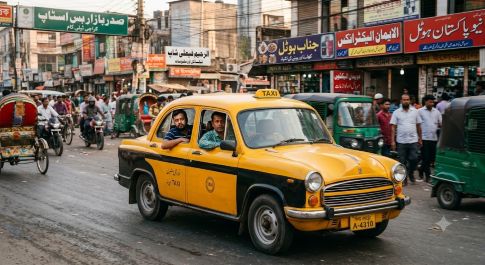
Stories of Karachi’s Taxi Drivers from 1993 to 2000
Zaffar Junejo
[Author’s Note: I joined a non-government organization in mid-1993. In those days, we were frequent travelers to other Asian countries, and during that period I maintained a diary. I once showed the notes to Muhammad Ibrahim Joyo — the legendary scholar, translator, and intellectual giant of the Sindhi world — who suggested categorizing the entries by theme and getting them published. He recalled that long ago, perhaps in 1955, the Sindhi journal Mehran had launched a similar idea titled ‘Hik Deenh Ji Ghaleh’ (The Story of a Day), even offering a prize for it. He himself had submitted the first story, he told me with a smile, just to set a standard for other writers. Later, Maulana Ghulam Muhammad Girami, a scholar of high standing and journalist; Shamsher ul Haidri, a distinguished Sindhi poet, journalist, and playwright; and Siraj ul Haq Memon, an iconic novelist, linguist, and journalist, all contributed their observations of a single day. These writings were published until 1968.
I agreed with Joyo Sahib that I would group the write-ups by subject and get them published, but I failed to do so. Recently, I sat down to organize my notes. I found various entries about the taxi drivers of Karachi city. Some were very brief and incomplete; others were short but held a finished truth. I have chosen five stories from each year, all of them gathered from the drivers of those cars. In total, there will be thirty-five stories covering the period from 1993 to 2000.]
Dhaka Speaks, Karachi Shouts
The taxi stood at the curb. I waved once. The driver did not stop. I waved again. He slowed. I climbed in.
Clouds hung low over Karachi. Winter waited nearby. The wind moved dry across the street. It carried no moisture today.
The driver looked back. His face held lines from many years. I doubted he was Bihari or Bengali. So, I asked a blind question: “How is Bihar these days?”
That question led to a conversation.
He turned his eyes to the road. “Babu, I am Bengali.”
A small smile came. He nodded. “A man of Bangla Bondo. Sheikh Mujibur Rahman.”
He stayed quiet after that. Reserved. I spoke of my visits—Jagannath Hall, the University of Dhaka, Dhanmandi, and the Shaheed Minar for the language martyrs.
His shoulders eased. He became another man.
“How long have you been here?” I asked.
“Since Bhutto’s time. Zulfikar Ali Bhutto.”
He had not returned to Bangladesh. Not once. Yet he held a Pakistani passport and had crossed the border five or six times.
“Your family?”
“Two wives. One in Dhaka. One in Karachi. Both Bengali. The children in Dhaka speak Bangla. The ones in Karachi speak Urdu.”
He drove steady. The engine hummed low.
“Driving a taxi adds to my earnings. My real job is in government service—the industries department.”
Traffic thickened. Horns rose around us. I asked about the cities. He did not understand at first. I tried again. “How do you see the transport in Dhaka and Karachi?”
He smiled. “There is no Nizam (system) in Karachi.”
In Dhaka, buses ran many routes. Most were old. People knew them by the owner’s name and the paint on their sides. Some companies gave franchises to operators.
He cleared his throat. “Local buses stop anywhere. Passengers step on and off. Direct buses run straight. They save time.”
Karachi had none of that.
I asked what else Dhaka offered that Karachi missed.
He looked ahead. “Dhaka is Dhaka. Karachi is Karachi. One city speaks Bangla with one voice. The other carries noise in many tongues.”
I kept the talk on transport. He understood.
“The Buriganga River gives Dhaka something special.”
I waited.
“Thousands travel by water every day. Ferries, launches, water buses, small boats—they carry people from villages and suburbs into the city. Cargo vessels and barges bring goods straight to markets along the banks.”
He spoke with quiet pride. I had never pictured it quite like that.
“The river connects to the big waterways: Dhaleswari, Meghna, Padma.”
For short distances in Dhaka, men pulled bicycles and rickshaws. In Karachi, taxis and rickshaws served any distance. Rules decided the right vehicle for the right road.
He gave examples. Three-wheelers ran outside central Dhaka, carrying five passengers. Legunas—small converted trucks—took eleven or fourteen people for medium runs.
I asked what he thought worked best.
He thought for a moment. His face changed, and light came into it. “My friends and family in Dhaka still love the train. Kamalapur Station stays important. People move through it with hope.”
Joy touched his words. I was not sure if it came from having the correct answers or from a deep love for his motherland—Sonar Bangla, Golden Bengal.
The taxi moved on through the Karachi streets. The dry wind pressed against the windows. He drove with steady hands. Two homes. Two cities. One heart that never left the river.
I paid him at the end. He nodded once, respectful. We parted.
_______________________
 Dr. Zaffar Junejo has a Ph.D in History from the University of Malaya. His areas of interest are post-colonial history, social history and peasants’ history. He may be reached at junejozi@gmail.com



I had heard many stories about Sonar Bangla (Golden Bengal) long ago. During training programs in different countries, I often had conversations with Bangladeshi friends. Those I met carried an immense love for their homeland in their hearts. They had earned their country through great sacrifice. Although they faced class divisions and social inequalities, they were intellectually united and deeply conscious of their national identity.
Similarly, in Dr. Zafar’s brief taxi journey, his conversation with the Bangali driver revealed a heart divided between two countries. The contrast between Bangladesh, with its single national language, and Karachi, with its many languages, was a remarkably insightful observation.
The descriptions of Bangladesh’s rivers and scenic river cruises, alongside Karachi’s rickshaws and the buses of the 1980s, were especially heartfelt and vividly portrayed.