Stories of Karachi’s Taxi Drivers from 1993 to 2000
Zaffar Junejo
[Author’s Note: I joined a non-government organization in mid-1993. In those days, we were frequent travelers to other Asian countries, and during that period I maintained a diary. I once showed the notes to Muhammad Ibrahim Joyo — the legendary scholar, translator, and intellectual giant of the Sindhi world — who suggested categorizing the entries by theme and getting them published. He recalled that long ago, perhaps in 1955, the Sindhi journal Mehran had launched a similar idea titled ‘Hik Deenh Ji Ghaleh’ (The Story of a Day), even offering a prize for it. He himself had submitted the first story, he told me with a smile, just to set a standard for other writers. Later, Maulana Ghulam Muhammad Girami, a scholar of high standing and journalist; Shamsher ul Haidri, a distinguished Sindhi poet, journalist, and playwright; and Siraj ul Haq Memon, an iconic novelist, linguist, and journalist, all contributed their observations of a single day. These writings were published until 1968.
I agreed with Joyo Sahib that I would group the write-ups by subject and get them published, but I failed to do so. Recently, I sat down to organize my notes. I found various entries about the taxi drivers of Karachi city. Some were very brief and incomplete; others were short but held a finished truth. I have chosen five stories from each year, all of them gathered from the drivers of those cars. In total, there will be thirty-five stories covering the period from 1993 to 2000.
On the surface, these pieces appear to be simple narratives. However, beneath the prose, they depict the complex socio-political and cultural landscape of Karachi during those turbulent days. They are the echoes of a city in motion.]
The Corner Stand
The sun was low over Tariq Road. It was five-fifteen. The chill of the December dusk stayed in the asphalt, thick and sharp, and the brisk evening breeze was starting to whip up the dust.
My friend and I walked into the Dolmen Mall. The air inside smelled of polished floors and artificial heating. It was our first time there. A guard stood by the glass doors in a heavy woolen uniform jacket.
“Where is the bookshop?” I asked.
“First floor,” the guard said. He took two brisk steps after us, his boots clicking on the terrazzo. “Shop G-101. Look for the sign.”
“Thank you.”
The bookstore was quiet. It smelled of paper and new ink. I found what I wanted on a lower shelf: two volumes of Tolstoy’s collected stories, bound in stiff paper. I paid the clerk, and he slid them into a plastic bag. The handles stretched under the weight of the prose.
Outside, the Karachi traffic had begun its evening roar under a pale, early-winter sky. We drank hot tea at a concrete stall near the corner, the small glass cups warming our cold fingers. The tea was sweet, steaming heavily, and tasted of boiled milk and cardamom. When the cups were empty, my friend pulled his shawl tighter around his shoulders, nodded, and parted.
I walked to the side lane. A black-and-yellow taxi sat in the shadow of a high wall, just short of the main road where the white Suzuki pickups and rickshaws fought for space. An old man with a white cap, a namazi topi, sat behind the wheel, his windows rolled up against the biting air. He had an Urdu evening paper, Awam, spread across the steering wheel, his eyes tracking the bold black headlines.
I tapped the glass. He rolled it down a few inches.
“Gulshan-e-Iqbal,” I said into the gap.
He looked up. His eyes were milky at the edges, the color of old coins. He wore a faded, oversized sweater. “Two hundred and fifty rupees.”
“Two hundred.”
“Two hundred and fifty,” he said, not unkindly. He did not close the newspaper. “The traffic at University Road is bad in the cold.”
“Two hundred and fifty is fair.”
I opened the door and sat in the front seat beside him. The dashboard was covered in a faded piece of green carpet. He started the engine; it coughed in the cold air, then settled into a rhythmic, metallic rattle. He turned the car into the stream of the main road.
“Why were you standing back there in the corner?” I asked.
He didn’t answer. He shifted gears. The city moved past us—brightly painted plazas, neon-light-decorated malls, and shops.
“Do you think people will come into the alley to find you?” I asked.
He steered around a stalled donkey cart. “Who hides from his rozi?” he said. His voice was deep, thick with the smoke of cheap cigarettes and winter dust. “Who hides from his daily bread?”
“I don’t understand.”
“You would not,” he said. He kept his eyes on the brake lights of the Corolla ahead of us. “Only the old ones understand this city. How long have you been here?”
“Since 1993.”
He begged my pardon and spat a red stream of betel nut juice out the window into the cold air.
“Then I must tell you. In the fifties—let us say the sixties—a taxi driver did not hide. We had stands. Good stands. Outside the cinema houses, the grand hotels, the railway station. Outside the government offices where the babus worked. Outside the schools at dismissal time, chhuti.”
He stopped talking. He used both hands to haul the heavy steering wheel to the left, avoiding a swerving motorcycle.
“And then?” I asked.
He let out a long, dry sigh that sounded like paper sliding across a floor.
“Then came General Zia. The martial law.” He shifted into third gear. The engine whined. “He brought three things to the common man of this city, Karachi: heroin, smuggled goods, and the Afghans.”
“Yes,” I said. “That is true.”
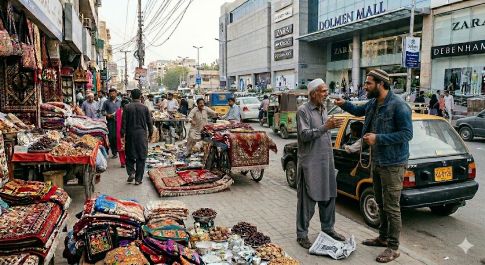
He sighed again, his breath misting slightly on the windshield. “The Afghans brought their carts. They brought their wooden stalls. They took the fronts of the shops. They took the markets. They took the footpaths. In the old days, a taxi could idle against the curb and wait for a gentleman or ladies to walk out of a shop. Now? These Afghan badmashes own the curbs. You stop for a minute, they curse your mother. They want to fight. They have knives, sometimes worse.”
He looked at me for a split second, then back to the dark asphalt.
“So we go to the corners, naujawan. We wait in the dark lanes where they don’t care to stand. Or we drive aimlessly and burn petrol, raising our hands to strangers. That is why the taxi stays in the corner.”
We fell silent. The car moved through the evening rush. On the left, the yellow stone building of the Pakistan Post Office slid by. The light was completely gone now, leaving the winter air sharp and dark.
“The petrol pump ahead,” I said. “That will be fine.”
He pulled the taxi over by the pumps. The ground was black with spilled diesel. I counted out two hundred and fifty rupees and laid the notes on the green carpet of the dashboard.
“Shukria,” he said.
I took my Tolstoy volumes and got out. The door slammed with a loose, tinny sound. I pulled my jacket tight against the winter wind, waited for a gap in the roaring traffic, then crossed the wide road toward the Crescent Complex. When I looked back, the taxi was already gone into the dark, cold flow of the city.
***
The VIP Tea
The sun was already above the buildings when I woke. It was a holiday. I had a fixed time to meet the others at Khori Garden near the Light House to see a new consignment of books. My watch said the time was short. I skipped my routine morning tea, left the flat quickly, and walked fast down to University Road.
The road was quiet because of the holiday. A taxi crawled down the lane, heading slowly toward NIPA Chowrangi. I raised my hand and waved. The driver saw me and pulled over to the curb.
I opened the door and got in. I did not give him the destination right away.
“Where can we get a good tea?” I asked.
The driver looked back over his shoulder. “There are many stalls on the way.”
“You choose,” I said. “Halt at the one you think is good.”
“The hotel by the Bait-ul-Mukarram Masjid stop is a good place,” he said.
“Okay. Please stop there.”
He drove through the light morning traffic. He stopped the car in front of the Quetta-Darbar Hotel. The front display faced the street, where big brass kettles steamed over blue gas flames.
“This is a VIP hotel,” the driver said, pointing a finger through the windshield. “It serves VIP tea.”
He called out to the boy at the front display and ordered two cups. The tea came in thick porcelain cups. It was hot and sweet, with the heavy taste of cardamom and boiled milk. It tasted good.
As I drank, I looked at the crude wooden tables and the grease on the walls. I wondered why the common man took titles meant for human character and gave them to non-living items. I kept the thought in my head. I decided I would raise this point before the Khori Garden book group.
I finished the tea and paid the boy. The taxi started again.
“Why do you call that hotel a VIP?” I asked the driver as we moved.
He thought for a moment, keeping his eyes on the road. “It is good,” he said. “Its tea is very good.”
The traffic remained thin. We crossed the intersections without stopping and reached the Light House on time. The others were already there, waiting by the piled books.
We spent two hours going through the new consignment. The paper was rough and smelled of the sea voyage. I bought The Structure of Scientific Revolutions by Thomas S. Kuhn and A History of God by Karen Armstrong. Then we walked to a nearby hotel for more tea.
After we had sat down and finished ordering, the ambient hum of the hotel lobby offered a welcome refuge from the chaotic symphony outside. We carefully placed our newly purchased books on the table.
“Why are non-living items attributed with titles that do not belong to them?” I asked.
The others looked at me. No one spoke.
“Suppose a term like ‘Very Important Person’—the VIP acronym,” I said. “It is attached to things that are not alive. VIP hotel. VIP tea. VIP sweets. VIP shop.”
There was a silence. Then the group began to argue. We talked for a long time but could not decide. One said it was a technique for marketing. Another said it was figurative writing, or branding to make a product seem higher than it was. We used words like personification and characterization.
One friend sat at the end of the bench. He had not spoken during the long debate. He looked at his empty cup, then he looked up.
“The common man does not consult linguists,” he said. “He does not ask anthropologists or the custodians of culture. He encounters a situation, he needs a name for it, and he decides. The rest of us can follow it or we can leave it. But when everyone uses it every day, the rules of language have to bend to make room.”
The table went quiet. No one had anything to add to that.
We paid for the tea, stood up, and said goodbye. I took my books under my arm and walked out into the crowded afternoon heat of Khori Garden.
______________________
 Dr. Zaffar Junejo has a Ph.D in History from the University of Malaya. His areas of interest are post-colonial history, social history and peasants’ history. He may be reached at junejozi@gmail.com