

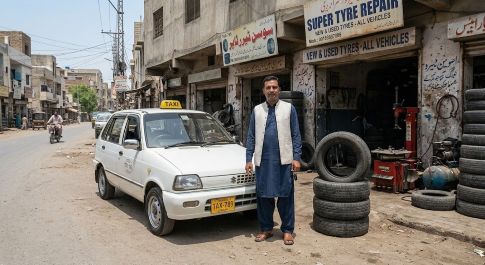
Stories of Karachi’s Taxi Drivers from 1993 to 2000
Zaffar Junejo
[Author’s Note: I joined a non-government organization in mid-1993. In those days, we were frequent travelers to other Asian countries, and during that period I maintained a diary. I once showed the notes to Muhammad Ibrahim Joyo — the legendary scholar, translator, and intellectual giant of the Sindhi world — who suggested categorizing the entries by theme and getting them published. He recalled that long ago, perhaps in 1955, the Sindhi journal Mehran had launched a similar idea titled ‘Hik Deenh Ji Ghaleh’ (The Story of a Day), even offering a prize for it. He himself had submitted the first story, he told me with a smile, just to set a standard for other writers. Later, Maulana Ghulam Muhammad Girami, a scholar of high standing and journalist; Shamsher ul Haidri, a distinguished Sindhi poet, journalist, and playwright; and Siraj ul Haq Memon, an iconic novelist, linguist, and journalist, all contributed their observations of a single day. These writings were published until 1968.
I agreed with Joyo Sahib that I would group the write-ups by subject and get them published, but I failed to do so. Recently, I sat down to organize my notes. I found various entries about the taxi drivers of Karachi city. Some were very brief and incomplete; others were short but held a finished truth. I have chosen five stories from each year, all of them gathered from the drivers of those cars. In total, there will be thirty-five stories covering the period from 1993 to 2000.]
The Bridge and the Border
The last week of June was hot. The concrete buildings trapped the heat, and the road baked. The hot air grew thin and rose straight up into the still sky. There was no wind.
I walked out of the office. The air hit me like an oven, and my shirt stuck to my back. I saw a taxi parked near a tire repair shop. Walking over, I raised my hand. The driver looked up, and I signaled with my fingers. Vacant?
He nodded once. “Yes.”
I opened the door and sat in the front passenger seat next to him. He shifted into gear and turned the wheel toward the shrine of Abdullah Shah Ghazi.
The taxi rolled toward the Kothari Palace roundabout. Suddenly, the air shifted. A cool breeze touched my face. It was faint, but it was there. My skin cooled, my breathing slowed, and I felt good.
“How much to Gulshan-e-Iqbal?” I asked.
He kept his eyes on the road. “Gulshan?”
“Near Kalaboard,” I said.
He nodded. “Six hundred rupees.”
“Good,” I said.
I looked at him. His clothes were clean and well-pressed. He did not look like the regular drivers who spent all day in the dust. I wanted to know his story.
“How long have you driven this cab?” I asked.
“One month,” he said. He paused, checking his rearview mirror. “Less than one month.”
“What did you do before?”
“I drove. I was the personal driver for a Seth.”
“Why did you leave?”
The driver said nothing. He gripped the wheel, and I waited. I expected the usual story—a dispute over money, or perhaps the Seth’s family causing trouble. I thought he would tell me he left to keep his honor.
Instead, he broke the silence. “It is a long story.”
“The drive is long,” I said. “Tell it.”
“It happened on the twenty-ninth of May,” he said. “The Seth told me to drop his friend in PECHS. The friend was an old man, very fat. The Seth lives in the Muhammad Ali Society.”
He turned the taxi down a wider street.
“We entered the lane in PECHS,” the driver continued. “The guest’s house was close; I could see the gate light. I pulled up right in front of it and stopped the vehicle. It was a large double-cabin truck. The fat man struggled to get out. He could not find the running board with his foot, so I left my seat and walked around to help him down.”
He shifted gears, his voice remaining flat.
“When I turned around, three men stood there. They had me surrounded. The engine was still running. They pushed me into the back seat; one man took the wheel, another jumped into the front passenger seat, and the third sat next to me in the back.”
“Did they have a gun?” I asked.
“A pistol,” he said. “He pressed the cold steel into my stomach. The driver sped off. We hit speed bumps, and the truck bounced. Every time we jolted, I felt the trigger. I sweated. I thought his finger would slip from fear or haste. Sometimes he pulled the gun back an inch, then he pressed it in again.”
“Where did they take you?”
“They drove through Sachal Goth. We crossed the Jamali Bridge, then we hit the Super Highway, speeding toward Hyderabad. Near the lights of the Jamali Bridge, they slowed down. They kicked me out onto the dirt.”
He blew the horn at a motorcycle.
“I got up and stopped a rickshaw. I told the driver to go straight to the Muhammad Ali Society. When I arrived at the Seth’s house, the fat friend was already there. He had taken a cab.”
“So the Seth knew everything,” I said.
“Yes. He knew the double-cabin was gone. I told the Seth and his family the rest of it. While I spoke, a servant came in and said there was a phone call for the Seth. The Seth went to the study and stayed inside for fifteen minutes.”
“Who called?”
“The Seth came out,” the driver said. “He told us the call was from the Inspector General’s office—a friend of his. The IG said if the double-cabin turned toward Balochistan from the bridge, it was gone forever. If it went through Shahdadkot, it would rest in Hyderabad or Mehar tonight, then cross the border by sunrise.”
The driver spat out the window.
“The IG told the Seth to contact the political parties—the MQM, its rivals in Hyderabad, and other groups. He said to ask their handlers for help. Then one of the Seth’s guests spoke up. He said the political parties pretend to fight on television, but their armed wings share the same stolen goods.”
“Did you get the vehicle back?”
“No,” the driver said. “The vehicle was gone.”
“And the Seth fired you?”
“No. A few days later, the Seth called me. He told me to drive his other car. I refused.”
“Why?”
“Two things,” he said. “His friendship with police officers and his wealth. They bring too many eyes. I asked a friend who works for the government to hire me. Now, I drop my friend at his office in the morning, and he comes home with his colleagues. I take his car and run it as a taxi until dark.”
“What happened to the Seth’s double-cabin?”
The driver took one hand off the wheel and made a chopping motion in the air. “Cut into pieces. Sold for scrap.”
“Are you sure?”
“Yes,” he said. “Three days ago, the Seth called me again. He asked me to help serve tea to his guests. I needed the extra money, so I went. I walked into the drawing room with the tray and heard them talking.”
“What did they say?”
“They said the political parties have their criminal wings, just like the ‘Khakis’ have their political units. It is all the same machine.”
“Did they talk about the vehicle?”
“No,” the driver said. “But I know who took it. A new gang—a mix of Sindhis, Altaf’s old boys, and Balochs. They broke away from the big parties because the bosses took too large a cut. Now they work for themselves.”
The signs for my neighborhood appeared, and the stores were bright.
“Drop me near the General Store,” I said. “I need groceries for tomorrow.”
He pulled the taxi over to the curb and stopped. The engine idled. I counted out six hundred rupees and handed the paper notes to him. He took the money and nodded.
I opened the door, stepped out into the heavy night air, and walked into the store.
________________
 Dr. Zaffar Junejo has a Ph.D in History from the University of Malaya. His areas of interest are post-colonial history, social history and peasants’ history. He may be reached at junejozi@gmail.com



Political parties that nurture criminal gangs are often less political in nature and more rooted in criminal backgrounds. Behind their formation, there is usually the influence and support of powerful groups. Car snatching and other criminal activities serve as major sources of financial strength for these groups, while also helping them maintain their influence, dominance, and control. In this story, Dr. Zafar connects these realities through the experience of a driver, illustrating how this cycle of crime has persisted and, unfortunately, continues to this day.