A Legal and Philosophical Critique of Liberalism’s Broken Promise
By Noor Muhammad Marri Advocate | Islamabad
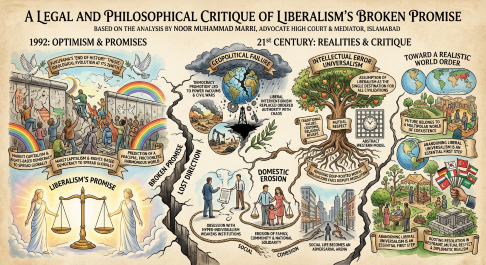
When the Berlin Wall collapsed, a distinct sense of triumphalism swept through Western academic and political circles. Francis Fukuyama famously synthesized this optimism in his 1992 thesis, The End of History and the Last Man, suggesting that ideological evolution had reached its absolute zenith in Western liberal democracy. The core presumption was straightforward: human society had finally discovered its ultimate governing framework. The age of great power rivalry, grand ideological struggle, and systemic war was supposedly behind us. Market capitalism and individualistic rights-based democracy were projected to gradually blanket the globe, creating a frictionless, harmonious world.
As an advocate interacting daily with the mechanics of law, and as a mediator dedicated to resolving human conflicts in Islamabad, I view this premise with deep skepticism. Far from ending war or ushering in lasting peace, the aggressive expansion of liberal ideology has frequently exacerbated global volatility, destabilized organic social structures, and generated intense cultural backlash. History did not end; it merely broke free from the temporary confines of the Cold War. The persistent realities of human nature, religious identity, cultural sovereignty, and geopolitical power quickly shattered the liberal illusion.
Liberalism’s most profound intellectual error lies in its dogmatic assumption of universalism. It posits that its specific framework of individualism, secularism, and free-market capitalism is not merely one cultural paradigm among many, but the single universal destination for all human civilizations. From a legal and mediation perspective, no single framework can successfully resolve disputes if it ignores the deep-rooted values, customs, and religious traditions of the parties involved. Mediation succeeds because it meets people where they are, respecting their specific identities and moral obligations. Liberalism, conversely, functions with an ideological rigidity that demands societies abandon their historical and organic structures in favor of an abstract, Western-centric model.
When liberal universalism is elevated to foreign policy, it transforms into a form of ideological imperialism. Believing itself to be the ultimate moral good, liberal hegemony feels entitled—and often obligated—to remake other nations in its own image. The consequences of this overreach are written across the political landscape of the 21st century. The post-Cold War attempts at “democracy promotion,” regime change, and nation-building in the Middle East and South Asia did not yield stable liberal societies; instead, they produced power vacuums, civil wars, and widespread human suffering. Rather than eliminating conflict as predicted, liberal interventionism replaced ordered authority with chaos.
Beyond its geopolitical missteps, liberalism harbors severe domestic flaws. At the center of liberal philosophy is the atomized individual—a creature stripped of unchosen obligations, communal duties, and traditional ties, elevated above the collective good. While protecting individual rights against state tyranny is a vital legal necessity, liberalism’s obsession with hyper-individualism systematically erodes the very institutions that hold human societies together: the family, the community, moral codes, and national solidarity. Society is reduced to a mere collection of isolated consumers negotiating contracts, rather than a living community bound by shared history, reciprocal duty, and mutual care.
In my legal and mediation practice in Islamabad, I frequently observe that stable, lasting resolutions depend on relational bonds—family integrity, social respect, and communal accountability. A legal ethos driven entirely by individual rights often turns social life into an adversarial arena. When every interpersonal dispute is viewed through the single lens of competing rights rather than mutual obligations, social cohesion weakens, giving way to alienation, institutional distrust, and societal polarization.
Fukuyama’s thesis suggested that economic interdependence and international institutions would render traditional war obsolete. Liberal economic doctrine assumed that free trade would bind nations so closely that the rational cost of war would become prohibitively high. This view fundamentally misinterprets what drives human behavior and sovereign states. As international relations theorist John Mearsheimer convincingly argues, when liberal ideology collides with nationalism or balance-of-power realism, nationalism and realism almost always prevail. Nations do not act merely as economic calculators; they are driven by identity, historical memory, security concerns, and regional pride.
The modern geopolitical landscape confirms this reality. The resurgence of major power competition between global superpowers has returned traditional geopolitics to center stage. Territorial disputes, resource competition, and military expansion remain active features of international relations. Armed conflicts around the globe demonstrate that ideological convergence has failed to suppress state interests. Far from moving toward a peaceful, borderless world, the international system remains fundamentally anarchic. States continue to prioritize security, sovereignty, and strategic balance over liberal institutional norms. Fukuyama’s “End of History” overlooked a fundamental legal and political reality: power, not abstract moral consensus, remains the ultimate arbiter in global affairs.
In non-Western societies, the aggressive promotion of liberal secularism creates profound legal and social friction. Liberalism demands a strict separation of public law from traditional, religious, and moral frameworks. In doing so, it frequently seeks to replace centuries of organic jurisprudence with standardized, secular codes. In contexts like Pakistan, law is not merely a secular contract between citizens and the state; it is deeply interwoven with religious values, customary practice, and moral duty. Imposing top-down liberal mandates under the guise of modernization frequently leads to severe cultural alienation. It creates a disconnect between the legal elite—who often adopt liberal frameworks—and the broader population, whose daily lives are anchored in traditional, spiritual values.
As a mediator, I know that an imposed agreement which violates the core beliefs of either party is inherently fragile. True legal harmony cannot be achieved by disenfranchising a society’s cultural inheritance. Law must reflect the living ethos of its people, rather than attempting to forcibly reshape them to fit an imported ideological model.
The belief that war would cease under a global liberal order was not merely naive; it was dangerous. It led Western states to frame complex geopolitical disputes in binary moral terms—good versus evil, progress versus backwardness. By turning foreign policy into a moral crusade rather than a diplomatic negotiation, liberalism often makes compromise impossible, prolonging conflict rather than resolving it.
What the world requires today is not a dogmatic push toward a single ideological endpoint, but a pragmatic shift toward restraint, mutual respect, and diplomatic realism. International law and diplomacy must accept that different civilizations will organize their political, moral, and legal systems according to their own histories and values. Respect for national sovereignty must supersede the impulse to intervene in the internal affairs of other nations under the banner of ideological export. Conflict resolution on both global and local levels must be rooted in realistic assessments of security, tradition, and mutual interest, rather than moral grandstanding.
History has not ended, nor will it. The future belongs to a multipolar world where diverse civilizations, sovereign states, and legal traditions must learn to coexist peacefully. Abandoning the flawed delusions of liberal universalism is the essential first step toward building a realistic, stable, and truly peaceful global order.
Read: Traditional Thinking – Foundation of Human Progress
______________________
 Noor Muhammad, Advocate and Mediator, Islamabad