

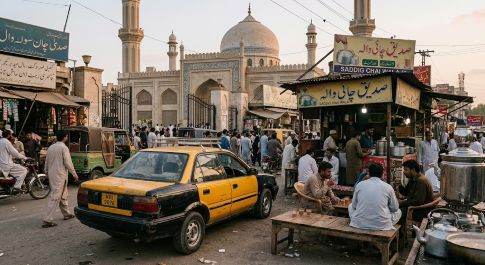
Stories of Karachi’s Taxi Drivers from 1993 to 2000
Zaffar Junejo
[Author’s Note: I joined a non-government organization in mid-1993. In those days, we were frequent travelers to other Asian countries, and during that period I maintained a diary. I once showed the notes to Muhammad Ibrahim Joyo — the legendary scholar, translator, and intellectual giant of the Sindhi world — who suggested categorizing the entries by theme and getting them published. He recalled that long ago, perhaps in 1955, the Sindhi journal Mehran had launched a similar idea titled ‘Hik Deenh Ji Ghaleh’ (The Story of a Day), even offering a prize for it. He himself had submitted the first story, he told me with a smile, just to set a standard for other writers. Later, Maulana Ghulam Muhammad Girami, a scholar of high standing and journalist; Shamsher ul Haidri, a distinguished Sindhi poet, journalist, and playwright; and Siraj ul Haq Memon, an iconic novelist, linguist, and journalist, all contributed their observations of a single day. These writings were published until 1968.
I agreed with Joyo Sahib that I would group the write-ups by subject and get them published, but I failed to do so. Recently, I sat down to organize my notes. I found various entries about the taxi drivers of Karachi city. Some were very brief and incomplete; others were short but held a finished truth. I have chosen five stories from each year, all of them gathered from the drivers of those cars. In total, there will be thirty-five stories covering the period from 1993 to 2000.
On the surface, these pieces appear to be simple narratives. However, beneath the prose, they depict the complex socio-political and cultural landscape of Karachi during those turbulent days. They are the echoes of a city in motion.]
Better to Avoid: The Driver’s Rule
The heat hung thick over Saddar. Rimpa Plaza exhaled a crowd of tired bodies into the fading light. M.A. Jinnah Road choked on steel and exhaust, a massive, iron river. The trucks, the rickshaws, and the ancient buses all surged in a single, crawling column toward the evening.
I needed out. I raised a hand.
At the edge of the current, a cab braked. The driver watched my hand through a dusty windshield. Fifty years of Karachi sun had carved deep lines into his face. I stepped off the curb.
“Gulshan-e-Iqbal,” I said. “How much?”
A tight grimace. “Four hundred and fifty.”
I nodded and climbed into the front seat.
The engine whined as we crawled into the mass of metal. Next to me, the man shifted. He gripped the steering wheel, leaned forward until his chest was nearly touching the dashboard, and then jerked back. His left leg pumped the clutch with a strange, unnecessary rhythm. He was a man sitting on a fire.
“Is there a problem?”
He swallowed hard, his eyes locked on the brake lights ahead. “Traffic is bad.”
He shifted again. His knees knocked against the steering column. He wiped sweat from his upper lip with the back of a trembling hand.
“Are you okay?”
A sharp intake of breath. Shame flashed in his eyes. “I need a toilet. It has been hours.”
The urgency hung between us. The road offered no exits.
“We can find a mosque,” I said. “Bait-ul-Mukarram is ahead. We can halt there.”
He gave a single, tight nod. He did not speak. He gripped the wheel and fought the gridlock.
At the grand mosque, he swung the wheel hard. The tires shrieked. He cut through the traffic and killed the engine near a roadside tea stall. He vanished into the crowd, moving with a stiff, hurried stride.
I waited in the heat.
Three minutes passed. The door pulled open. He dropped into the seat, his face darker than before, his jaw clenched in frustration.
“Locked,” he spat. “The gates are locked.”
He twisted the key. The engine roared. He forced the car into a sharp U-turn, cutting back onto University Road toward the Kala Board stop. His movements were jagged now. Irritation rolled off him in waves as he muttered beneath his breath.
“Find a shadow,” I told him. “The side of the road. Just relieve yourself.”
He didn’t answer. He veered toward a stretch of broken concrete walls shaded by a wild neem tree. He killed the power and bolted.
The silence of the car was heavy. Minutes stretched.
When the door opened again, the air changed. He slid behind the wheel, his shoulders dropping. The tension in his mouth had melted. He wiped his face with a handkerchief and smiled, a sudden, warm light breaking through his weathered features.
“A man cannot think when his bladder is full,” he said. His voice was soft now, steady.
He put the car in gear. The ride became smooth.
“It is the curse of the road,” he continued, his tone shifting from relief to a quiet, burning anger. “Most of us who cross fifty, we are ruined. The kidneys go. The bladder fails. We sit here for twelve hours with nowhere to go.”
He slammed his palm against the steering wheel. The aggression was back, but it wasn’t aimed at me. It was aimed at the city.
“They talk about progress,” he barked. “Where are the official taxi stands? If we fight and get a stand, what then? We need toilets. There is not a single restroom for a driver in this whole expanse. Why are public services blind to this?”
“It is a critical question,” I said.
He looked out at the sprawling, concrete horizon of Karachi, his eyes reflecting the neon signs of the market. He whispered, “No one cares about poor people… about drivers.” He added that he only drinks water when it is absolutely necessary; otherwise, he avoids it.
The taxi was moving smoothly down University Road, and my stop was not far away. I reminded him to drop me in front of the Sindh Technical Board. He did, and I walked home to my residential block of flats.
___________________
 Dr. Zaffar Junejo has a Ph.D in History from the University of Malaya. His areas of interest are post-colonial history, social history and peasants’ history. He may be reached at junejozi@gmail.com



Dr. Junejo sb has narrated the story of a taxi driver that highlights one of the most basic human needs after food—the need for public toilets. The lack of public toilets affects everyone, but it is especially difficult for passengers who travel daily for work. The absence of proper public transport terminals and the lack of basic facilities at these places create immense hardship for drivers. This true story vividly illustrates the challenges and frustration they face every day.