Multiple Resolutions and One Lost Decade: What Sindh’s Fight Against Division Actually Teaches
- The province has answered every threat to its boundaries with a resolution. Its own twentieth-century history shows that resolutions alone once weren’t enough — and explains why the fight has never really stopped.
SINDH CIVILIZATIONAL AND HISTORICAL RESEARCH SERIES
Dr. Nisar Ahmed Solngi
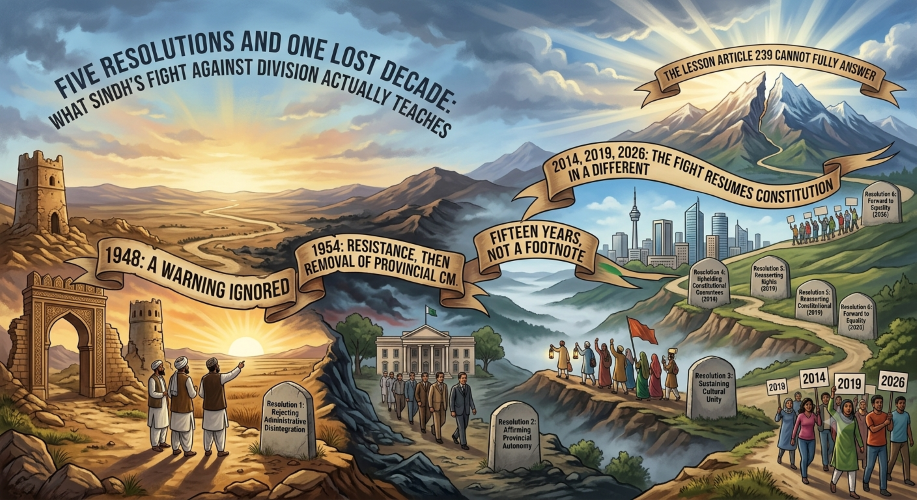
Every few years, someone in Islamabad raises the idea of redrawing Pakistan’s provincial map, and every few years, the Sindh Assembly answers with a resolution. It has now happened five times — 1948, 1954, 2014, 2019, and most recently in February 2026 — and each time the language has been almost identical: Karachi is inseparable from Sindh, the province’s boundaries are not open for negotiation, and any attempt to divide it is a betrayal of the compact under which Sindh joined Pakistan in the first place.
What gets lost in the retelling is that this is not simply a proud, unbroken record of a province defending itself. It is also the record of the one-time Sindh’s resistance was not defeated by argument, but by force — and it took fifteen years to undo.
1948: A Warning Ignored
Ten days after independence-era euphoria had barely settled, word reached the Sind Legislative Assembly that the central government intended to strip Karachi from provincial control and administer it directly as the new federal capital. On 10 February 1948, a member moved a resolution on behalf of his member colleague, seconded by another member, recording the House’s “apprehension and alarm” and warning that the move would cripple Sindh economically and politically. It invoked the 1940 Lahore Resolution’s promise that the units joining Pakistan would remain sovereign and autonomous.
The Assembly’s alarm changed nothing. Karachi was separated from Sindh and declared a federal territory regardless.
1954: Resistance, Then Removal
Six years later, with Karachi still under federal control and no compensation ever paid to Sindh for the lost capital and its revenue, the Leader of the Opposition at the time, moved a second resolution — in the year 1954 — asking the Sindh government to press Islamabad for Karachi’s return. An amendment, added on the floor by a member from Hala’s, spelled out exactly what Sindh felt it had been promised and denied: protection for Sindhi employment in Karachi’s administration, protection of local interests, and financial compensation. None of it, the amendment noted, had materialized.
This is where the story usually stops in the retelling — a second resolution, passed, on the record. What it leaves out is what happened eight months later, and why it happened in the same year.
Through 1953 and into 1954, the federal government was quietly finishing the design of a much larger scheme: merging all of West Pakistan’s provinces — Punjab, Sindh, NWFP, and Balochistan — into a single administrative unit, eliminating Sindh as a province altogether. Sindh’s Chief Minister at the time, fought it directly. By early November 1954 he had secured written commitments from seventy-four members of the Sindh Assembly opposing the scheme — a clear majority in a house of little more than a hundred.
Two days later, Pirzada’s ministry was dismissed. His replacement delivered Sindh’s vote in favour of the very scheme he had been removed for opposing.
On 8 November 1954, the Governor dismissed Pirzada’s government. Ayub Khuhro was installed as Chief Minister the following day — and within weeks, the province’s position had reversed. Sindh’s resistance to One Unit was not voted down. It was removed from office and replaced.
The scheme went ahead. On 14 October 1955, One Unit was formally enforced, and Sindh ceased to exist as a separate province. It would not exist again until 1970.
Fifteen Years, not a Footnote
What followed those fifteen years is usually compressed into a single sentence in accounts that move quickly from 1955 to restoration in 1970, as though the interval were empty. It was not. The Sindh Hari Committee organized against both One Unit and the feudal structures it entrenched. The “Jeay Sindh” movement, born in this period, became the defining current of Sindhi nationalist politics for a generation. Sindhi literature — prose and poetry alike — turned into a vehicle for a grievance the province had no legislature left to voice through ordinary politics. When restoration finally came in 1970, it came after a decade and a half of a province arguing, in every forum still open to it, that its erasure had been wrong.
This is the part of Sindh’s history that the language of the later resolutions — “unbroken legacy,” standing “beyond party lines” — tends to smooth over. The legacy is real. It was not, in fact, unbroken. It was interrupted for fifteen years and had to be fought back into existence.
2014, 2019, 2026: The Fight Resumes in a Different Constitution
The three most recent resolutions were passed under a different constitutional order — one built, in part, precisely because of what happened in 1955. The 1973 Constitution’s Article 239 requires a two-thirds vote of a province’s own assembly before its boundaries can be altered.
In 2014, when smaller-province proposals circulated nationally, the Sindh Assembly passed a unanimous resolution arguing that Talukas, Districts, and Divisions already provide the administrative decentralization such proposals claim to want.
In 2019, after a federal minister floated invoking emergency powers to place Karachi under central control, the Assembly rejected it as an unconstitutional end-run around the same provincial autonomy Article 239 was meant to protect.
The fifth resolution, tabled by the Chief Minister on 21 February 2026, was the most elaborate — and the most contested. It grounded Sindh’s claim in the fullest version of its own history: separation from the Bombay Presidency in 1936, the province’s role as the first in British India to pass the Pakistan Resolution in 1943, resistance to One Unit in 1955, and restoration in 1970, layered over the older civilizational claim running back to Indus Valley Civilization. But unlike the resolution of 2014, it did not pass unanimously. MQM-P’s MPAs opposed it on the floor — consistent with the party’s public campaign, led by Mustafa Kamal, for Karachi’s separation from Sindh, a campaign the party itself had not pursued when it supported the equivalent resolution in 2019.
The Lesson Article 239 Cannot Fully Answer
Article 239 is a real safeguard, and a considerably stronger one than anything available to Pirzada’s government in 1954. A governor today cannot simply dismiss a resisting chief minister and manufacture a two-thirds vote from a reconstituted assembly with anything like the speed the center managed in November 1954. That much has genuinely changed.
But the deeper lesson of 1954–55 is not really about the specific mechanism used against Sindh. It is that a province’s resistance is only as durable as the political conditions that let it stand. Pirzada had the numbers — seventy-four members on record — and it did not matter, because the numbers were not the thing that mattered. What mattered was who had the power to remove the government holding them. Sindh’s assembly has passed five resolutions asserting that its boundaries are settled. Its own history is the clearest evidence available anywhere of why that assertion has needed to be made five times.
This article draws on the original texts of the 1948, 1954, 2014, 2019, and 2026 Sindh Assembly resolutions, on contemporaneous reporting of the 2026 resolution and its aftermath (Dawn, Geo News, The Express Tribune, Pakistan Today, Dunya News), and on historical sources for the One Unit period including The News on Sunday, The Friday Times, the South Asia Journal, and Sindh Assembly Debates. Two details await primary-source confirmation before further use: the full text of the 1954 amendment and speaker list, and the reported vote count by which the Sindh Assembly ultimately endorsed One Unit.
Read: Lessons from the Indus Valley Civilization
_______________
Dr. Nisar Ahmed Ali Nawaz Solangi is a distinguished Public Health Specialist with over 28 years of experience in primary healthcare, health management, and policy development. Throughout his career, he has served in leadership capacities, He holds MBBS from the University of Sindh and a Master of Public Health from Griffith University, Australia. He is a dedicated polymath committed to the intersection of ancient civilization and emerging technology. He is deeply engaged in the study of the Indus Valley Civilization—focusing on its maritime history, trade networks, and egalitarian governance. Currently based in Saudi Arabia, Dr. Solangi is a tireless advocate for the digital preservation and global dissemination of the Sindhi language and culture. He is actively involved in pioneering initiatives on social media” Our Digital World”. By bridging the gap between historical heritage and digital innovation, he aims to create a new paradigm for cultural representation in the AI era.