Stories of Karachi’s Taxi Drivers from 1993 to 2000
Zaffar Junejo
[Author’s Note: I joined a non-government organization in mid-1993. In those days, we were frequent travelers to other Asian countries, and during that period I maintained a diary. I once showed the notes to Muhammad Ibrahim Joyo — the legendary scholar, translator, and intellectual giant of the Sindhi world — who suggested categorizing the entries by theme and getting them published. He recalled that long ago, perhaps in 1955, the Sindhi journal Mehran had launched a similar idea titled ‘Hik Deenh Ji Ghaleh’ (The Story of a Day), even offering a prize for it. He himself had submitted the first story, he told me with a smile, just to set a standard for other writers. Later, Maulana Ghulam Muhammad Girami, a scholar of high standing and journalist; Shamsher ul Haidri, a distinguished Sindhi poet, journalist, and playwright; and Siraj ul Haq Memon, an iconic novelist, linguist, and journalist, all contributed their observations of a single day. These writings were published until 1968.
I agreed with Joyo Sahib that I would group the write-ups by subject and get them published, but I failed to do so. Recently, I sat down to organize my notes. I found various entries about the taxi drivers of Karachi city. Some were very brief and incomplete; others were short but held a finished truth. I have chosen five stories from each year, all of them gathered from the drivers of those cars. In total, there will be thirty-five stories covering the period from 1993 to 2000.
On the surface, these pieces appear to be simple narratives. However, beneath the prose, they depict the complex socio-political and cultural landscape of Karachi during those turbulent days. They are the echoes of a city in motion. I present here the first instalment, which includes two stories: ‘Broken in Multan, Mending in Karachi’ and ‘The Stomach Has Its Own Rules.’]
Broken in Multan, Mending in Karachi
The evening sea breeze carried the smell of salt and wet earth from the coast. At Clifton the dusk settled fast over the shrine of Abdullah Shah Gazi. Lights began to flicker near the bungalow of Mumtaz Ali Bhutto. I left the office late and walked straight across 26th Street.
A yellow taxi pulled to the curb immediately. I opened the door.
“Defence Extension flats,” I said. “How much?”
The driver looked back. “Justice ought to be done, sir. Haq karna, saeen.”
“Four hundred,” I said.
He nodded. “Sit. Baithain “
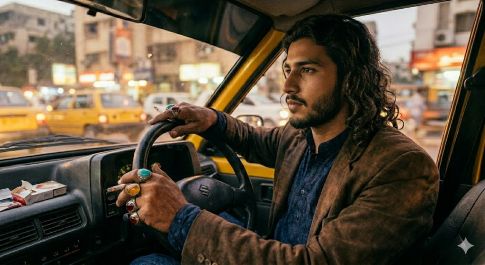
The car moved into the traffic. I watched his hands on the steering wheel. Heavy rings with large stones of different sizes and colours sat on his fingers. His hair hung long but lacked the wildness of a dervish. A lit cigarette burned close to his skin.
He caught my reflection in the glass. He gestured with the cigarette as if to throw it out the window. “Sir, does the smoke bother you?”
“It is fine,” I said.
He took a fast drag and blew the smoke out of the narrow crack of the window.
“When did you start?” I asked to pass the time.
He did not give a date. He shifted gears. “A man needs three things. Strong tea, Gold Flake cigarettes, and the voice of Attaullah Isa Khelvi.”
The city lights blurred past. “The tea and the smoke make sense,” I said. “But Isa Khelvi is an obsession.”
He did not answer. He reached for the dashboard. “May I play the cassette?”
I nodded. He pushed the tape into the old Sony player. The music started. The heavy, grief-laden voice of Attaullah Isa Khelvi filled the cabin, competing with the rush of the wind.
‘Idhar zindagi ka janaza uthay ga…’
We sat in silence until a deep sigh broke from his chest.
“Why do you like him so much?” I asked.
He remained quiet for another mile. He took a sigh, then spoke. “She taught in a private school. I drove a car. I picked her up with the other teachers.”
He stopped. The tape hissed.
“The story started like a flame,” he said. “I am a Bhatti from Multan.”
“What was her name?”
He tightened his grip on the wheel. “I cannot speak her name or her caste, sir.”
The music played lower now. He had turned the knob down.
“Let me guess the surnames from your area,” I said. “If I hit the right one, just raise the volume.”
He agreed with a tilt of his head.
I watched his face in the dim dashboard light. I spoke the names slowly, pitching my voice above the engine. “Sipra. Bhatti. Chachar. Khar. Noon. Joiya.”
He did not move.
“Sial,” I said.
A small smile touched his lips. His hand moved toward the radio, but I reached out and turned the volume up myself. The grief in the music returned.
“Love in Multan, but you wander the streets of Karachi,” I said.
“You speak the truth,” he said. “I am here for her. A friend told me she married a man here and lives in the Johar area. I sold my car three months later. I came to Johar. I stayed with boys from home district. They helped me get this taxi.”
He navigated a sharp turn. “I began the search. I used to park the taxi at Pehlwan Goth, Abbas Town, Safoora Goth, Zohra Nagar, and the Latifi Society. I waited every morning. I thought she might use the taxi-stands to find a ride to school. I spent two and a half months there. I saw nothing.”
He took another drag of his cigarette. “Then I tried the schools. At closing time, I joined the line of drivers waiting for children. I failed there too.”
“She lives in Johar,” I said. “Why look for her here at the Clifton shrine?”
“Today is Thursday,” he said. “In Multan, she never missed her visit to the shrine of Bibi Pak Daman on this day. I believed she would come to Abdullah Shah Gazi. I arrive at five-thirty in the evening. I stay until eight.”
“How long have you kept this schedule?”
“Three months at the shrine,” he said.
“And the total time?”
“Eight months,” he said.
“Will you find her?”
“If God wills it,” he said. “If she is my destiny.”
“And if she is not?”
He looked straight ahead at the dark road. “Only God knows that.”
The tape ended with a click. The machine flipped the side automatically. A new track started. Accha sila diya tune mere pyaar ka.
“Take a left at Toba Masjid,” I said.
The taxi stopped near the gate. I handed him four hundred rupees and offered to buy him a cup of tea from the roadside stall.
He refused the tea. “Just pray for me.”
I tapped his shoulder and stepped out into the humid night. The taxi pulled away into the dark grid of the city. I did not know if his story was true or a well-crafted lie, but the salt air felt heavy, and the music stayed in my head long after the car had gone.
****
The Stomach Has Its Own Rules
The morning of April 29 had the slow stillness that only a public holiday brings to Karachi. This city belongs to everyone and to no one. It is a sprawling concrete no-man’s-land where ownership is an illusion. Nobody truly possesses Karachi. Instead, the city simply absorbs people and dilutes their pasts until they become part of its chaotic landscape.
At Hasan Square, the sun was already bleaching the sky into a pale, humid blue, promising a thick afternoon heat. I had just stepped out of a friend’s flat, leaving behind the lingering warmth of tea-fuelled literary debates. My plan was to head toward Sachal Goth, but on a holiday, Karachi moves like molasses. The streets were eerie in their emptiness. I stood on the dusty shoulder of University Road, watching the heat rising from the asphalt in wavy, shimmering lines. The city was waking up in slow motion.
Two yellow-and-black taxis sped past, their drivers completely ignoring my raised hand. The third overshot me by several yards, its worn brake pads letting out a sharp screech before the car aggressively reversed through the dust.
I stepped up to the open passenger window. The interior smelled of old rexine and cheap air freshener. “Sachal Goth. Kitna logay?”
“Two-fifty,” the driver said flatly, not even looking at me.
“Two hundred,” I countered.
He gave a single, tight nod. “Baitho.”
I climbed into the back seat, and the old Mehran car rattled to life. As we crossed the intersection by the National Institute of Public Administration, the unusual lack of traffic made the city feel terrifyingly vast. Without the bumper-to-bumper friction of buses and motorcycles, Karachi looked like an abandoned monument to concrete.
I looked at the driver in the rearview mirror. He had a sharp, deeply weathered profile, but his high cheekbones and the specific set of his eyes didn’t quite fit the typical Pashtun drivers who dominate the city’s transport. Curiosity got the better of me.
“Are you from the Northwest—from KP?” I asked, leaning forward against the vinyl seat.
“Yes,” he said, shifting gears with a loud, mechanical clunk. “But not Pathan. Wakhi.”
“Then where?”
“Baroghil Valley.” He caught my blank stare in the mirror and a small, knowing smile broke through his stern expression. “You can say Upper Chitral.”
“Chitral to Karachi?” I marveled, trying to reconcile the jagged, snow-capped peaks of the extreme north with the flat, dusty urban sprawl outside. “When did you come here?”
“1990,” he said, his voice softening as if stepping into a memory. “I came during my winter vacations. I was a first-year Arts student. I just came to visit my Khala. But the moment I arrived, I fell in love with this city. It was so bright. The roads felt endless, and the winter here was so mild—like a gentle breeze compared to the killer frost back home. I told my Khala I wasn’t going back. She spoke to my uncle, they figured out my college admission, and by April, I was a part of the city. “
“What do you remember most about those first few days?” I asked, looking out the window as a sudden gust of dry Karachi wind whipped up a cyclone of plastic bags along the sidewalk.
The driver laughed, a short, barking sound that filled the cramped cabin. “I remember eating wheat bread until my stomach was completely full.”
I paused, genuinely confused. “Wheat bread? Until your stomach was full?”
“Yes,” he said, turning the steering wheel casually with one hand. “In Baroghil, the cold is brutal. The ground is frozen most of the year. Wheat rarely grows there. We only had barley, buckwheat, or fodder. When I first stood at Sohrab Goth in 1990 and saw a tandoor surrounded by mountains of hot, fluffy, white rotis, I couldn’t move. I just stood there on the pavement, staring at the bread, thinking it was a miracle.”
The landscape outside was shifting now. The massive, uniform concrete blocks of Gulistan-e-Jauhar were blurring past as we neared the link road. The city felt entirely indifferent to our conversation, a blank canvas where a man from the roof of the world could find salvation in a roadside clay oven.
“Do you ever think about going back?” I asked quietly.
“Sometimes,” he sighed, his eyes tracking the empty road ahead. “The heart longs for the mountains in the summer. But the stomach demands more than the heart desires. Karachi Zindabad. It’s a cheap city. Koi poochta nahi hai—no one asks who you are, where you came from, or what you’re doing here. Who would leave a place like that?”
The taxi pulled up to the bustling link road leading to Sachal Goth. I asked him to stop near the main gate. The rattle of the engine finally died down as I handed him his three hundred rupees. He took the cash, gave a polite nod, and immediately began scanning the empty street for his next fare.
As I watched the little car disappear into the hazy glare of the Karachi morning, a fragment of a poem I had once read inside a London Underground train flashed vividly through my mind:
‘Here, the soil is kind, the air is clear,
And no one asks: Why are you here?
No curious eyes dissect your past.
________________
 Dr. Zaffar Junejo has a Ph.D in History from the University of Malaya. His areas of interest are post-colonial history, social history and peasants’ history. He may be reached at junejozi@gmail.com