Latif composes not merely a lyric but a complete symphony of life.
- Anyone aware of Bhittai’s thought and art would understand the masterfulness that this saintly artist poet put in his literary creations
By: Raphic Burdo
Many might dispute presenting Shah Abdul Latif Bhittai as the greatest poet in the world. However, anyone aware of his thought and art would understand the masterfulness that this saintly artist poet put in his literary creations. There are many threads of his message, there is variety of his thoughts, and there is amazing celebration of human spirit in the poetry of Shah Latif.
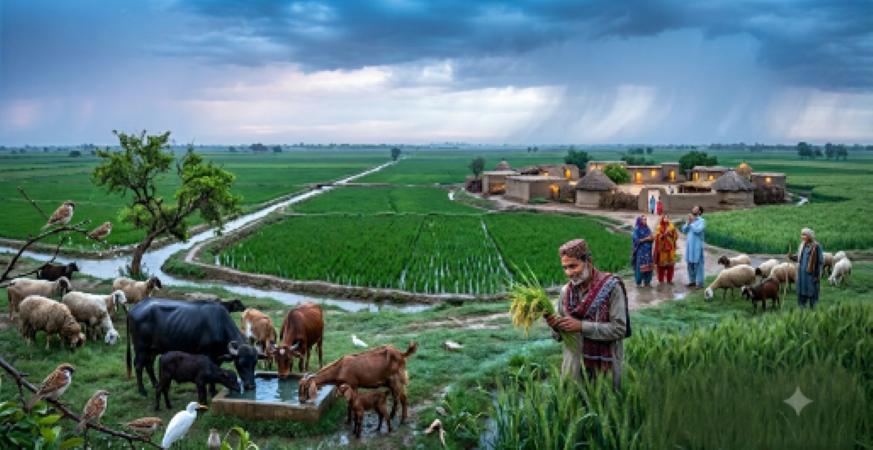
Shah jo Risalo, the compilation of Bhittai’s poems is divided by experts in surs (chapters or musical raags). Saarang is the chapter that sings rain, clouds and joy that water falling from sky brings to people in Sindh. Shah is universally acknowledged as national and representative poet of Sindhi language for many reasons, one of them being his masterful capturing of Sindh’s tone and tenor, in his poetry.
Today, I am taking up only one poem, a triplet or three-liner, of Shah from his Sur Saarang. Let us first read the poem in Sindhi script, then render it into Roman script of Sindhi for facilitating diaspora that is not literate into Arabic Script of Sindhi. I am not very familiar with Devnagri script and Shah Mukhi script of Sindhi, hence I am not attempting those two scripts.
First, the poem as it appears in various versions of Shah jo Risalo:
سارنگ! سار لهيج، الله لڳ اُڃين جي؛
پاڻي پوڄ پٽن ۾، ارزان ان ڪريج،
وطن وسائيج، ته سنگھارن سک ٿئي.
شاھ عبداللطيف ڀٽائي
Now, the poem in Roman Script of Sindhi. Following is the transliteration that preserves the Sindhi sound while allowing an English-speaking reader to hear the music could be:
Saarang! Saar lahej, Allah lag unyan ji;
Paani poj patan mein, arzaan an karej,
Watan wasaaej, ta sanghaaran sukh thiye.
(Shah Abdul Latif Bhittai)
I will not translate the given poem word for word. Instead of literal translation, here I attempt to render it as a poetic reimagining that seeks the inner music and spiritual pulse of the verse. Shah says:
Dear Clouds!,
remember the thirsty.
Come carrying mercy.
Pour your water
into the cracked hands of the fields.
Please be generous.
Let abundance fall
without measure.
Bring the bloom back
to our homeland,
so the farmers,
the shepherds,
the ordinary people,
the country folk,
may once again
witness peace and prosperity.
The literary critics always say, art lies in concealing art. Shah is supremely deep in meaning wherever he is astonishingly simple in articulation. Here, in this poem too, behind the veneer of description of everyday phenomena and a simple prayer, closer residing reveals the deepest layer of Shah’s verse. This is not merely a prayer for rain. It is a prayer for the entire chain of life. The genius of Shah Abdul Latif Bhittai lies in simplicity of presentation and the order of his prayer.
I invite you to read the poem again and notice how the prayer expands in widening circles.
Circle One: Compassion for the Living:
Saarang! Saar lahej, Allah lag unyan ji;
Latif begins not with land, wealth, production, or power. He begins with suffering. The first concern of civilization is not prosperity but people and their food. The ‘thirsty’ in the first line of poem are not only human beings. They are also cattle, birds, trees, streams, and every living thing waiting for relief. The prayer starts with empathy. Before asking for abundance, Latif asks us to recognize need. Indeed, a society becomes humane when it can hear the cry of the thirsty.
Circle Two: Fertility of the Land:
‘Paani poj patan mein, arzaan an karej,’
Once human suffering is acknowledged, Shah turns our attention and the attention of the Weather System, to the source of sustenance. The fields are where life is transformed. Water becomes grain. Grain becomes bread. Bread becomes civilization. Latif understands a truth that economists would later express in different language: production precedes distribution.
Without fertile land, compassion alone cannot feed people. Thus the prayer moves from human need to the means by which that need is met.
Circle Three: Abundance, Not Mere Survival:
‘arzaan an karej’
Shah Latif is not praying merely for survival. He is asking for abundance. There is a profound distinction between a society that survives and a society that flourishes. Scarcity breeds fear, conflict, hoarding, and competition. Abundance allows generosity, culture, learning, beauty, and peace. Bhittai, the poet, therefore asks not for a few drops but for overflowing grace.
Circle Four: The Nation
‘Watan wasaaej’
This is perhaps the most remarkable leap. Shah’s poetic prayer now rises from the individual and the fields to the nation itself. A nation is not made prosperous through slogans, monuments, or political speeches. Instead, a nation flourishes when its people flourish.
The homeland becomes prosperous when its children are fed, its farmers are secure, its water flows, its land bears fruit, its villages are alive. Latif’s conception of patriotism is rooted in human welfare, not political rhetoric.
Circle Five: Happiness of the Producers
‘ta sanghaaran sukh thiye’
The poem ends with extraordinary humility. The beneficiaries of prosperity are not kings, courtiers, generals, or merchants. Latif ends with the ‘sanghaar’, the farmer, shepherd, and ordinary working person. This reveals the moral philosophy of the poet-saint lovingly called Laal Latif.
The success of a nation, in fact, should be measured by the wellbeing of those who work closest to the earth. If the farmer is distressed, the nation is distressed. If the farmer is secure, the nation is secure. Surprisingly, centuries before modern development economics, Latif placed the common producer at the center of national prosperity.
In modern language, this verse of Shah Abdul Latif can almost be read as a development framework:
- Care for people.
- Invest in productive resources.
- Ensure abundance and opportunity.
- Build a flourishing nation.
- Measure success by the wellbeing of ordinary citizens.
At another level, rain is not only rain. Water is grace. The thirsty are souls. The fields are hearts. The homeland is the human community. The prayer then becomes:
O Lord,
remember those who thirst:
for meaning,
for hope,
for justice,
for love.
Pour Your grace into barren hearts.
Let generosity replace scarcity.
Let the world become habitable again.
Let ordinary people find peace.
This is why this verse of Shah feels timeless and lovingly recited all across Sindhi community. It is simultaneously a prayer for rain, a prayer for economic prosperity, a prayer for social justice, a prayer for national development, and a prayer for spiritual renewal.
Latif begins with a thirsty creature and ends with a flourishing nation. In between those two points lies an entire philosophy of civilization: the prosperity of a country begins with the wellbeing of its people, and the wellbeing of its people begins with mercy.
A fuller appreciation of this poem of Shah Latif requires us to look not only at what it says, but how it says it. Shah Abdul Latif Bhittai’s greatness lies as much in his craftsmanship as in his wisdom. The poem is structured as a direct address:
‘Saarang! Saar lahej…’
The poet is speaking to the rain-bearing cloud as though it were a conscious being capable of hearing, understanding, and responding.
This technique, known as apostrophe, is common in mystical and classical poetry. The poet addresses an absent or non-human entity as if it were present.
Yet the cloud is more than a cloud.
It is:
- Nature,
- Providence,
- Divine Mercy,
- The unseen source of sustenance.
Thus the poem operates simultaneously on literal and symbolic levels.
Read aloud:
Saarang! Saar lahej,
Allah lag unyan ji;
Paani poj patan mein,
arzaan an karej,
Watan wasaaej,
ta sanghaaran sukh thiye.
One immediately notices the repetition of soft consonants: S, L, P, W. These sounds create a flowing movement resembling falling rain and moving water. There are no harsh sounds or abrupt stops. The poem itself behaves like rain. It descends gently.
Shah Latif also employs subtle alliteration. Consider:
Saarang! Saar lahej.
The repetition of the S sound creates a musical invocation. The word Saarang is immediately echoed by Saar.The effect resembles the first distant rumbling of clouds.
Similarly:
Paani Poj Patan
The repeated P sound creates a rhythmic pattern suggestive of drops striking earth. The words seem to pour from the mouth.
Notice the line endings:
lahej
karek
wasaaej
The repeated ‘-ej’sound binds the lines together. This is not a strict end-rhyme in the English sense, but a musical echo. The repeated sound creates continuity and gives the verse its prayer-like quality. One can imagine a gathering of villagers or Shah’s singers repeating these lines in unison. The recurrence of the sound produces a sense of longing and supplication.
The rhythm of the poem is remarkably balanced. Each phrase is short. No line is overloaded. The poem breathes.
For example:
Saarang! Saar lahej
It is a call. Then after a pause:
Allah lag unyan ji
It is a plea, a supplication. Again after a pause:
Paani poj patan mein
It is a request. And after a pausr:
Arzaan an karej
This line intensifies the prayer. Again a pause. The movement resembles waves or rainfall. The poem advances through successive petitions. Each line adds a wider horizon to the previous one.
In my view, one of the most beautiful formal feature in Shah this verse from Sur Saarang is its expanding scope. As discussed earlier, the architecture of the verse resembles concentric circles. This creates what might be called a spiral structure. The poem continuously widens its embrace. The movement is from Need to Resource to Prosperity to Nation to Human Happiness. Thus the structure of the verse itself embodies generosity.
As I said, art lies in concealing art. The imagery used in the poem is simple yet powerful. There are no elaborate metaphors. No decorative language. Instead we encounter elemental realities: Thirst, Water, Fields, Homeland, and Farmers. These are archetypal images. Every agrarian civilization understands them. Because this imagery of Shah is universal, the poem remains fresh centuries later.
Another highly astonishing feature of the poem is compression. Many poets require pages to express what Latif has expressed in three lines. The verse contains Ecology, Economics, Politics, Ethics, Spirituality, and Patriotism. Yet there is not a single unnecessary word. This is one of the hallmarks of great classical poetry: maximum meaning with minimum language. Shah Latif qualifies this litmus test.
If one listens carefully, the poem’s phonetics mirror its subject. The recurring vowels: ‘aa, ee, oo’ create liquidity.
Words ‘Saarang, Saar Paani, Poj, Watan, Wasaaej’ flow into one another. The poem does not merely describe water. It sounds like water.
Finally, the question: why the poem has survived? Many poems about rain merely celebrate weather. Shah Latif transforms rain into a philosophy.
The music is gentle.
The imagery is elemental.
The structure is expansive.
The symbolism is profound.
Most importantly, the poem never loses sight of the ordinary person. The verse begins with compassion and ends with human wellbeing. That movement from mercy to prosperity is the secret rhythm beneath all the visible rhythms of the poem.
The music of the words is beautiful, but the deeper music is moral: a vision of a just and flourishing society where divine grace falls first upon the thirsty, then upon the fields, and finally upon the nation as a whole. In three short lines, Latif composes not merely a lyric but a complete symphony of life.
Read: Shah Latif and Authentic Living
___________________
Raphic Burdo is a student of Literature, Psychology, Public Policy and Entrepreneurship. He writes on the subjects where all four intersect.