Stories of Karachi’s Taxi Drivers from 1993 to 2000
Zaffar Junejo
[Author’s Note: I joined a non-government organization in mid-1993. In those days, we were frequent travelers to other Asian countries, and during that period I maintained a diary. I once showed the notes to Muhammad Ibrahim Joyo — the legendary scholar, translator, and intellectual giant of the Sindhi world — who suggested categorizing the entries by theme and getting them published. He recalled that long ago, perhaps in 1955, the Sindhi journal Mehran had launched a similar idea titled ‘Hik Deenh Ji Ghaleh’ (The Story of a Day), even offering a prize for it. He himself had submitted the first story, he told me with a smile, just to set a standard for other writers. Later, Maulana Ghulam Muhammad Girami, a scholar of high standing and journalist; Shamsher ul Haidri, a distinguished Sindhi poet, journalist, and playwright; and Siraj ul Haq Memon, an iconic novelist, linguist, and journalist, all contributed their observations of a single day. These writings were published until 1968.
I agreed with Joyo Sahib that I would group the write-ups by subject and get them published, but I failed to do so. Recently, I sat down to organize my notes. I found various entries about the taxi drivers of Karachi city. Some were very brief and incomplete; others were short but held a finished truth. I have chosen five stories from each year, all of them gathered from the drivers of those cars. In total, there will be thirty-five stories covering the period from 1993 to 2000.
On the surface, these pieces appear to be simple narratives. However, beneath the prose, they depict the complex socio-political and cultural landscape of Karachi during those turbulent days. They are the echoes of a city in motion.]
When Markets Worked, Neighbourhoods Lived
The sun hung heavy over Lyari. The meeting inside the brick building ended late.
I walked onto the road. My eyes searched the standing cars for the driver from yesterday. He was not there.
I went to the side of a tea stall. A small wooden bench stood outside it. I sat down and waved a hand at the boy behind the boiling kettle. He brought a small glass of strong, brown doodh patti. I blew across the hot surface, watching the steam rise and vanish into the heavy air. The hand of my wristwatch ticked. I finished the tea and stood up.
An old man wiped the windshield of a car with a gray rag. I waved at him. He saw me approaching and dropped the cloth. His face had deep lines, dark as dried riverbeds.
“NIPA.” I held up seven fingers. “Seven hundred.”
He opened the rear door for me. “Get in.”
The smell of old iron, worn upholstery, and years of use hung inside the car. He climbed into the front seat, adjusted his mirror, and started the engine.
I leaned forward against the front seat. “You have driven this city a long time.”
He cleared his throat and looked at the road ahead. “My father drove before me. I took his wheel, but the city is not the same.”
I watched the back of his gray head. “Your father saw a different town.”
He let out a long breath through his nose. His shoulders rose and fell. “Yes.” His fingers tapped the steering wheel. “My father’s world is gone. You cannot fit it into this one.”
He turned the wheel hard to avoid a deep rut. “My father talked of Saddar.” His voice settled beneath the rumble of the engine. “Elphinstone Street. He took foreigners to European cafés. Clean bars. High stores.” He rubbed his chin, his thick beard scratching against his palm. “His Bunder Road was clean then. You picked up men with money in Kharadar. You took them to Mithadar. The pockets stayed full.”
The taxi rolled past old stone buildings. He gestured eastward with a blunt thumb. “My father’s time, Jodia Bazaar and Napier Road were wholesale markets. The merchants bought in bulk. They did not argue over a few paisas.” He spat out the window. “No doubt, in those days, Soldier Bazaar had its own stand.”
I looked at the streets outside and tried to imagine the old port city with its European quarters, crowded trading houses, and evenings filled with social life.
He shifted gears. His knuckles turned white on the lever. “Angrez ke zamane mein, the City Railway Station was the heart. It carried freight from the docks to the mainland. Lyari was the muscle. Lea Market, the Timber Market, the oil presses at Chakiwara. We had the fish trade at Khadda Market. The washers at Dhobi Ghat lined the river. The stands stayed busy.”
He looked at me through the mirror. His eyes were tired. “The trains ran. The camels moved the bulk. A taxi driver had a place then.”
For a moment, only the engine filled the space between us.
“My father used to say that Karachi had order. Business areas were separate from living quarters. The markets worked. The neighbourhoods lived.”
“And now?” I leaned forward.
A faint smile appeared beneath his mustache. “Now there is confusion.” His eyes followed a motorcyclist weaving through traffic. “Sometimes I wonder whether people are living in markets or whether the markets have entered their homes.”
“So?” I wanted him to continue.
He drew in a deep breath. “So we keep roaming. We drive from one end of the city to the other looking for passengers. We burn petrol. We wear out the vehicle. We shorten the life of the roads.”
Before he could finish, I pointed through the windshield. “And damage the environment.”
He nodded. “Zahir si baat hai, dhuwan to hoga.” His eyes remained fixed on the road ahead.
We crossed the bridge. On the left stood the Sadequain Gallery. The afternoon traffic moved beneath a thin veil of dust and heat. I asked him to stop near the Sindh Board of Technical Education.
He pulled over and pressed the brake. I handed him seven hundred rupees.
He folded the notes into his kameez pocket and dipped his head slightly. “Thank you, Saeen.”
I stepped onto the roadside. He shifted into gear and drove away. I stood for a moment and watched the old taxi disappear into the traffic. It carried the memory of another Karachi, one that survived now only in the stories of men who had inherited the wheel from their fathers.
***
The City That Never Finishes Its Roads
The autumn wind blew dust across University Road. It was neither hot nor cold.
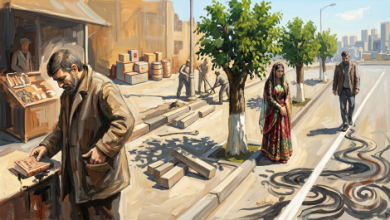
I stepped out of the Crest Square gate. The concrete of Gulshan-e-Iqbal felt hard under my boots. I walked to the curb, squinting against the glare.
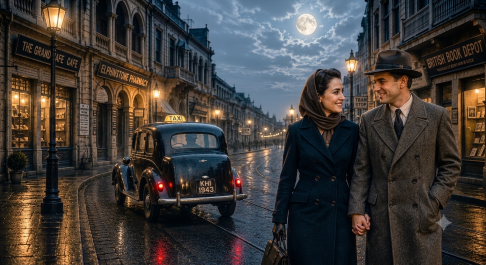
A yellow cab pulled over. The driver leaned across the seat and rolled down the window. He studied me for a moment, his eyes dark, patient.
“Shaheen Flats/Complex,” I said. “Near the school.”
He gave a small nod and shifted the gear. The engine coughed as the car merged into traffic.
“Layyah.” His gaze stayed fixed on the rearview mirror, as if measuring the road behind us. “From Punjab.”
“Karachi is big,” I said.
His shoulders sank slightly, as though the weight of the sentence had settled on him. His grip tightened on the steering wheel. “But it has no future.” His thumb pressed briefly against the horn and released it without sound. “Its roads work only for a month. Two, if lucky. Then nothing.”
“Why?”
He tapped the wheel twice, then pointed ahead without turning his head. “The roads. Look.” His finger traced the broken surface through the windshield. “They dig. They never finish.”
The taxi jolted over a ridge of uneven earth.
“M.A. Jinnah Road is a trap.” He spat the words lightly, as if the road itself had offended him. “Demolitions. Patchwork. The car stops. The fuel burns.”
I shifted in the worn seat. “Shahrah-e-Faisal?”
His head tilted slightly, a tired refusal. “Excavations. Flyovers. Karsaz is closed half the time.” His hand swept across the dashboard. “University Road—they cut it open for pipes. Every week, another hole.”
He took a sharp left. “Kutchery Road is blocked.” His fingers drummed faster now. “We burn petrol just standing still. The meter doesn’t count waiting.”
“They will finish the work,” I said.
A short, dry laugh escaped him. He did not look at me. His eyes stayed on the broken line of traffic ahead.
“My friend’s father works in KDA,” his voice lowered. “Engineer.” He raised one finger. “First contract has the money. Work order comes, millions are released.” He flicked his wrist as if scattering papers in the air. “They launch the project, take the cash, dig the hole, and fix the inauguration plates.”
He shifted into second gear. The engine strained, whining softly.
“Then the funds stop,” he continued. His hand dropped toward the window. “Or they come late. So the holes stay. Sand, stones… and those plates shining on nothing.”
The car slowed. The high boundary wall of Shaheen School appeared on the left. He pulled the handbrake. It clicked repeatedly in short, mechanical bursts.
I placed the notes in his palm. He took them without counting. His eyes were already back on the cracked road, as if memorizing it.
I stepped out. The door shut with a dull, heavy thud.
The taxi moved away, trailing a thin cloud of gray exhaust through the autumn air.
______________________
 Dr. Zaffar Junejo has a Ph.D in History from the University of Malaya. His areas of interest are post-colonial history, social history and peasants’ history. He may be reached at junejozi@gmail.com