

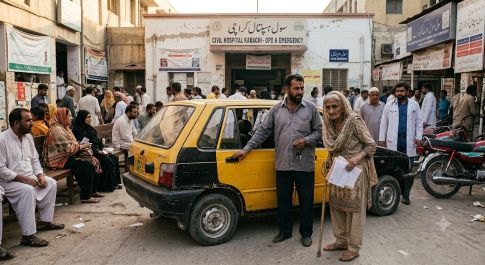
Stories of Karachi’s Taxi Drivers from 1993 to 2000
Zaffar Junejo
[Author’s Note: I joined a non-government organization in mid-1993. In those days, we were frequent travelers to other Asian countries, and during that period I maintained a diary. I once showed the notes to Muhammad Ibrahim Joyo — the legendary scholar, translator, and intellectual giant of the Sindhi world — who suggested categorizing the entries by theme and getting them published. He recalled that long ago, perhaps in 1955, the Sindhi journal Mehran had launched a similar idea titled ‘Hik Deenh Ji Ghaleh’ (The Story of a Day), even offering a prize for it. He himself had submitted the first story, he told me with a smile, just to set a standard for other writers. Later, Maulana Ghulam Muhammad Girami, a scholar of high standing and journalist; Shamsher ul Haidri, a distinguished Sindhi poet, journalist, and playwright; and Siraj ul Haq Memon, an iconic novelist, linguist, and journalist, all contributed their observations of a single day. These writings were published until 1968.
I agreed with Joyo Sahib that I would group the write-ups by subject and get them published, but I failed to do so. Recently, I sat down to organize my notes. I found various entries about the taxi drivers of Karachi city. Some were very brief and incomplete; others were short but held a finished truth. I have chosen five stories from each year, all of them gathered from the drivers of those cars. In total, there will be thirty-five stories covering the period from 1993 to 2000.]
The Mask We Wear
The morning air in Karachi carries a salty, damp chill before the sun fully clears the horizon, but today it felt heavier. I read Daily Kawish’s front-page headline: MQM Calls for Strike.
Outside the window, Karachi’s streets were trapped in a tense, ticking countdown. The tea stalls were still steaming, and a few hurried pedestrians kept their heads down, but the usual chaotic roar of the city was missing. It was a silence born of fear.
The man at the wheel gripped the steering wheel, his knuckles white. He let out a long, ragged sigh that rattled in his chest.
I leaned forward, resting an arm on the back of the front seat, my eyes shifting from the road to his tense profile. “You look worried.”
I waited, watching the rapid rise and fall of his shoulders, then gently tapped the back of the seat to prompt him. “What happened?”
He released a heavy, shuddering breath, his head shaking slowly side to side. “This morning I picked up a fare from the waiting area outside Civil Hospital. A young man came to me.”
I raised an eyebrow, gesturing slightly with an open hand. “He needed a taxi?”
He nodded once, sharply. “Yes. He offered eight hundred rupees to take a patient to Manzoor Colony. I agreed.”
I nodded slowly, settling back slightly into the vinyl seat. “What happened then?”
He eased his foot off the accelerator as a stray dog crossed the road, his eyes reflecting the pale morning light. “I parked beside the ward. I waited.”
“For how long?”
He shrugged slightly, his voice dropping an octave. “A few minutes. Then, I stepped out. I stood under the shadow of the ward wall. The young man came back.”
“What did he do?”
He raised his left hand from the wheel, pointing a single index finger upward in mimicry. “‘Just a minute.'”
I nodded, a faint, understanding grimace crossing my face. “Hospitals always stretch time.”
He tapped the dashboard with his fingers, the rhythm uneven and anxious. “After some time he returned. He carried a shoulder bag. A clear plastic bag held medicines. There was a discharge file. X-rays. Medical reports.”
I frowned, sensing the sudden shift in his posture. “And the patient?”
His voice thinned to a near-whisper, his eyes reflecting a deep, sudden sorrow. “I saw an old woman. She dragged herself along the wall. She held the posts. She held the wall. Each step looked painful.”
I tightened my grip on my own shoulder bag, waiting. “Who was she?”
He shook his head slowly, his expression hollow. “I did not know. But then I heard one word. ‘Afzal.’ Only one word. It came again. ‘Afzal.’ It was hardly a whisper.”
I frowned deeply, my brow furrowing. “What did the young man do?”
He imitated a dismissive flick of a hand, his face tightening with disgust. “He turned his head. He waved his hand. He asked her to wait. The old woman almost fell.”
I straightened up, my voice hardening. “And you?”
He slapped his open palm gently against the steering wheel. “I called him. ‘Afzal.’ I called again. He never came. I ran to her. I held her arm. I called him again.”
I leaned in closer. “What did he say?”
He pulled a bitter, tragic smile, mocking the young man’s distant, cold tone. “‘Bring her quickly.'”
I stared at him, a wave of respect washing over me. “You really helped her?”
He shrugged, as if compassion were the only logical choice a human could make. “I could not leave her there. I held a woman who looked more than ninety. She felt as light as a child. I think she wore a printed dress—the kind people wore in films from the nineteen-fifties. We walked slowly. She leaned on my arm.”
I watched his eyes soften in the rearview mirror. “Did she say anything?”
He nodded, a soft warmth returning to his voice. “She thanked me again and again. ‘You are a good boy.’ I smiled. ‘It is nothing.’ But when we reached the car, I found Afzal already sitting in the front seat.”
I scoffed, shaking my head in disbelief. “He never helped?”
He glared at the empty road ahead. “No.”
I leaned forward, my voice sharp. “Did you ask him why?”
He nodded slowly. “I did. He looked away and said, ‘She is my mother.'”
I stared blankly, utterly stunned by the revelation. “You asked nothing more?”
His voice rose slightly, carrying the weight of his lingering disbelief. “I asked why he would not help his own mother. He nodded and said he feared for himself. He believed she had a disease that could spread. ‘I have my own family,’ he told me.”
I folded my arms tightly across my chest. “Where did he get such an idea?”
He let out a dry, humorless laugh, shaking his head at the absurdity. “He believed his neighbor’s mullah. The mullah told him the illness only attacked close relatives. I had already held her, so I asked him whether I should also be afraid. He stayed silent.”
I sighed deeply, looking out at the shuttered shops of Manzoor Colony as we neared my destination. “What happened next?”
He gesticulated toward his face, mimicking the pulling on of a mask. “The old lady sat behind me. Afzal wore a face mask. He kept it on all the way. We finally reached Manzoor Colony. I stopped where Afzal pointed. He picked up his bags. He stepped out. He walked to the gate.”
I peered out the window, visualizing the cold scene. “Did anyone meet them?”
He stared blankly ahead, his tone flat. “A child stood there. A young woman waited beside the door. Neither moved. Neither came forward. Afzal only waved his hand. He wanted me to help again. So I opened the rear door. I gave the old lady my arm. She thanked me once more.”
I asked quietly, almost dreading the answer. “Did you ask her about the disease?”
He pulled the vehicle over to the curb, letting the engine idle. He turned his head completely to look back at me, his eyes wet with unshed tears. “I asked her, ‘What illness do you have?’ She smiled. A tired smile. ‘Son, I have no disease that spreads. I simply cannot control my bowels. Sometimes it becomes worse. The hospital helps me when it happens.'”
The engine hummed in the quiet cabin. Outside, the streets of Karachi were now completely barren, surrendered to the fear of the strike. Yet, inside the car, a far more chilling silence lingered—the quiet devastation of a mother abandoned by her own blood, not out of malice, but out of a foolish, manufactured fear.
_____________________
 Dr. Zaffar Junejo has a Ph.D in History from the University of Malaya. His areas of interest are post-colonial history, social history and peasants’ history. He may be reached at junejozi@gmail.com



The way Dr. Zaffar has portrayed the atmosphere during the terrorists’ strike is both vivid and engaging. Even more compelling, however, is the taxi driver’s story, which illustrates how, even in a large metropolitan city like Karachi, the unscientific remedies and advice of certain religious clerics have driven people into psychological distress. The way a cleric misdiagnoses an elderly woman’s illness ultimately separates her from her own children—to the extent that her son is unwilling even to touch her. This powerfully exposes the deep-rooted superstition that continues to prevail in society.