Stories of Karachi’s Taxi Drivers from 1993 to 2000
Zaffar Junejo
[Author’s Note: I joined a non-government organization in mid-1993. In those days, we were frequent travelers to other Asian countries, and during that period I maintained a diary. I once showed the notes to Muhammad Ibrahim Joyo — the legendary scholar, translator, and intellectual giant of the Sindhi world — who suggested categorizing the entries by theme and getting them published. He recalled that long ago, perhaps in 1955, the Sindhi journal Mehran had launched a similar idea titled ‘Hik Deenh Ji Ghaleh’ (The Story of a Day), even offering a prize for it. He himself had submitted the first story, he told me with a smile, just to set a standard for other writers. Later, Maulana Ghulam Muhammad Girami, a scholar of high standing and journalist; Shamsher ul Haidri, a distinguished Sindhi poet, journalist, and playwright; and Siraj ul Haq Memon, an iconic novelist, linguist, and journalist, all contributed their observations of a single day. These writings were published until 1968.
I agreed with Joyo Sahib that I would group the write-ups by subject and get them published, but I failed to do so. Recently, I sat down to organize my notes. I found various entries about the taxi drivers of Karachi city. Some were very brief and incomplete; others were short but held a finished truth. I have chosen five stories from each year, all of them gathered from the drivers of those cars. In total, there will be thirty-five stories covering the period from 1993 to 2000.]
Lucky Numbers
The sun hung low over Karachi. The heat was heavy. I left the flat and raised my hand. A yellow taxi stopped by the curb.
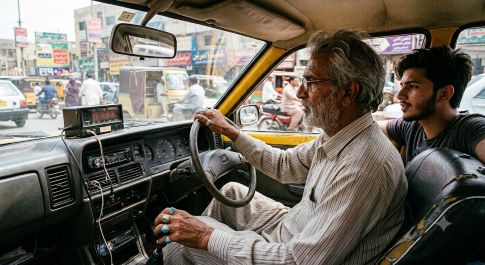
I froze at the door. The driver sat behind the wheel. His appearance stopped me. Wild dark hair was parted down the middle. Heavy silver rings caught the harsh sun. His left hand held four rings; his right hand held three. Thick stones of blue Neishabur turquoise and red Yemeni aqeeq sat on his fingers. Three rings occupied his right index finger, middle finger, and ring finger. The left hand showed the exact same pattern.
“Gulshan-e-Iqbal,” I spoke through the window.
“Five hundred and fifty rupees.” His voice was low.
The price was fair. The engine rattled. The car pulled into the thick traffic.
“What is your name?” I leaned forward.
The driver did not look back. He pointed one ringed finger toward the roof of the cab.
“Praise belongs only to the Almighty. I am a mere Faqir. A worthless man has no name to speak of.”
The dust filled the cab. The air smelled of old petrol. It brought a sudden ache for old places.
“You wear an odd number of rings,” I remarked. “Seven in total. Four on the left. Three on the right. What is the mystery?”
“Numbers hold the truth,” he murmured. “Odd numbers carry respect. The numbers one and five hold the highest reverence.”
“Why is that?”
“One is the absolute unity. It is God. Five represents the pillars of the faith and the five daily prayers. It honors the Panjtan Pak.”
“But you wear seven rings, not five.”
“Look closer. Count the fingers with rings. Three on the right. Four on the left.” He spoke with total conviction. The car bumped over a pothole.
“Tell me more about these numbers.”
“Seven hundred and eighty-six is the most sacred,” he replied. “It is the weight of the holy words: Bismillahir Rahmanir Raheem. Then comes seven. The soul climbs seven stages to reach the light. And forty is the number of completion. A dervish sits in the chilla for forty days—forty days of hunger, silence, and prayer in the dark.”
“What about lucky numbers?”
“Every soul has its own number. Man, woman, or child.”
“What is yours?”
The driver went silent. The city moved past the windows in a blur of gray concrete.
“Three,” he finally whispered.
“Why three?”
“A holy man told me so at a shrine festival in Punjab. I asked him why. The Faqir laughed. He told me all good things arrive in threes.”
“The Christians say three represents the Trinity,” I noted. “The Father, the Son, and the Holy Spirit.”
“I know nothing of Esa,” the driver stated. “But three stands firm. It is stable. It is fortunate.”
He gestured to the empty cabin. “Remove my seat. What remains? Three seats. One in the front. Two in the back. A perfect balance. And look at the license plate of this car. The number three appears twice.”
The rattling of the old taxi shifted my thoughts. My mind traveled back to 1918, to a cold English hospital room. Srinivasa Ramanujan lay dying of tuberculosis in his bed. His Cambridge mentor, G.H. Hardy, walked into the room. Hardy lacked words for small talk. He mentioned his ride, noting the taxi bore the dull number 1729. He called it an uninspired, small number.
The dying genius did not hesitate. He needed no pencil; he needed no paper. Ramanujan sat up against his pillows. He corrected the professor instantly. He called 1729 a magical number. It was the smallest integer in the universe expressible as the sum of two cubes in two different ways. In a flash of light, Ramanujan saw that one cubed plus twelve cubed made 1729, and nine cubed plus ten cubed also made 1729. Hardy sat stunned.
I looked at the driver’s reflection in the mirror.
“Mathematicians have a famous number just for cabs,” I told him. “They call it the Taxicab Number. It is 1729.”
The driver stared at the road ahead. He did not understand the mathematics, but he understood the mystery.
“God knows best,” he sighed.
The car slowed down near the bustling intersection.
“Stop here. Near the NIPA stop.”
I paid the fare, stepped out into the heavy Karachi heat, and watched the taxi disappear into the dust.
____________________
 Dr. Zaffar Junejo has a Ph.D in History from the University of Malaya. His areas of interest are post-colonial history, social history and peasants’ history. He may be reached at junejozi@gmail.com