Stories of Karachi’s Taxi Drivers from 1993 to 2000
Zaffar Junejo
[Author’s Note: I joined a non-government organization in mid-1993. In those days, we were frequent travelers to other Asian countries, and during that period I maintained a diary. I once showed the notes to Muhammad Ibrahim Joyo — the legendary scholar, translator, and intellectual giant of the Sindhi world — who suggested categorizing the entries by theme and getting them published. He recalled that long ago, perhaps in 1955, the Sindhi journal Mehran had launched a similar idea titled ‘Hik Deenh Ji Ghaleh’ (The Story of a Day), even offering a prize for it. He himself had submitted the first story, he told me with a smile, just to set a standard for other writers. Later, Maulana Ghulam Muhammad Girami, a scholar of high standing and journalist; Shamsher ul Haidri, a distinguished Sindhi poet, journalist, and playwright; and Siraj ul Haq Memon, an iconic novelist, linguist, and journalist, all contributed their observations of a single day. These writings were published until 1968.
I agreed with Joyo Sahib that I would group the write-ups by subject and get them published, but I failed to do so. Recently, I sat down to organize my notes. I found various entries about the taxi drivers of Karachi city. Some were very brief and incomplete; others were short but held a finished truth. I have chosen five stories from each year, all of them gathered from the drivers of those cars. In total, there will be thirty-five stories covering the period from 1993 to 2000.]
A City of Deaf Men
The clock on the wall read five. The winter air held a damp chill. Gray light fell across the concrete, and darkness came early from the coast.
The wind felt good on my skin. It blew soft from the south, cool and steady. Thick clouds climbed out of the Arabian Sea, swallowing the last blue of the afternoon.
At the edge of Neelam Colony, near 26th Street, I spotted a yellow cab idling by the curb.
I raised five fingers in the air to flag the driver.
“Six hundred rupees to Gulshan-e-Iqbal.”
The driver leaned across the passenger seat and spat out the window. He held up five fingers, then added a thumb. “Five hundred and fifty.”
I nodded to settle it. The door clicked shut.
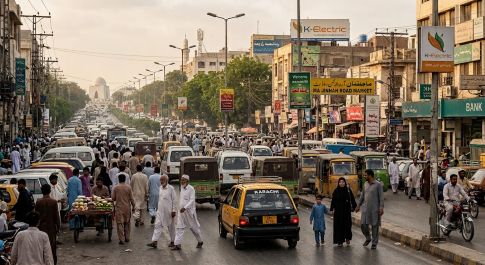
The cab rolled into the traffic. We crawled through the tight streets of Saddar and turned onto M.A. Jinnah Road. At the Numaish intersection, the world grew quiet inside the car. Outside, the city roared. The driver kept his right thumb flat on the steering wheel, right over a large plastic button. Every ten seconds, he pressed it down. A blast like a ship in a fog tore through the glass.
The thumb came down again. The noise shook the dashboard.
I pointed a finger toward the wheel. “That horn is too loud for this car.”
The driver did not turn his head. He stared straight through the cracked windshield, his jaw tight. “Men are deaf here.”
I waved a hand toward the sea of steel outside. “All of them?”
The driver gripped the wheel until his knuckles turned white. “I drive every day. I know.”
By the Old Sabzi Mandi, the road died. The wide road shrank to a single lane of metal boxes stood bumper to bumper, crawling like beetles in the dust.
Suddenly, a group of men stepped from the curb. They did not look left. They did not look right. They walked straight into the path of vehicles.
The driver slammed his foot down. The tires bit the dirt with a hard screech. His thumb pounded the button three times. The horn ripped the air open.
Ahead, three traffic constables stood under a dead streetlight. They watched the smoke rise from the exhaust pipes. They did not move their feet.
The driver rolled his window down an inch. He blew the horn right next to them.
One cop raised a limp palm and shook it once. He looked away.
The driver turned his torso, his eyes wide and dark in the dashboard light. “Watch.”
He let the clutch out. The cab crept into a thick knot of shoppers. The people moved like loose gravel in a stream, drifting back and forth. Two men bumped hard against the front hood of our car. They did not blink. They did not look at the glass.
The driver hit the brake. He held the horn down for five long seconds. The crowd split around the car like water around a rock, faces blank, eyes on the ground.
The driver open palms up. “You see?”
I gave a slow nod. That was my only answer.
The driver gripped the wheel again, his voice dropping an octave. He touched the lobes of both ears with his left hand. “If the car taps their skin, they wake up. They scream. They break the glass. If a man falls under the wheel, they bring the oil. They burn the car. If you stay inside to save your bread, they burn you too.”
The air in the cab grew heavy.
The driver looked sideways, waiting for me to speak. “Is it not better to blow the horn? Is it not better than the fire?”
I kept my mouth shut. Silence filled the space between our seats.
The driver looked back at the road. He nodded to himself. “It is better.”
The cab neared my destination in Gulshan. The neon green of a sweet shop lit the driver’s face.
I reached out and touched the dashboard. “The next U-turn is fine.”
The car stopped by a pile of gravel. I paid him.
I opened the door to the cold night air. One foot touched the pavement.
Behind the glass, the driver’s thumb came down hard. The horn gave one sharp, deafening blast into the dark. It echoed off the concrete walls of the shops.
I watched the cab pull away into the dust, its red taillights small and dim. I could not tell if that last blast was for fun or from a deep fear. The sound stayed in my ears long after the road was clear.
____________________
 Dr. Zaffar Junejo has a Ph.D in History from the University of Malaya. His areas of interest are post-colonial history, social history and peasants’ history. He may be reached at junejozi@gmail.com