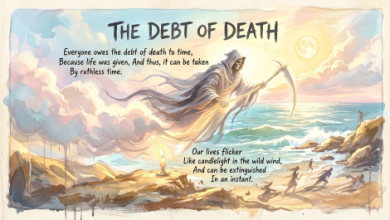
No trace remains of cave cranes or pool-dwelling dragons,
Yet the clear green waters still echo the gibbons’ cries.
Turning back the boat when joy fades holds its own charm,
A thousand years of poetic paths stretch level with the clouds.
Ma Yongbo — Poet & Translator
 Cultural Contribution: The first Chinese scholar to systematically translate post-WWII American postmodern poetry, building a bridge for Sino-American poetic exchange and advancing the transformation of avant-garde Chinese poetry.
Poetic Contribution: Introduced postmodern techniques such as meta-poetry, polyphonic narration, and complex individual experiential writing, revolutionizing the aesthetic and intellectual depth of contemporary Chinese verse.
Shared Heritage: He carries forward the same mission as ancient scripture translators. Bridging civilizations across two languages, he revitalizes native Chinese literature with foreign artistic nourishment and unlocks brand-new expressive horizons for the Chinese language.
Ma Yongbo is renowned for his modern avant-garde poetry and translations of European and American verse. In recent years, he has also composed ancient-style poems and traditional regulated verse. His works weave together the vast, rugged experiences of northern China, the tranquil contemplation of his study in Jinling, landscapes encountered on his travels, and intimate reflections on family life. Meticulously crafted in formal meter and rhyme, his verse carries contemporary thematic threads, free from the stale clichés of old literati, blending ecological lyricism with profound meditations on individual existence.
Sacred Sites of Holy Mountains
Morning bells and evening drums permeate the misty vastness,
Buddhist chants drift with clouds, stretching far across the land.
Mountains gain transcendent grace bathed in the light of Zen,
Temples nestle on sacred peaks, guarding the distant wilderness.
Cut off from mortal chaos, pure serenity abides,
Boundless vows of compassion embrace all living realms.
Thousands of years of merciful grace flow endlessly,
The river’s ethereal beauty nourishes the lotus heart.
_____
Ode to Faxian, Eminent Monk of Eastern Jin
At sixty-five he left the passes for Buddha’s land,
Alone he trekked ten thousand li through wild wastes.
Snow shrouds desert depths with countless hidden perils,
One frail boat braves the churning ocean waves.
He roamed all realms to seek the precept canon,
Left a unique chronicle of distant foreign lands.
Two centuries prior to Xuanzang’s pilgrimage,
His eternal wisdom flame lights boundless space.
______
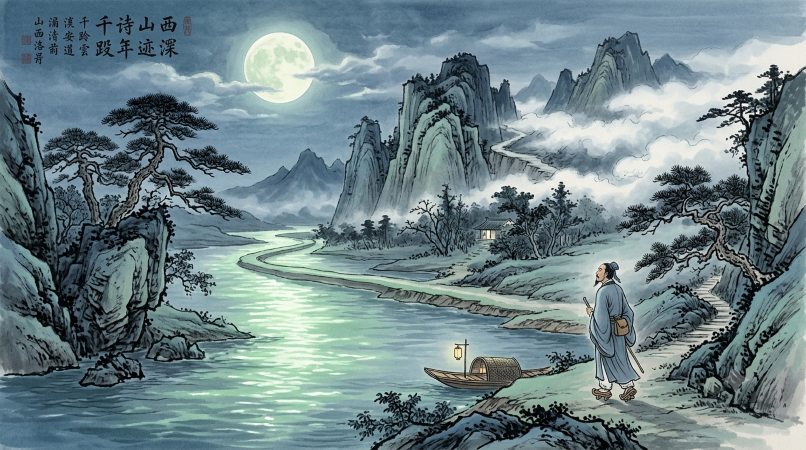
Poetic Traces Along Shan Creek
Moonlight over Shan Creek spills across the long dyke;
Du Fu’s verse of its hidden grace lingers in my mind.
I seek famed peaks to follow Xie’s wooden climbing clogs,
And once braved wintry snows to visit An Dao’s abode by the stream.
No trace remains of cave cranes or pool-dwelling dragons,
Yet the clear green waters still echo the gibbons’ cries.
Turning back the boat when joy fades holds its own charm,
A thousand years of poetic paths stretch level with the clouds.
Notes on Historical Allusions
Xie’s Wooden Climbing Clogs (谢屐):
Xie Lingyun, the founding father of Chinese landscape poetry, invented a special type of wooden clog for mountain climbing while traveling along the Shanying Stream. These later became famously known as “Lord Xie’s Clogs.”
Visiting An Dao’s Abode (访安溪):
This refers to a classic romantic anecdote of the Shanying Stream. On a snowy night, Wang Ziyou took a boat to visit the hermit Dai Kui (courtesy name Andao). Upon reaching Dai’s door, he decided he had fulfilled his desire for the journey and turned back without knocking, perfectly capturing the free-spirited essence of the Wei-Jin era.
Du Fu’s Verse (杜老题):
An adaptation of Du Fu’s lines from his poem A Grand Tour (“Zhuang You”): “The Shanying Stream holds such extraordinary beauty, / A sight so unforgettable, one cannot bear to leave.” (Original Chinese: 剡溪蕴秀异,欲罢不能忘).
_____
Meeting Madam Shen Shuibo After Five Years Apart at Xikou
Five winters of frost have passed since we parted,
We meet at stream-side, all worldly dust swept away.
We weathered the plague’s trials, our bodies still hale and sound,
The grand hall, long quiet, retains its fresh spring glow unimpaired.
Your Buddhist heart grows clearer, your features radiant and fair,
My faith in the Lord broadens the path of all sacred truth.
I hope we may translate the master’s verses side by side,
Two streams of compassionate light to comfort all mortal realms.
_____
Thoughts Strolling Along Shan Creek on My Birthday Morning
The ancient stream traces its source to the vast blue sea,
It has witnessed all mortal paths and every earthly guise.
Through a thousand trials, the heart abides steady,
After a hundred sorrows, the true nature rests tranquil.
I trudge alone through misty valleys, wrestling the void,
Weary yet hearing a sacred voice quietly guiding onward.
Turbid waves roll forth, yet my essence never shifts,
My authentic self-endures, eternally clear and bright.
Dawn, July 17, 2026
Xikou, Fenghua
Postscript
The water’s vein mirrors the vein of the soul. May the years ahead find me like this stream of Shan Creek: no matter how many rocky rapids and mist-shrouded valleys I traverse, I shall forever preserve clarity and freedom, peaceful through every passing year.
_____
Translating Wisdom Through a Thousand Years
Kumarajiva translated sutras to awaken Chan’s first light,
Xuanzang journeyed west to unite all spiritual truth.
Ten thousand scrolls of Sanskrit blend with Chinese grace,
A thousand profound precepts expand the written art’s space.
Western verse crosses far seas to open new poetic realms,
A modern scholar wields his brush to carry on the ancient winds.
Sages of old passed the torch; today their path extends,
Master of two tongues, he lifts the vault of written words.
Comparative Notes on Ancient and Modern Translators
Ancient Sutra Translators:
Kumarajiva & Xuanzang
- Cultural Contribution: They translated Buddhist scriptures from Sanskrit, establishing a complete system of Chinese Buddhism and reshaping the spiritual landscape of the Chinese people.
- Linguistic Contribution: Coined thousands of new Chinese words including ksana (instant), world, karma, and the other shore, enriching the Chinese lexicon and its capacity for philosophical discourse.
- Translation Paradigms: Kumarajiva pioneered fluid free translation, while Xuanzang set the standard for rigorous literal translation, laying the foundational rules for Chinese translation over a millennium.
_____
Ode to Visiting Dai on a Snowy Night: Past and Present
Preface
Long ago, Wang Ziyou rowed a boat through snow to visit Dai Kui. He arrived at Dai’s gate but did not knock, then turned back once his mood passed — this showed the free spirit of scholars in the Wei and Jin dynasties.
Now I travel to see a friend in the hot summer. We visit temples together and share kindness, matching the caring heart of Maitreya Bodhisattva. Though times and scenes differ, our inner goals are the same. I wrote two poems, one about the old tale and one about today, to mark this special meeting.
Poem One: The Old Poem
I float on Shan Creek’s cold water, drawn by sudden joy,
Sailing a lone boat through snow night to find an old friend.
All around the white snow wipes away worldly troubles,
A jug of plain wine washes off all life’s hardship.
I reach his gate but do not knock, following old ways,
I leave once my heart feels full, keeping my true self.
No night holds such timeless charm as this one,
The moon glows round over the Cao’e River’s waves.
I finish poems about seclusion and chant them on and on,
Sitting quietly on my small boat, free from worry.
I come and go as my heart wishes, no fixed plan,
Why bother forcing a meeting with Dai Kui?
____
Poem Two: The New Poem
Ancient wise man sailed snow streams to meet his friend,
I travel through hot summer to visit my beloved.
We talk about our beliefs, forgetting the heavy heat,
We walk through temple halls and eat plain vegetarian food.
You put down your writing brushes to practice zen dance,
I keep writing poems, holding fast to my true thoughts.
We’ll wait till spring when peach and apricot flowers bloom,
And meet again on Xuedou Mountain to read Buddhist texts.
We’ll sit in the long porch, listen to rain and brew tea,
All truths lead us to praise the sacred Buddha.
While my body has not grown old and weak,
We will spread Maitreya’s kindness to all people in the world.
_____
Reflections on a Short Stay at Heshiheyuan
1
Trees stand still, veiled in morning mist;
I brush my robes, gazing low o’er the wild.
Through ages past, one such soul lingers here,
Alone facing the stream of Ziyou’s tale.
2
Cherry blossoms like snow brighten clear skies after rain;
Fine drizzle dims the dust and ash.
Birds fly toward the water’s source,
Wanderers return to where they once came.
3
At dawn I watch mist shroud Mount Shan;
At dusk I gather spring along the Shan Stream.
Deep within the clouds of Xuedou Mountain,
Monks’ grey robes fade through countless turns of time.
4
Early cherry blossoms yet unbloomed, mist cloaks all hills;
I sit quiet in the meditation hall amid clouds and streams.
One calm thought endures through thousands of years, silent and still;
Unaware, flower hues drift soft upon my gown.
Composed March 15–16, 2021,revised 16,2026
Heshiheyuan, Xikou, Fenghua
NOTE:
Heshi Heyuan: A Zen-themed cultural hotel situated by the Shan Stream in Xikou, Fenghua. Close to the Maitreya sacred site on Xuedou Mountain, it features serene meditation and landscape aesthetics.
Ziyou Stream: Derived from the classical tale of Wang Ziyou visiting Dai Kui on a snowy night, it is another name for the Shan Stream. This place has long been a retreat for literati throughout history.
Xuedou: Short for Xuedou Mountain, one of China’s five great Buddhist Mountains and the sacred shrine of Maitreya Buddha. It is the core Zen scenic spot of Xikou.
_________________