The insightful review of ‘Duet of Bookmarkers’ explores the captivating contrast between Maki Starfield’s postmodern, fluid verses and Yang Geum-Hee’s grounded, traditional lyricism. Together, the review illustrates how these two distinct poetic voices beautifully converge to form a harmonious dialogue of warmth and mutual brilliance.
Dr. Siyoung Doung
As the Chao Phraya River flowing through Bangkok seems to pour into the poetry of Maki Starfield, I too find myself flowing into her poems.
In her poetry, even profound and weighty contemplation never feels heavy. It carries the wings of lightness. This quality is reflected in expressions such as Just Because and Lightness, which vividly embody the spirit and mindset of our age.
 Her poems also exhibit many characteristic features of postmodernist writing, including fantasy, the creation of striking images through compound expressions that bring together entirely contradictory signifiers, the deliberate blurring of semantic unity, and Jacques Derrida’s concepts of deconstruction and dissemination.
These qualities resonate with Buddhist and Zen perceptions of reality, both of which embrace a deconstructive worldview. Her poetry offers readers the pleasure of the text while expanding, together with them, the range of meanings that poetry can generate. Its ambiguity becomes the fertile ground from which this abundance continually grows.

‘Love, Dark as a Night on the Chao Phraya’ constructs a parallel sequence of fresh similes—like the night, like a gaze, like existence, like a prisoner, like the Angel of Death, like a human being—thereby generating a distinctive poetic rhythm and a richly layered network of imagery.
The “Dark love” that evokes the chaos preceding life itself invites us to gaze into the very source of existence. As finite beings, both love and mortality emerge through the opposing signifiers of love and death, performing a tragic emotional symphony. Although such a phenomenon is familiar from Romantic literature, here it is read not as a manifestation of literary -ism, but as an expression of love and death as inseparable conditions of finite existence.
The “Dark Love” that appears in the opening movement of the poem and the “long waves of black hair” at its conclusion form another parallel. This corresponding imagery at the beginning and the end creates a firm structural unity. It is a classic compositional pattern rooted in the long tradition of poetry. The open-work ending, which deliberately erases closure in much contemporary poetry, is absent here.
One can clearly observe Maki Starfield’s poetic strategy of building an axis of choice while moving freely between tradition and modernity.
‘Love, Dark as a Night on the Chao Phraya’ eloquently demonstrates both the techniques and structural characteristics of her poetry. In this sense, it serves as a kind of formula for reading the rest of Maki Starfield’s poetic texts.
In ‘Whispers of Words (Resonance with the Squall)’, whose lively rhythm invites a joyful skipping movement through the poem, and in ‘Here, Too (Dedicated to Sunthorn Phu)’, which reveals a spiritual encounter with Thailand’s national poet Sunthorn Phu, one encounters an intimate communion of spirits alongside vividly tangible moments of individual reality. My attention repeatedly returns to the signifier of “shadow,” which functions as a dominant code throughout these works.
Likewise, “guided only by a first snapshot” summons a primordial past that precedes memory. It unfolds the nihilistic playfulness of mortal existence, where discourses such as “Risk was only a game /Desire was only an act” open an infinite field of speech. Listening to this boundless discourse becomes an artistic pleasure.
This language, forever postponing the final period, overflows within my heart. It will continue to cross endlessly beyond the boundaries of the printed page.

Through the gateway of Professor Yang Geum-Hee‘s poem ‘The Light that Illuminates the World’, we enter her poetic world. Her poetry is declarative and traditional, consistently maintaining the unity of meaning throughout the text. Like traditional lyric poetry, its signifiers and compositional techniques strive for clarity. It is never obscure and demands no strenuous tension from the reader.
The central thesis running through Yang Geum-Hee’s poetry may be understood as the question of existence itself. Her poems continually articulate what Martin Heidegger described as Entwurf (projection toward possibility) within the existential condition of Geworfenheit (thrownness), a condition into which one is cast without choice.
In the poem mentioned above, darkness and light function as signifiers within a binary opposition, generating an existential conflict. As the code that mediates this conflict, “prayer” emerges as the mediator.
In ‘The Power Within Me’, amid the fierce winds symbolizing life’s hardships, the rainbow appears as the mediator. Likewise, in ‘Under the City Moonlight’, within a similar structural pattern, the natural image of the moon assumes the role of mediator. This recalls the mediating role of natural objects found in Sijo, Korea’s traditional poetic form. Together, these poems form a coherent modeling system through their interrelated structures. ‘The Wind and Water Do Not Fight’ may likewise be read as another variation of this same underlying textual model.
Such recurring patterns constitute one of the defining structural characteristics of Yang Geum-Hee’s poetry. As Roman Jakobson observed, repetition itself creates structure.
The poetry of Maki Starfield and Yang Geum-Hee stands on opposite sides in terms of structure, technique, and poetic conception. Yet, gathered together within a single volume and walking the shared artistic path of poetry, they shine brilliantly as the light of poems facing one another with warmth and mutual regard.
_______________
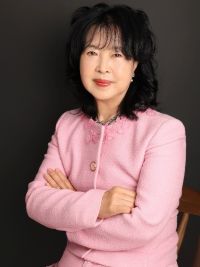 Dr. Siyoung Doung graduated from the Department of Korean Language and Literature at Dongguk University and earned a Ph.D. in Korean Language and Literature from Hanyang University. She further expanded her academic pursuits by studying humanities at Regensburg University in Germany. Her teaching career includes positions as a professor at Korea Tourism University in Korea and Jilin University of Finance and Economics in China. Her literary journey began in 2003 with her poetry debut in the literary magazine Dacheung. Since then, she has published numerous poetry collections, including Future Hunting, In Search of a Strange God, The Phone Call from God, The Eyes of November, The Carnival of Time (Anthology), Was It You, Was It Me, or Was It Longing?, The Scent of Secrets, Aria of Everyday Life, The River Flowing Under the Pen, The Magic Letters, and The Horizon Never Gets Wet. In addition to poetry, Doung has contributed significantly to literary research with works such as Roh Cheon-myung’s Poetry and Semiotics, Korean Literature and Semiotics, and Semiotics of Modern Poetry. Her exploration of literature extends into travel writing, with essay collections like Encountering Culture Through Travel and Encountering Travel Through Literature. Her literary excellence has been recognized with numerous prestigious awards, including the Park Hwa-mok Literary Award (2010), Poetry and Poetics Young Poet Award (2011), the Grand Prize at the Korean Buddhist Literature Awards (2018), the 32nd Dongguk Literary Award (2019), the Yeongrang Literary Award for Criticism (2020), and the 7th Woltan Park Jong-hwa Literary Award by the Korean Writers’ Association (2021). Most recently, she received the Literary Youth Work Award in 2024. In recognition of her contributions to literature, she was also a recipient of a creative grant from the Arts Council Korea in 2005. Dr. Doung serves as the 5th President of the Korean Association of World Literature and resides in Seoul with her husband, a former university professor.