A community of boatmen robbed the most feared conqueror of his age — and paid for it three years later, when he built a navy just to find them.
Sindhi Civilizational & Historical Research
By: Dr. Nisar Ahmed Solangi
In the winter of 1026, somewhere in the marshes where the Indus breaks apart into a hundred sluggish channels before reaching the sea, a column of exhausted soldiers was dying by the roadside. They were not dying in battle. They were dying of thirst, of fever, of the sheer punishment of the Sindh desert — and they were carrying, on the backs of thousands of camels, one of the largest hoards of looted treasure the subcontinent had ever seen. Their commander was Mahmud of Ghazni, by then the most feared man between Baghdad and Delhi. And watching them stagger through the delta, from behind the reeds, were the people who lived there.
A Sultan Humiliated
Mahmud made it home to Ghazni with his life and most of his treasure. But something had cracked. For the first time, a scattered, folk community with non-dynastic, without capital, and no standing army had done what king after king had failed to do — bloodied him on the retreat, and gotten away with it.
He could not let his final chapter in India be written by a people he had never even bothered to conquer.
He could not let that stand. Late in 1027, in what chronicle tradition remembers as his seventeenth and last campaign into the subcontinent, Mahmud marched back — not toward another king, another fort, another temple, but toward the river itself.
 An Empire Builds a Navy
What he did next was, for a man who had built his entire reputation on cavalry, almost bizarre. Arriving at Multan, Mahmud realized his horsemen were useless against people who lived on the water. So he built a navy — his first and only one — from scratch.
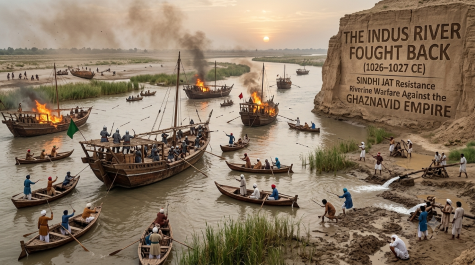
Chroniclers describe fourteen hundred purpose-built warboats, each armed with three iron spikes, one at the prow to ram and split an enemy hull, two along the sides to keep boarders off. The gunwales were raised and pierced with holes so archers could fire while staying under partial cover. Each boat carried about twenty men — bowmen, spearmen, and soldiers armed with fire-projectiles the sources simply call “rockets.”
The Jats, for their part, did not run. They moved their families and their stored wealth to a fortified island in the middle of the river, and put together a fleet of their own — somewhere between four and eight thousand small boats, according to the chroniclers, light and quick but built of reed and unarmored wood.
By the Numbers
1,400 — Ghaznavid warboats built at Multan
3 — iron spikes on each Ghaznavid vessel
~20 — soldiers per boat
4,000–8,000 — Jat vessels, by chroniclers’ varying counts
1030 CE — Mahmud’s death, three years after this campaign
These figures come chiefly from Ferishta’s account, written some six centuries after the battle from earlier tradition — treat them as the chronicle record, not an audited count.
The Trap on the River
It was, on paper, no contest — and Mahmud made sure it stayed that way. Before a single boat touched the water, he lined both banks of the Indus with cavalry and war elephants, sealing the channel so the Jat fleet had nowhere to run once the fighting started. It was less a naval battle than an execution with a river for a killing floor.
When the fleets met, the iron spikes did exactly what they were built to do — punching through hull after hull of unarmored reed boats, spilling fighters into the water. Those who kept afloat were met with arrows and fire. Those who tried to swim for the banks ran straight into the cavalry waiting for them there. The chronicle record describes what followed as closer to a massacre than a battle: most of the Jat fighters drowned or were cut down, and the island refuge — with its women, children, and hidden treasure — fell without a fight.
A Costly Victory
Mahmud got his revenge, and he recovered what had been taken from him the year before. But the river campaign seems to have cost him something he couldn’t recover. Chroniclers place the onset of the illness that would eventually kill him — generally described as malarial — right around this 1027 expedition. He returned to Ghazni already in decline, and died on 30 April 1030, three years almost to the day after his boats went into the water at Multan.
How much wealth changed hands across the whole affair is harder to pin down than popular retellings suggest. The figure most often repeated for the Somnath treasure — twenty million dinars — comes from Ferishta, writing in the early 1600s, six centuries after the fact; a handful of modern accounts put the real number closer to a tenth of that. No contemporary Ghaznavid ledger survives to settle it. What survives instead is the story itself, and the story is the point.
 What the River Remembers
Ghaznavid court chroniclers filed the 1027 campaign away as one more pacification of unruly border tribes — a footnote to the real business of temples and thrones. Sindh remembers it differently. In the region’s own telling, this was the moment a community with no army, no fort, and no king looked at the most feared conqueror of the age and decided the river belonged to them, not to him — and made him pay in gold, in humiliation, and, in the end, perhaps in years of his own life, for disagreeing.
He built an entire navy to answer them. That, more than any tribute or title, is the measure of what the “Sindhi Jats” managed to do with nothing but boats built for shallow water and a river they knew better than anyone who came to take it from them.
A note on sources: the numerical details in this account — fleet sizes, crew counts, the Somnath treasure figure — derive chiefly from Ferishta’s early-seventeenth-century Tarikh-i-Firishta, itself compiled from earlier tradition, supplemented by Gardizi’s near-contemporary Zayn al-Akhbar and the Elliot & Dowson translations of the medieval chronicle corpus. Where the sources disagree — as they do on the exact scale of the treasure, and on which Rajput ruler forced Mahmud’s desert retreat — this piece has favoured the most widely repeated tradition while noting, where it matters, that certainty is not available.
Read: Lessons from the Indus Valley Civilization
__________________
Dr. Nisar Ahmed Ali Nawaz Solangi is a distinguished Public Health Specialist with over 28 years of experience in primary healthcare, health management, and policy development. Throughout his career, he has served in leadership capacities, He holds MBBS from the University of Sindh and a Master of Public Health from Griffith University, Australia. He is a dedicated polymath committed to the intersection of ancient civilization and emerging technology. He is deeply engaged in the study of the Indus Valley Civilization—focusing on its maritime history, trade networks, and egalitarian governance. Currently based in Saudi Arabia, Dr. Solangi is a tireless advocate for the digital preservation and global dissemination of the Sindhi language and culture. He is actively involved in pioneering initiatives on social media” Our Digital World”. By bridging the gap between historical heritage and digital innovation, he aims to create a new paradigm for cultural representation in the AI era.