The Arctic Wind Preserves Lofoten’s Timeless Stockfish Tradition
A journey through Norway’s picturesque Lofoten Islands reveals how centuries-old stockfish traditions still thrive without modern machinery. Powered purely by Arctic winds and Viking ingenuity, this sustainable process turns seasonal cod into a globally celebrated delicacy.
By Abdullah Usman Morai | Sweden
An encounter with Norway’s centuries-old fish-drying tradition reveals how Arctic winds, Viking heritage, and coastal communities continue to produce one of the world’s most celebrated seafood delicacies.
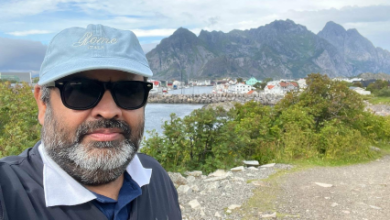
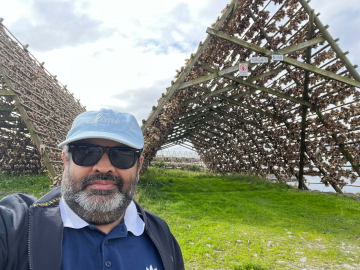
During our recent journey through the breathtaking Lofoten Islands in northern Norway, my friend, Dr. Imran Jamali, and I came across a sight that immediately captured our curiosity. Across the coastal villages stood enormous wooden structures resembling giant open-air cathedrals. From a distance, they looked like rustic sculptures against the dramatic backdrop of jagged mountains and the Norwegian Sea. As we drove closer, we realized they were covered with thousands upon thousands of fish hanging in neat rows, gently swaying in the cool Arctic breeze.
We had arrived in the heart of Lofoten’s centuries-old stockfish industry.
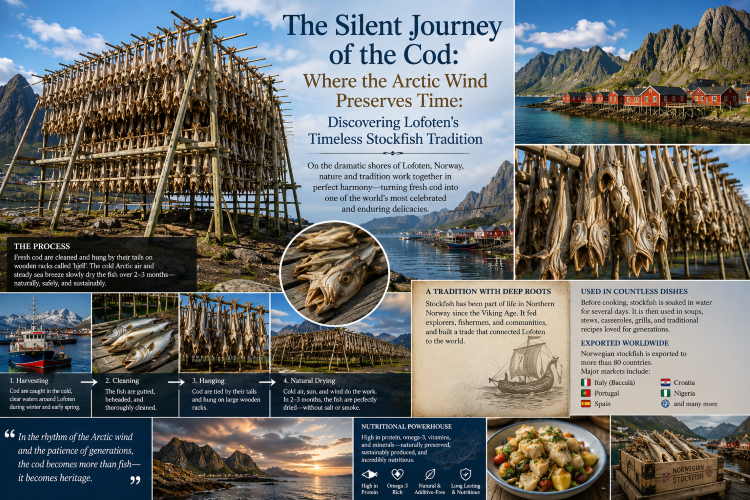 For travelers unfamiliar with Norway’s northern coast, the sight can be quite surprising. Why would anyone leave fish hanging outdoors for months? Yet this simple, natural process has sustained communities here for over a thousand years and has made Lofoten famous across the globe.
Stockfish is made primarily from Atlantic cod that migrate every winter from the Barents Sea to the waters surrounding Lofoten to spawn. Between February and April, fishermen harvest these fish at their peak condition. After being cleaned and beheaded, the cod are tied together by their tails and hung on large wooden drying racks, known locally as hjell.
Nature then takes over.
Unlike many preserved foods that rely on salt, smoke, or artificial drying, stockfish is created using nothing more than the cold Arctic air, steady coastal winds, and the unique climate of northern Norway. Over the course of two to three months, the fish slowly loses most of its moisture while retaining its nutrients. The cool temperatures prevent spoilage, while the constant breeze ensures a gradual and even drying process. It is one of the world’s oldest and most environmentally friendly methods of food preservation.
Standing beneath these towering racks, Dr. Imran and I could not help but admire the simplicity of the process. No modern machines were humming, no industrial smoke, and no chemical preservatives. Instead, there was only nature quietly performing a task that generations of Norwegians have trusted for centuries.
 The history of stockfish stretches back to the Viking Age. Long before refrigeration existed, dried cod became an ideal food for sailors, explorers, and traders because it was lightweight, highly nutritious, and could be stored for years without spoiling. Viking ships carried stockfish on their long voyages across the North Atlantic, helping fuel exploration and trade.
During the Middle-Ages, stockfish became one of Norway’s most valuable exports. Merchants from across Europe eagerly purchased it, particularly from the Hanseatic traders based in Bergen. The trade brought prosperity to northern Norway and helped establish Lofoten as one of Europe’s most important fishing regions. Even today, fishing remains deeply intertwined with the culture and economy of these islands.
 Modern technology has transformed many industries, but the traditional production of stockfish remains remarkably unchanged. While hygiene standards and quality controls are now much stricter, the essential method still depends on the Arctic climate rather than mechanical dryers. In many ways, the landscape itself remains the most important ingredient.
Today, Norwegian stockfish is exported to numerous countries worldwide. Italy is perhaps its most famous market, where it is used in classic dishes such as baccalà. It is also highly valued in Portugal, Croatia, Spain, Nigeria, and several other countries. In many places, stockfish is regarded as a delicacy and plays an important role in traditional cuisine. Before cooking, it is soaked in water for several days to restore its texture before being transformed into soups, stews, casseroles, or grilled specialties.
Besides its culinary value, stockfish is also a nutritional powerhouse. Rich in high-quality protein, omega-3 fatty acids, vitamins, and essential minerals, it provides excellent nourishment while remaining naturally preserved without additives.
 As visitors, however, what fascinated us most was not merely the fish itself but the harmony between people and nature. The drying racks have become as much a part of Lofoten’s landscape as its dramatic mountains, emerald waters, and picturesque red fishermen’s cabins. They remind visitors that long before technology simplified our lives, human ingenuity often meant learning to work with nature instead of against it.
Our encounter with the stockfish racks turned out to be far more than an unexpected sightseeing stop. It became a lesson in history, sustainability, and cultural heritage. In an age where speed and convenience dominate food production, Lofoten’s stockfish tells a different story—one of patience, tradition, and trust in the rhythms of nature.
As Dr. Imran Jamali and I continued our journey through the islands, the towering wooden frames gradually disappeared in our rearview mirror. Yet they left behind something far more lasting than photographs. They reminded us that some of the world’s greatest traditions endure not because they resist change, but because they continue to prove that the simplest methods are sometimes the most extraordinary.
Read: Across the Arctic Circle
________________
Abdullah Soomro, penname Abdullah Usman Morai, hailing from Moro town of Sindh, province of Pakistan, is based in Stockholm Sweden. Currently he is working as Groundwater Engineer in Stockholm Sweden. He did BE (Agriculture) from Sindh Agriculture University Tando Jam and MSc water systems technology from KTH Stockholm Sweden as well as MSc Management from Stockholm University. Beside this he also did masters in journalism and economics from Shah Abdul Latif University Khairpur Mirs, Sindh. He is author of a travelogue book named ‘Musafatoon’. His second book is in process. He writes articles from time to time. A frequent traveler, he also does podcast on YouTube with channel name: VASJE Podcast.