Jeju does not have three things: thieves, gates, and beggars.
By George Sadiq | New York
My journey to Jeju was a remarkable experience — one that felt like stepping into a different world. I travelled with a group participating in a major international event. Our flight arrived late at night amid heavy rain, and darkness concealed the beauty of the island during our drive to the hotel.
The next morning, however, revealed an entirely different scene. As I stepped onto the balcony, I was greeted by a breathtaking landscape. The overnight rain had washed the island clean, leaving the trees, shrubs, and roads glistening with freshness. A gentle drizzle still lingered in the air, adding to the serenity of the surroundings.
 Located off the southern coast of South Korea, Jeju is a small self-governed island often described as a paradise on earth. Widely known as the “Hawaii of South Korea,” the island attracts millions of tourists every year because of its natural beauty, peaceful environment, and unique cultural character. Lush green hills, dense vegetation, and scenic roads create an atmosphere of complete tranquility, where even the chirping of birds and the gentle splashing of flowing brooks can be clearly heard.
Beyond its scenic beauty, the values and honesty of the island’s residents leave a lasting impression on visitors. During the international event attended by nearly 10,000 participants from around the world, the island initially experienced some logistical challenges as it had never hosted an event of such magnitude before. Through the event’s group communication system, reports began pouring in about participants leaving behind valuable belongings in taxis — including laptops, wallets containing foreign currency, and suitcases.
 Soon afterward, however, messages also began arriving confirming that the missing belongings had been safely returned by local taxi drivers, who made efforts to locate the rightful owners. This remarkable display of honesty was witnessed and appreciated by thousands of international visitors.
The island’s sense of security and good governance was reflected when one of the governing officials of the event made a presentation and claimed that “Jeju has no thieves, no gates, and no beggars.” Visitors travelling through residential areas at night can easily observe this sense of trust and openness. Many homes have only mesh screen doors and windows, through which families can be seen dining together or watching television. Most houses and apartment buildings have no boundary walls or gates, offering a rare glimpse into a society where people live without fear of theft or intrusion.
 The island is also home to several natural wonders and UNESCO-recognized heritage sites. Among the most famous is Seongsan Ilchulbong, a volcanic crater formed by an underwater eruption thousands of years ago. Spanning approximately three square kilometers, the crater has been exceptionally well preserved. Its crown-like shape has earned it the local nickname “Crown of the Earth.” As one of Jeju’s most visited attractions, it draws tourists from across the globe. Reaching the summit requires considerable effort, but those who make the climb are rewarded with spectacular panoramic views.
Jeju’s underground lava caves are another fascinating attraction. The surfaces within these tunnels clearly reveal traces of ancient lava flows that once moved toward lower ground. The temperature inside remains noticeably cooler than the surface outside, and visitors can physically experience the rough texture of hardened lava beneath their feet.
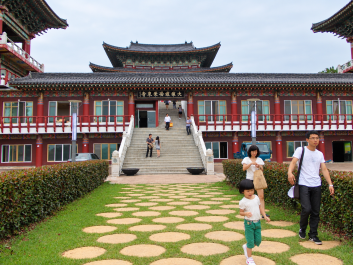
Another notable landmark is Yakcheonsa Temple, the largest Buddhist temple on the island. Surrounded by peaceful natural scenery, the temple is an architectural masterpiece adorned with intricate interior paintings and magnificent golden statues. The calm atmosphere of the temple offers visitors both spiritual comfort and artistic inspiration.
Jeju’s remarkable natural wonders have contributed to the island earning UNESCO World Heritage recognition, further enhancing its global reputation as one of the world’s most beautiful destinations.
For anyone seeking natural beauty, tranquility, good governance, and a glimpse of an almost utopian way of life, Jeju Island is truly a perfect destination.
Read: Nests of Birds – A Poem from Jeju Island of Korea
________________
 George Sadiq is a freelance travel writer and photographer based in New York.