Responsible Citizens, Tolerant Governments and the Real Purpose of Digital Accountability
Let the pressure cooker release its steam safely. Let citizens speak responsibly and let the state listen patiently. The goal should not be to eliminate disagreement, but to ensure that disagreement does not turn into violence, hatred, or injustice.
By Abdullah Usman Morai | Sweden
We live in an age when information travels faster than ever. A message written in one corner of the world can reach millions of people within seconds. A photograph, video, voice recording, or social media post can spread like wildfire, crossing borders and reaching people before anyone can verify its authenticity. This extraordinary power of communication has connected humanity in unprecedented ways, but it has also brought new responsibilities for individuals, institutions and governments.
In this fast-paced digital era, sharing or forwarding information without checking its source is not merely an innocent mistake. It can be an act of irresponsibility that damages reputations, creates fear, spreads hatred, and sometimes puts people’s lives at risk. A little caution before pressing the share button can prevent considerable harm.
Unfortunately, many social media users behave as though being the first to share something is more important than knowing whether it is true. An unverified allegation, an edited video, a misleading headline or a fabricated announcement may circulate widely before the truth catches up. By the time a correction appears, the damage may already have been done.
We must therefore develop a culture in which verification is considered a sign of intelligence and responsibility. Before sharing information, we should ask three simple questions: Is the source reliable? Has the information been independently confirmed? Could sharing it cause unnecessary panic, hatred or unrest?
Even verified information requires judgement. There may be circumstances in which publishing sensitive details, private information, or inflammatory material could put individuals or communities in danger. Freedom of expression is an important right, but exercising that freedom responsibly is equally important. The objective should not be to silence people; it should be to prevent avoidable harm while protecting open discussion.
The State Must Also Learn to Tolerate
Responsibility, however, cannot be demanded from citizens alone. Governments and state institutions have an equally important obligation to demonstrate patience, restraint and accountability.
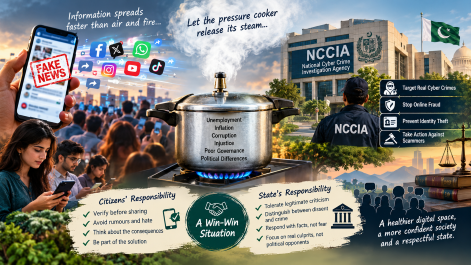
Imagine social media as a pressure cooker. In everyday life, people experience frustration because of unemployment, inflation, corruption, injustice, poor public services and political disagreements. They need legitimate ways to express their feelings, criticize decisions and demand improvements. Social media has become one of the most accessible platforms for releasing this accumulated frustration.
A pressure cooker is designed to release excess pressure through its safety mechanism. If that mechanism is blocked while pressure continues to build, the consequences can be dangerous. Society is not literally a pressure cooker, of course, but the comparison offers an important lesson: suppressing every expression of public anger does not necessarily eliminate dissatisfaction. It may simply drive it underground, where grievances can grow without constructive discussion.
A government that responds to every criticism with intimidation, surveillance, or legal threats risks losing public trust. Criticism is not automatically disloyalty, and disagreement does not necessarily amount to hostility towards the state. Sometimes, a harsh post reflects genuine frustration with a public problem. At other times, it may be unfair, exaggerated or offensive. These situations should be assessed according to evidence, context and the law, rather than the personal sensitivities of those in power.
Of course, freedom of expression is not an unlimited license to threaten people, incite violence, defraud citizens or deliberately spread harmful falsehoods. A democratic society needs clear laws and fair enforcement. The essential distinction is between legitimate criticism and conduct that genuinely violates the law.
NCCIA: Accountability or another Instrument of Pressure?
In Pakistan, the establishment of the National Cyber Crime Investigation Agency (NCCIA) has brought renewed attention to the question of how cybercrime should be investigated and controlled. A specialized institution can play a valuable role in addressing online fraud, identity theft, harassment, impersonation, blackmail and other forms of digital abuse.
Thousands of ordinary people can suffer from fake social media accounts, fraudulent foreign university admission offers, deceptive employment advertisements, financial scams and the misuse of their personal information. Students hoping to study abroad may lose their savings to fraudulent agents. Families may be deceived by impersonators, while individuals can find their names and photographs misused without their consent.
These are real problems that deserve serious attention. People need an institution that listens to their complaints, investigates evidence professionally and helps protect them from digital criminals.
Yet an important concern remains: can such institutions operate independently, fairly and transparently? Pakistan’s history of political confrontation and selective accountability provides reasons to insist on strong safeguards. Whenever investigative powers are used selectively against political opponents, journalists, activists or ordinary citizens who criticize those in authority, public confidence suffers.
The purpose of a cybercrime agency should be to investigate actual offences, not to protect powerful people from embarrassment or punish citizens for expressing unwelcome opinions. Every complaint should be assessed on its merits. Investigations should follow the law, respect due process and provide accused individuals with a fair opportunity to defend themselves. Independent oversight, transparent procedures and remedies against abuse are essential.
The real test of any institution is not how many people it summons or how many critical posts it removes. Its success should be measured by how effectively it protects citizens, pursues genuine offenders and applies the law without discrimination.
A Win-Win Approach
The way forward requires responsibility from both sides.
Citizens should verify information before sharing it, avoid spreading rumours and refuse to participate in online harassment or campaigns of hatred. If a claim cannot be confirmed, it is better to wait than to become an unwitting source of misinformation.
At the same time, the state should distinguish between criticism and criminal conduct. It should tolerate peaceful disagreement, allow citizens to question public decisions and protect their right to express frustration within the framework of the law. When information is false, official institutions should respond with evidence, timely clarification and transparent communication rather than reflexive punishment.
Newly established agencies should priorities the people who exploit digital platforms for fraud, blackmail, identity theft and organized deception. Their resources should address genuine public needs instead of becoming instruments for settling political scores.
Ultimately, a healthy digital society cannot be built through fear alone. It requires trust, education, accountability and mutual restraint. Citizens must understand that every forward carries responsibility, while governments must understand that every attempt to silence legitimate criticism carries a cost.
Let the pressure cooker release its steam safely. Let citizens speak responsibly and let the state listen patiently. The goal should not be to eliminate disagreement, but to ensure that disagreement does not turn into violence, hatred, or injustice.
When citizens verify before sharing, and institutions investigate without discrimination, both sides benefit. That is the foundation of a healthier online environment, a more confident society, and a state that earns respect not by silencing its people, but by serving them fairly.
Read: Thari Youth Beyond The Borders
_____________
 Abdullah Soomro, penname Abdullah Usman Morai, hailing from Moro town of Sindh, province of Pakistan, is based in Stockholm Sweden. Currently he is working as Groundwater Engineer in Stockholm Sweden. He did BE (Agriculture) from Sindh Agriculture University Tando Jam and MSc water systems technology from KTH Stockholm Sweden as well as MSc Management from Stockholm University. Beside this he also did masters in journalism and economics from Shah Abdul Latif University Khairpur Mirs, Sindh. He is author of a travelogue book named ‘Musafatoon’. His second book is in process. He writes articles from time to time. A frequent traveler, he also does podcast on YouTube with channel name: VASJE Podcast.