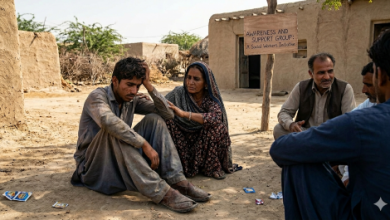
Sujawal faces severe socio-economic, environmental, and public health crises. From deep-seated poverty and rampant malnutrition to a crumbling education system, the region requires urgent, coordinated intervention to break its cycle of hardship.
- Disasters, poverty, and systemic neglect have turned Sindh’s Sujawal district into the epicenter of a growing humanitarian emergency. Facing extreme food insecurity, widespread drug use, and falling educational indicators, the district stands in desperate need of sustained development and governance.
By Abdul Qayum Soomro
Sujawal, carved out from Thatta as the 28th district of Sindh in 2013, is one of the province’s youngest and most vulnerable districts. It comprises four administrative talukas: Sujawal, Mirpur Bathoro, Jati, and Shah Bundar, with its headquarters at Sujawal.
Sujawal’s geography plays a major role in shaping its socio-economic conditions. A large portion of its land is scattered and rural, with nearly 70% of the population in the Jati and Shah Bundar talukas living in widely dispersed settlements. This scattered geography creates major challenges for infrastructure development, service delivery, and access to essential amenities like healthcare, education, and markets. Despite its rich historical and cultural heritage, the district faces complex socio-economic and environmental struggles.
The district is also one of the most disaster-prone areas in Sindh. Located at the tail-end of the Indus River system and near the Arabian Sea coastline, Sujawal is frequently exposed to cyclones, riverine floods, droughts, and famines. These recurring disasters cause immediate destruction while driving long-term socio-economic decline. Homes, crops, and livelihoods are repeatedly wiped out, making recovery increasingly difficult for already impoverished communities.
Food insecurity is one of the most visible outcomes of this economic decline. The proverb “Faith fades where hunger dwells” captures the reality of many households in Sujawal, where daily access to sufficient and nutritious food is uncertain, and achieving a balanced diet remains a distant dream. All three pillars of food security—availability, access, and utilization—are severely compromised. While food is physically available, access is restricted by deep poverty and inadequate infrastructure. Furthermore, public awareness regarding proper nutrition and balanced diets remains minimal.
According to recent media reports, over 70% of Sindh’s population lives below the poverty line. In Sujawal, the situation is even more alarming: data from the Planning and Development Department’s Research and Training Wing reveals that over 80% of Sujawal’s residents live below the poverty line, making it one of the poorest districts in the province. This extreme poverty leaves many families unable to afford two meals a day, let alone a diet that meets basic nutritional needs.
Although Sujawal is primarily an agricultural area, low crop yields, inequitable water distribution, limited market access, and poorly maintained canals and drainage systems worsen the situation daily.
The consequences of poverty and food insecurity are most visible in the district’s health and nutrition indicators. High rates of malnutrition among women and children fuel a vicious cycle of illness, disability, and premature death:
Child Mortality: Over 15% of children in Sujawal die before reaching the age of five due to preventable causes linked to poverty, malnutrition, and poor healthcare access.
Maternal Health: More than 50% of women and adolescent girls are anaemic, significantly increasing the risk of complications during pregnancy and childbirth. The maternal mortality ratio stands at 230 deaths per 100,000 live births—higher than the Sindh provincial average of 224.
Malnutrition: Among children under five, 56% suffer from stunting (chronic malnutrition), 30% suffer from wasting (low weight for height), and 9% suffer from severe acute wasting—a life-threatening condition. Over 50% of women also suffer from chronic malnutrition.
These figures signal a severe public health emergency that threatens the district’s human capital and future development.
Education, a fundamental tool for breaking the cycle of poverty, is similarly in crisis. Out of 1,666 schools in the district, over 500 are temporarily closed and more than 400 are permanently shut down. A significant number of operational schools consist of single-room structures, many of which are illegally used as Otaqs (guest houses) by local influentials rather than for teaching. As a result, Sujawal’s literacy rate stands at a shockingly low 22.9%—less than half of Sindh’s provincial average of 48.8%.
These overlapping challenges are further compounded by gender inequality and cultural barriers. Women, who make up nearly half the population, face systemic discrimination that restricts their access to education, healthcare, property, and decision-making. Early marriage, low literacy, restricted mobility, and heavy domestic workloads severely curtail their opportunities for advancement. Uneducated women are also less likely to seek antenatal care, maintain a healthy diet, or adopt family planning methods—leaving both mothers and children vulnerable to chronic health issues.
Adding to these crises is the widespread drug trade across Sujawal. An estimated 80% of the population uses harmful substances, particularly gutka, Z21, and JND. This epidemic drives severe economic hardship alongside devastating health outcomes:
Mouth cancer cases and related death rates have surged rapidly.
The consumption of gutka and JND by pregnant women has exacerbated severe anaemia, leading to higher maternal and infant mortality rates.
The crisis in Sujawal demands urgent, prioritized, and coordinated action. Government agencies, NGOs, and civil society must collaborate to implement integrated programs linking food security, healthcare, nutrition, disaster risk reduction, education, and livelihood support. Efforts must focus on strengthening basic infrastructure, building community resilience, and addressing key systemic issues in an inclusive, sustainable manner. Strict monitoring and accountability by the district administration are essential to ensure transparency, efficiency, and real, measurable impact for the people of Sujawal.
__________________