

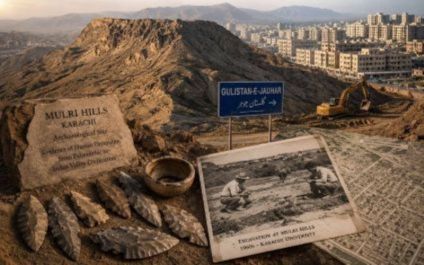
Scientific archaeological research tells us that human beings were living in the Karachi region at least 12,000 years ago.
- Long before there were roads, ports, buildings, kingdoms or even agriculture, prehistoric communities had already found a home among the limestone ridges now known as the Mulri Hills. Their lives were simple, but their existence marks the earliest known chapter of Karachi’s human history.
By Ramesh Raja
Every city has a story. Some stories are written in books, some are preserved in monuments, and others remain buried beneath the ground, waiting to be rediscovered. Karachi, Pakistan’s largest city and economic heart, is no exception. Most of us believe Karachi’s history began with the fishing village of Kolachi a few centuries ago, followed by British rule and its transformation into a modern port after 1947. While these are important chapters, they are not the beginning of Karachi’s story.
 Scientific archaeological research tells us that human beings were living in the Karachi region at least 12,000 years ago. Long before there were roads, ports, buildings, kingdoms or even agriculture, prehistoric communities had already found a home among the limestone ridges now known as the Mulri Hills. Their lives were simple, but their existence marks the earliest known chapter of Karachi’s human history.
Sadly, this remarkable heritage remains unknown to most Karachiites. Even more unfortunate, much of the archaeological landscape has disappeared beneath modern urban development. Yet the discoveries made over the past several decades continue to remind us that beneath the concrete of a bustling metropolis lies one of Pakistan’s oldest documented human landscapes.
 Karachi Before History
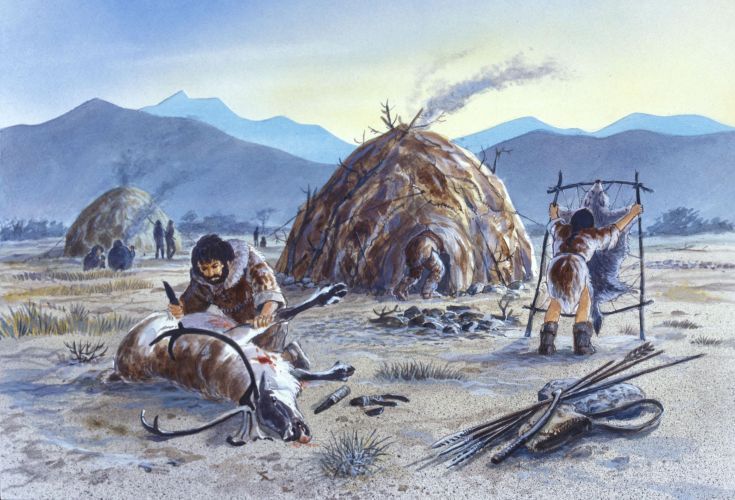
To understand why prehistoric people settled in Karachi, we must imagine a landscape very different from the one we see today.
Around twelve thousand years ago, the world was emerging from the last Ice Age. Sea levels, river channels and coastlines were different from those of the present day. The lower Indus region consisted of an extensive deltaic and estuarine environment shaped by changing channels of the mighty River Indus. The Lyari and Malir rivers flowed across the plains before meeting the Arabian Sea, while freshwater springs emerged from limestone formations in several places.
The Mulri Hills formed part of a ridge extending through what are today Drigh Road, Hill Park, Gulistan-e-Jauhar and towards Gizri. These elevated limestone outcrops overlooked rivers, wetlands and the coast, making them ideal locations for early human occupation.
For hunter-gatherers, survival depended upon water, food and raw materials. The Mulri Hills offered all three. Freshwater was available nearby, the surrounding plains supported wildlife, the Arabian Sea provided fish and shellfish, and the limestone contained high-quality flint and chert from which sharp stone tools could be made.
It was an ideal prehistoric landscape.
 The Discovery That Rewrote Karachi’s History
The importance of the Mulri Hills remained largely unnoticed until the twentieth century. Early British geologists and surveyors reported prehistoric stone artefacts from the Karachi region, drawing attention to the area’s archaeological potential. However, the first systematic archaeological investigation was undertaken by Professor Abdul Rauf Khan of the University of Karachi.
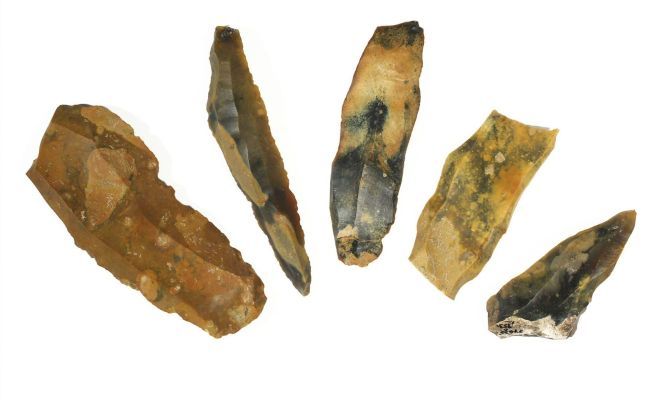
Between 1968 and 1976, Professor Khan conducted extensive field surveys across the Mulri Hills and documented approximately 18 to 20 prehistoric localities. He recovered thousands of stone artefacts, including microliths, scrapers, blades, burins, cores and flakes. These were not naturally broken stones but carefully crafted tools produced by prehistoric humans.
In later years, internationally recognized archaeologist Professor Paolo Biagi and other researchers examined Professor Khan’s collections and confirmed that the assemblage belonged primarily to the Mesolithic Period, placing the Mulri Hills among the most significant prehistoric sites in Sindh.
The discoveries transformed Karachi’s historical timeline. The city’s story no longer began with Kolachi or colonial rule. Instead, it stretched back into the prehistoric past, nearly twelve millennia before the present.
 Karachi’s First Inhabitants
The people who lived at the Mulri Hills were Homo sapiens, anatomically identical to modern humans. They were not primitive in the popular sense of the word. They possessed intelligence, planning ability and a deep understanding of their environment.
Archaeological evidence suggests that they lived in small family groups, probably 20 to 50 people in each camp. They did not build permanent towns or cities. Instead, they moved seasonally, establishing temporary camps according to the availability of water, wildlife and edible plants.
Their economy was based on hunting, fishing and gathering.
They hunted wild animals, caught fish from nearby rivers and coastal waters, collected shellfish along the Arabian Sea, and gathered fruits, nuts, seeds and edible roots from the surrounding landscape.
Every member of the community contributed to survival. Adults hunted and gathered food, while children learned practical skills by observing their elders. Knowledge was passed from one generation to another through experience rather than books.
These early Karachiites lived in harmony with nature because their survival depended upon understanding it.
 Masters of Stone Technology
Perhaps the greatest achievement of these prehistoric communities was their remarkable stone technology.
The Mulri Hills have yielded numerous microliths, tiny stone blades carefully shaped from flint or chert. Although small in size, these tools represented sophisticated engineering for their time. They were attached to wooden or bone handles to make spears, arrows, knives and cutting implements.
The manufacture of a microlith required considerable skill. A single mistake could ruin the tool. Their existence demonstrates careful planning, knowledge of raw materials and generations of accumulated craftsmanship.
Innovation did not begin with modern civilization.
It began when early humans learned to transform stone into technology.
 How Do We Know They Lived Twelve Thousand Years Ago?
Many readers naturally ask how archaeologists determine the age of such sites.
Contrary to popular belief, no published direct Carbon-14 (radiocarbon) date has yet been reported from the Mulri Hills because no suitable organic material, such as charcoal or bone, has been recovered for laboratory testing.
Instead, archaeologists estimate the age through typological analysis. They compare the design and manufacturing techniques of the Mulri Hills stone tools with securely dated Mesolithic assemblages from Pakistan and neighboring regions. Geological evidence and regional prehistoric sequences further support this interpretation.
This is a standard scientific method widely used in prehistoric archaeology.
The estimated age of approximately 12,000 years therefore represents the best interpretation of the available archaeological evidence rather than speculation.
 From Hunter-Gatherers to Civilization
The Mulri Hills contain no evidence of a planned city.
There are no brick buildings, streets, drainage systems or monumental structures similar to Mohenjo-daro or Harappa.
Instead, they represent a much earlier chapter of human history when people still lived as hunter-gatherers.
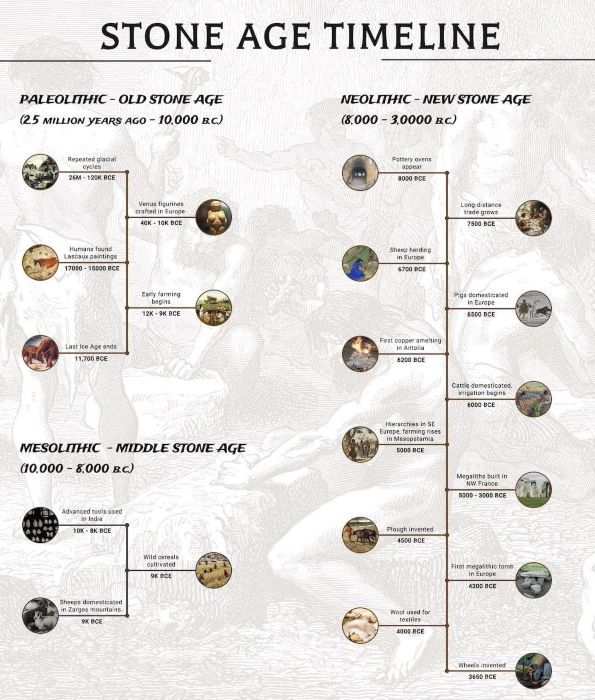
Several thousand years later, around 7000 BCE, farming communities appeared at Mehrgarh in present-day Balochistan. Agriculture gradually replaced hunting as the principal means of survival.
By 2600 BCE, the Indus Valley Civilization had developed magnificent cities such as Mohenjo-daro and Harappa, displaying advanced engineering, organized town planning and long-distance trade.
The Mulri Hills therefore remind us that every civilization begins with small communities learning to survive, innovate and adapt.
Timeline of the Mulri Hills
* 12,000 years ago: Mesolithic hunter-gatherers repeatedly camp in the Mulri Hills.
* 1947: British researchers Todd and Paterson recovered a small number of prehistoric flint tools from the Lyari River area.
* 1968–1976: Prof. Abdul Rauf Khan conducts the first systematic archaeological surveys, documenting approximately 18–20 prehistoric sites.
* 1980: Development of Gulistan-e-Jauhar begins, covering much of the documented Mesolithic landscape.
* 2000s onwards: Prof. Paolo Biagi and other researchers analyze the collections and confirm the Mesolithic significance of the Mulri Hills.
The Mystery of the Name “Mulri”
Interestingly, the exact meaning of the word Mulri remains unknown.
The name appears in colonial maps and official records long before archaeological research began, indicating that it was already an established local place name.
Some historians believe it may preserve the memory of an old settlement or geographical feature, while others suggest it has older Sindhi or Balochi origins.
However, no published linguistic research has conclusively explained its meaning.
Responsible history accepts uncertainty where evidence is lacking.
Where Is the Evidence Today?
Although much of the original archaeological landscape has disappeared, the evidence itself has not been lost.
The stone tools collected by Professor Abdul Rauf Khan are documented in the records of the Department of Archaeology, University of Karachi.
The Department of Archaeology and Museums, Government of Pakistan, recognizes the Mulri Hills as a prehistoric archaeological site.
Research has been published in respected academic journals including Grassroots and Ancient Sindh, while Professor Paolo Biagi’s studies have introduced the Mulri Hills to the international archaeological community.
The National Museum of Pakistan in Karachi also preserves prehistoric artefacts from Sindh, including material from the Karachi region.
These collections remain valuable scientific evidence of Karachi’s earliest inhabitants.

We have research papers to reach for references
* Khan, A. R. The Mesolithic of Sind and Baluchistan. Grassroots, University of Sindh.
* Akhtar, S., & Dhanani, M. R. (2017). Mesolithic Settlement in the Mulri Hill, Karachi (Sindh), Pakistan. Grassroots.
* Biagi, P. (2004). The Mesolithic Settlement of Sindh (Pakistan): A Preliminary Assessment.
* Biagi, P. (2018). The Mesolithic Settlement of Sindh: New Evidence from the Khadeji River Course.
* Allchin, B., & Allchin, R. The Rise of Civilization in India and Pakistan. Cambridge University Press.
* Department of Archaeology, University of Karachi.
* Department of Archaeology and Museums, Government of Pakistan.
Why Did Research Decline?
Many people assume that archaeological work at the Mulri Hills stopped because the Government officially closed the site.
There is no published evidence of any government order declaring the site closed or prohibiting archaeological research.
Instead, research declined because of several practical reasons.
During the 1970s and 1980s, Karachi expanded rapidly. Housing schemes, roads and commercial development gradually occupied large parts of the Mulri Hills.
The launch of Gulistan-e-Jauhar in 1980 covered much of the documented Mesolithic landscape beneath modern urban development.
Extensive limestone quarrying removed sections of the hills, disturbing archaeological deposits.
At the same time, Pakistan’s limited archaeological resources were understandably directed towards internationally renowned sites such as Mohenjo-daro, Harappa and Taxila, leaving Karachi’s prehistoric archaeology relatively under-funded and underexplored.
Natural erosion and occasional collection of artefacts by visitors also contributed to the gradual loss of archaeological evidence.
The decline was therefore primarily the result of urban expansion, limited funding and changing research priorities rather than political decisions.
Lessons for Modern Karachi
The story of the Mulri Hills is not about opposing development. Karachi needed homes, schools, hospitals and roads. Cities must grow.
The real lesson is that development and heritage conservation should grow together.
Many countries successfully protect archaeological landscapes while continuing to expand their cities. Athens preserves its ancient monuments within a modern capital. Rome integrates archaeology into everyday urban life.
Türkiye has protected Göbekli Tepe while welcoming visitors from around the world.
Karachi can learn from these examples. Future infrastructure projects should include archaeological impact assessments wherever prehistoric evidence may survive. Modern technologies such as satellite imagery, Geographic Information Systems (GIS), ground-penetrating radar and LiDAR can help identify and document buried heritage before construction begins.
A Mulri Hills Interpretation Centre could display prehistoric stone tools, explain Karachi’s ancient environment and introduce schoolchildren to the city’s earliest history through interactive exhibits.
A Call to Karachi’s Youth
Every generation inherits two responsibilities: to build the future and to protect the past. The youth of Karachi have an opportunity to rediscover a forgotten chapter of their city’s identity. They can visit museums, read archaeological research, support heritage conservation and encourage schools to teach Karachi’s prehistoric history.
A city is more than its buildings. It is the memory of everyone who has lived upon its land.
Conclusion
Karachi’s history did not begin with Kolachi, nor with the British Empire, nor even with the Indus Valley Civilization.
It began thousands of years earlier when small groups of hunter-gatherers found water, shelter and opportunity among the Mulri Hills. They left no palaces, temples or written records. Instead, they left carefully crafted stone tools that continue to tell their story across twelve millennia.
Today, much of that landscape lies beneath the streets and neighborhoods of modern Gulistan-e-Jauhar. Yet the scientific evidence preserved in museums, universities and published research leaves little doubt that Karachi possesses one of Pakistan’s oldest documented human histories.
The Mulri Hills are more than an archaeological site. They are a reminder that every great city has deep roots, and that progress should never come at the cost of forgetting where those roots began.
If Karachi truly wishes to understand itself, it must look beyond the last few centuries and embrace the full span of its remarkable journey. The first Karachiites may never have imagined the modern metropolis that stands today, but their footsteps marked the beginning of a story that still continues.
Read: Next Generation of Civil Engineering: Self-Healing Cracks
____________________
 Hailing from Gambat town of Sindh, Engr. Ramesh Raja is a civil engineer and managerial/ planning professional who also contributes as a freelance writer on technical matters. He may be reached at engineer.raja@gmail.com


