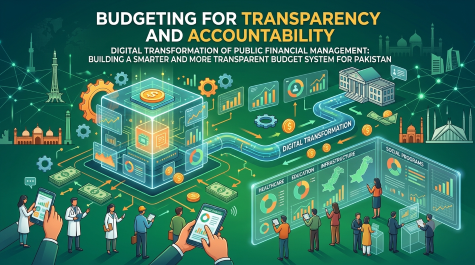
Digital Transformation of Public Financial Management: Building a Smarter and More Transparent Budget System for Pakistan
By Nuzair Ahmed Jamro
“Good governance begins when public resources are planned wisely, managed transparently, and used where they create the greatest impact.”
Every year, governments prepare budgets to decide how public money will be collected, allocated, and spent. These decisions directly affect the lives of ordinary citizens because budgets determine investments in schools, hospitals, roads, social protection, climate resilience, and economic development.
However, a successful budget is not measured only by the size of allocations. The real question is: Are public resources reaching the right places, at the right time, and creating meaningful results?
This question has become increasingly important in today’s rapidly changing world. Governments are facing complex challenges, including economic pressures, growing public expectations, climate-related risks, and the need for better service delivery. Therefore, traditional approaches to financial management are no longer enough.
Pakistan needs a modern Public Financial Management (PFM) system that combines strong administration, effective planning, transparency, and digital innovation.
Public Finance Is More than Numbers
Public Financial Management is often considered a technical area dealing with budgets, accounts, and expenditures. However, at its core, it is about improving people’s lives. When a government allocates funds for healthcare, education, infrastructure, or social development, citizens expect those resources to be utilized efficiently and produce visible results.
A strong PFM system helps governments answer important questions:
- Where is public money being spent?
- Are development projects progressing as planned?
- Are resources reaching deserving communities?
- Are government programs achieving their intended outcomes?
Without accurate information and effective monitoring, even well-designed policies may fail to deliver expected benefits. Therefore, improving financial management is not only a finance reform; it is a governance reform.
The Journey from Paper-Based Systems to Digital Governance
For decades, government financial systems relied heavily on manual files, physical approvals, and periodic reports. Although these methods provided administrative control, they often resulted in delays, limited transparency, and difficulty in accessing real-time information.
Today, digital technology provides an opportunity to transform this process.
A digitally enabled financial system can allow government institutions to:
- Prepare budgets through online platforms.
- Monitor expenditure in real time.
- Track development projects.
- Generate automated reports.
- Identify financial gaps quickly.
- Support evidence-based decision-making.
However, digital transformation is not simply about replacing files with computers. It is about redesigning government processes to make them faster, simpler, and more accountable. Technology should support administrators in making better decisions, not create additional complexity.
Learning from Neighboring Countries
Several countries in the region have taken important steps towards digital public finance reforms. Their experiences provide valuable lessons for Pakistan.
India: Using Technology for Financial Transparency
India has strengthened its public financial management through digital platforms such as the Public Financial Management System (PFMS).The system has helped government institutions monitor fund transfers, track expenditure, and improve transparency in public programs. The key lesson from India’s experience is that digital financial systems should not only record transactions; they should help policymakers understand where resources are going and what results they are producing. For Pakistan, a similar approach can help connect budgeting, expenditure monitoring, development planning, and performance evaluation.
Bangladesh: Digitalizing Government Financial Processes
Bangladesh has also focused on improving public sector efficiency through digital reforms, including electronic procurement and financial management systems. These initiatives have helped reduce delays, improve transparency, and strengthen accountability in government operations. The experience of Bangladesh shows that successful digital reforms require not only technology but also administrative commitment and institutional ownership.
China: Linking Data with Development Planning
China’s experience demonstrates the importance of using technology for large-scale governance and development management.
Digital systems have supported:
- Financial monitoring.
- Development planning.
- Performance evaluation.
- Data-based decision-making.
The lesson for Pakistan is clear: technology becomes effective when it is supported by strong institutions, skilled professionals, and effective management practices.
The Need for Smarter Financial Management in Pakistan
Pakistan has already taken steps towards digital governance. However, there is significant potential to further strengthen public financial management through integrated digital solutions.
Future reforms can focus on:
Integrated Financial Management Systems
Government financial systems should be connected so that budget preparation, expenditure monitoring, accounting, auditing, and development programs can work together. Such integration will reduce duplication and provide a complete picture of public spending.
Real-Time Budget Monitoring
Modern dashboards can help decision-makers monitor:
- Department-wise expenditure.
- Development project progress.
- Budget utilization.
- Financial performance indicators.
Consequently, problems can be identified earlier and corrective actions can be taken more effectively.
Using Data for Better Decisions
Government institutions generate enormous amounts of financial information. The challenge is converting this data into useful knowledge. Through data analytics and modern technologies, governments can improve:
- Budget forecasting.
- Resource allocation.
- Risk identification.
- Development planning.
A data-driven approach can help ensure that public spending is based on evidence rather than assumptions.
The Future Finance Professional: Beyond Traditional Skills
One of the most important aspects of digital transformation is human capacity. A modern finance professional cannot rely only on traditional knowledge of accounting rules, budget procedures, and financial regulations.
The future PFM practitioner should also understand:
- Digital governance.
- Management Information Systems (MIS).
- Data analysis.
- Process automation.
- Public administration.
- Policy implementation.
Similarly, digital transformation officers in finance institutions should not be selected only on the basis of IT knowledge. A successful digital finance reform requires professionals who understand both technology and administration. An individual with IT skills but no understanding of government procedures may develop a system that does not fully address administrative realities. On the other hand, an administrator with no digital understanding may struggle to utilize modern technology effectively.
Therefore, the ideal professional should have a combination of:
- Information Technology knowledge.
- Economics and financial understanding.
- Public Administration background.
- Experience in government operations.
- Practical experience in digitization projects.
Such professionals can bridge the gap between finance experts, administrators, and technology teams.
Connecting Budgets with Climate, Gender, and SDGs
Modern budgeting is no longer limited to allocating money. Governments today must also measure the social and environmental impact of spending. Digital systems can support:
- Climate-responsive budgeting.
- Gender-responsive budgeting.
- SDG-based planning.
For example, digital monitoring can help track whether climate-related funds are being utilized effectively, whether development programs are benefiting vulnerable groups, and whether public investments are contributing towards sustainable development goals. In this way, technology can help transform budgets from financial statements into tools for social progress.
Challenges: Technology Alone Cannot Reform Institutions
Although digital transformation offers many opportunities, it also brings challenges. These include:
- Resistance to change.
- Lack of digital skills.
- Data quality issues.
- Cybersecurity concerns.
- Weak coordination between institutions.
Therefore, successful digital reforms require more than software and systems. They require:
- Strong leadership.
- Skilled human resources.
- Continuous training.
- Institutional commitment.
- Administrative reforms.
Technology is a powerful tool, but its success depends on the people and institutions managing it.
The Way Forward
Pakistan’s future development depends on how effectively public resources are managed. Every rupee saved from inefficiency can become an investment in education, healthcare, infrastructure, and social welfare. The government should focus on building a modern PFM ecosystem based on:
- Digital budgeting.
- Transparent expenditure monitoring.
- Data-driven planning.
- Performance-based management.
- Skilled multidisciplinary professionals.
The goal should not only be creating digital systems but creating a culture of better governance.
Conclusion
Digital transformation of Public Financial Management is not just about adopting new technology. It is about creating a smarter way of governing. The future of public finance lies at the intersection of technology, administration, economics, and effective leadership.
Pakistan can learn from regional experiences and develop a financial management system that is transparent, efficient, and focused on results. Ultimately, a smarter budget system will not only improve government performance but will also ensure that public resources create meaningful change in the lives of citizens.
Read: Climate-Resilient Education in Sindh
__________________
 Hailing from Shikarpur, Sindh, Nuzair Ahmed Jamro is a civil servant and MS research fellow in Public Administration. He writes on governance, public policy, and digital transformation. Email: najamro@gmail.com.