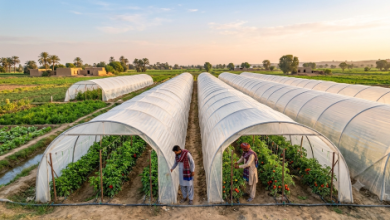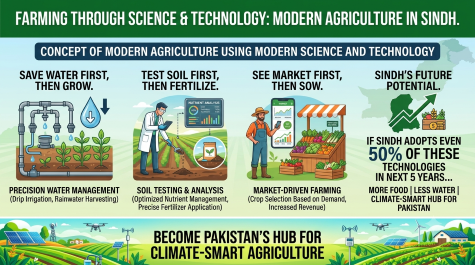
Concept of Modern Agriculture Using the Modern Science and Technology
- Modern agriculture is not about buying expensive machines. It is about thinking differently: Save water first, then grow. Test soil first, then fertilize. See market first, then sow.
- If Sindh adopts even 50% of these technologies in next 5 years, it can produce more food with less water and become Pakistan’s hub for climate-smart agriculture.
By Ramesh Raja
Modern agriculture is the shift from resource-based farming to knowledge-based farming. While traditional agriculture asked “how much land do you have?” modern agriculture asks “how much data do you have per acre?” This essay explains the scientific pillars of modern agriculture, gives practical examples of countries that transformed their production with it, and applies those lessons to Sindh province, which is facing one of the worst water shortages as a tail-ender of the Indus Basin.
WHY MODERN AGRICULTURE?
By 2050, the world must feed 9.7 billion people with 30% less water per capita. Pakistan, with 225 million people and 5th largest population, has the same challenge. Traditional flood irrigation, local seeds, and calendar-based farming cannot meet it.
Modern Agriculture is defined by 5 principles:
- More crop per drop of water
- More yield per seed through genetics
- Decisions by data, not by guess
- Soil as a living biology, not just dirt
- Farming as a value-chain, not just production
PILLARS OF MODERN SCIENCE AND TECHNOLOGY IN AGRICULTURE
Precision Agriculture and IoT
Use of GPS, sensors and satellite imagery to apply exact amount of water, fertilizer and pesticide only where needed.
- Laser Land Leveling saves 25% water.
- Soil moisture sensors and automated drip reduce water use by 40-60%.
- Drones for NDVI mapping detect stress 10 days before human eye and spray 90% less chemical.
Biotechnology and Seed Science
- Drought, heat, salinity and pest tolerant varieties. Example: CRISPR-edited tomatoes, Sub1 flood-tolerant rice, Bt cotton.
- Hybrid seeds increase yield 30-50%.
- Tissue culture for disease-free banana and date palm.
Water Smart Technologies
- Drip Irrigation, Sprinkler, Alternate Wetting and Drying (AWD) in rice, Direct Seeded Rice (DSR).
- Rainwater harvesting, aquifer recharge, and desalination for agriculture.
Soilless Agriculture
- Hydroponics (roots in nutrient water), Aeroponics (roots in mist), Aquaponics (fish + plants). Uses 90-95% less water. Ideal for urban areas and saline zones.
Digital Agriculture and AI
- AI advisory apps for weather, pest attack prediction.
- Blockchain for traceability from farm to supermarket.
- Robotics for weeding and harvesting.
Conservation and Regenerative Agriculture
- Zero tillage, bed planting, mulching, cover crops, bio-fertilizers. Increases organic matter from 0.5% to 2%, which doubles soil water holding capacity.
PRACTICAL EXAMPLES OF COUNTRIES USING MODERN AGRICULTURE
ISRAEL – Farming a Desert with 50% Less Water
Israel gets 50mm rainfall and is 60% desert, yet exports $2.5 billion agriculture.
- Invented drip irrigation in 1965 (Netafim company).
- 86% of wastewater is recycled for agriculture – highest in world.
- Precision fertigation: water + fertilizer through computer.
- Result: Tomato yield 300 tons/hectare in greenhouse vs. 50 tons in open field in Pakistan.
- Lesson for Sindh: Drip for sugarcane, cotton and chilies, and recycling of drainage water in Badin and Thatta.
NETHERLANDS – Small Country, 2nd Largest Food Exporter
Netherlands is smaller than Sindh (41,000 sq km vs 140,000 sq km) but is world’s 2nd largest food exporter after USA.
- Greenhouse agriculture with climate control, hydroponics and LED lights.
- Produces 1 kg tomato with 4 liters water vs 60 liters in open field.
- Use of seed genetics – Dutch companies control 40% of global vegetable seeds.
- Lesson for Sindh: Greenhouse clusters around Karachi, Hyderabad for off-season vegetables, and focus on high-value seed production.
UNITED STATES OF AMERICA – Data-Driven Farming
- GPS-guided tractors with 2 cm accuracy, no overlap.
- Yield mapping combines harvesters that map yield acre by acre.
- Satellite insurance and commodity trading.
- Average US farmer feeds 166 people, compared to 15-20 in Pakistan.
- Lesson for Sindh: Mechanization through service providers and use of satellite advisory like NASA Harvest.
CHINA – Technology for Small Farmers
- China has similar small holdings like Pakistan (0.6 ha average).
- Deployed 200 million soil tests, drone spraying is done on 30% area.
- Developed hybrid rice that feeds 70 million extra people.
- E-commerce – Taobao villages – farmers sell directly.
- Lesson for Sindh: Soil health cards for every farmer and direct marketing platforms.
INDIA – Relevant Model for Sindh
Punjab and Rajasthan have similar climate to Sindh.
- Direct Seeded Rice in Punjab: Saved 30% water and solved labour crisis.
- Bed planting of wheat: Adopted on 2 million hectares, saves 1 irrigation.
- Micro-irrigation in Gujarat and Maharashtra: 1.2 million ha under drip for cotton, sugarcane, banana with 50% subsidy.
- eNAM digital market: Farmers get best price.
- Lesson for Sindh: SIAPEP project for drip can be expanded like Gujarat model.
AUSTRALIA – Farming with Salinity and Drought
Australia faces similar tail-end salinity like Sindh.
- Uses salt-tolerant wheat (Sundor, Krichauff), raised bed farming for waterlogging.
- Water trading: farmers buy and sell water shares – efficient allocation.
- Lesson for Sindh: Salinity management through gypsum + salt tolerant varieties like quinoa and barley.
SINDH AGRICULTURE – PROBLEMS AND POTENTIAL
Current Status
Sindh contributes 23% of Pakistan agriculture GDP. Main crops: cotton 35%, rice 35%, sugarcane 30%, wheat, chilies, mango, banana, dates. 5.5 million hectares irrigated from Indus via 3 barrages – Guddu, Sukkur, Kotri. Lower Sindh produces 70% of Pakistan’s chilies, 50% bananas, 30% mangoes.
Core Problems
- Tail-end Water Shortage: As last user of Indus, Sindh receives less in shortage years. Kotri barrage flow often <10 MAF vs required 25 MAF. Within Sindh, 40% water lost in unlined channels.
- Water-Intensive Cropping: Rice and sugarcane use 70% of water but low return per litre.
- Salinity and Waterlogging: 2.8 million acres affected by salinity, 4.5 million by waterlogging. Sea intrusion in Thatta, Badin, Sujawal – 1.2 million acres lost.
- Low Organic Matter: Sindh soils <0.5% organic matter vs required 1.5%.
- Post-Harvest Loss: 30% fruits and vegetables wasted due to no cold chain.
- Climate Change: Heat wave 50C+, erratic monsoon, 2022 floods proved vulnerability.
How Modern Technology Can Transform Sindh – A Practical Roadmap
Immediate Actions (0-2 years) – Low Cost
- Laser leveling on 100% area through service providers.
- Bed planting for wheat and DSR + AWD for rice on 30% area. This alone can save 2 MAF water – enough for 1 million acres of oilseeds.
- Soil health card scheme: free test + gypsum recommendation from SAU Tando Jam and Agriculture Extension.
- Shift at tail ends from rice to sesame, sunflower, mung, guar – 70% less water, 2x profit.
Medium Term (2-5 years) – Investment Needed
- Drip irrigation on 500,000 acres of cotton, sugarcane, chilies, orchards under SIAPEP with 60% subsidy model of India.
- Establishment of 10 greenhouse clusters around Karachi, Hyderabad, Mirpurkhas for hydroponic vegetables – targeting urban market.
- Aquaponics with Tilapia in coastal belt where groundwater is brackish. Pilot in Gharo, Dhabeji already successful.
- Drone spray service centers in every district – reduces pesticide cost 40% and water 90%.
- Date palm tissue culture lab in Khairpur to replace 80% old orchards.
Long Term (5-10 years) – Policy
- Water accounting with telemetry and sensors on barrages and canals – transparent data like Australia.
- On-farm water storage ponds to harvest monsoon rain in Kohistan and Thar.
- Cold chain and solar dryers for chili, onion, tomato in Mirpurkhas and Badin.
- Agri-tech university linkages: SAU Tando Jam to become center for salinity and heat-tolerant research.
A MODEL FOR 50% WATER SCENARIO – PRACTICAL FOR A SINDH FARMER
If a farmer in Badin has 10 acres and only 50% canal water:
Kharif: 5 acres sesame (2 irrigations) + 5 acres mung (2 irrigations) instead of 10 acres rice (20 irrigations). Water saving 80%. Profit increase 40%.
Rabi: 7 acres bed wheat (3 irrigations) + 3 acres mustard (2 irrigations). Uses 35 acre-inches vs 60.
Total water use: Half, profit same or more, soil health improved.
CONCLUSION
Israel proved you can farm a desert if you control water. Netherlands proved a small area can feed the world if you control environment. China and India proved small farmers can adopt technology if government gives service, not just subsidy.
Sindh does not lack sunlight, land, or hardworking farmers. It lacks water management and adoption of science. The Indus water dispute will continue, climate change will worsen. The only control Sindh has is what it does inside its fields.
Modern agriculture is not about buying expensive machines. It is about thinking differently: Save water first, then grow. Test soil first, then fertilize. See market first, then sow. If Sindh adopts even 50% of these technologies in next 5 years, it can produce more food with less water and become Pakistan’s hub for climate-smart agriculture.
Reference:
- FAO. (2023). The State of Food and Agriculture – Water management for climate-smart agriculture. Food and Agriculture Organization, Rome.
- World Bank. (2022). Pakistan – Sindh Water and Agriculture Transformation Project. Washington DC.
- IWMI – International Water Management Institute. (2021). Water productivity in the Indus Basin.
- Pakistan & Sindh Specific:
- Pakistan Council of Research in Water Resources (PCRWR). (2023). Water scarcity and salinity in Lower Indus.
- Sindh Agriculture University, Tando Jam. (2022). Research on salt-tolerant wheat and rice varieties.
- PARC – Pakistan Agricultural Research Council. (2023). National Food Security Policy and Soilless Agriculture Guidelines.
- IRSA – Indus River System Authority. Water Accord 1991 and Kotri downstream data.
- Govt. of Sindh – SIAPEP. Sindh Irrigated Agriculture Productivity Enhancement Project – Drip Irrigation Subsidy Report.
- Technology References:
- National Geographic. (2017). How the Netherlands Feeds the World.
- Van der Velden et al. Wageningen University Research (WUR) – Greenhouse Horticulture Yield and Water Use Efficiency.
- Narayan et al. (2020). Direct Seeded Rice and Alternate Wetting and Drying – IRRI, Philippines.
- Jensen, M.H. (2018). Hydroponics and Aeroponics for Food Security – University of Arizona.
Read: Turning Urban Waste into Wealth
____________________
 Hailing from Gambat town of Sindh, Engr. Ramesh Raja is a civil engineer and managerial/ planning professional who also contributes as a freelance writer on technical matters. He may be reached at engineer.raja@gmail.com