Finland’s Experiment for Electricity to travel without Wires
- The first electrical revolution taught humanity how to generate and distribute electricity. The next may teach us how to deliver it without wires.
By Ramesh Raja
For more than a century, the modern world has been tied together by wires. Electricity travels through copper and aluminum conductors from power stations to cities, factories, homes and, finally, to the smallest devices in our hands. But Finland is helping to explore a remarkable possibility: electricity that can travel without a physical wire.
Finland’s journey toward wireless electricity has developed steadily rather than through a single breakthrough. On 26 May 2022, researchers at Aalto University publicly demonstrated a wireless power-transfer system capable of powering moving robots without a physical electrical connection. Research subsequently expanded toward longer-range and higher-power applications. In February 2026, reports highlighted further Finnish work involving Aalto University, the University of Helsinki and the University of Oulu, while Willo Technologies, a Finnish deep-tech company originating from Aalto research, announced a €2.9 million pre-seed investment to commercialize its alignment-free wireless-power technology. The idea sounds futuristic, yet the story begins much earlier.
From Lightning to Electricity
Electricity was not invented by a single person. It is a natural phenomenon present in lightning, static charges and the electrical activity of living organisms. Humanity gradually learned to observe, understand, generate, control and use it.
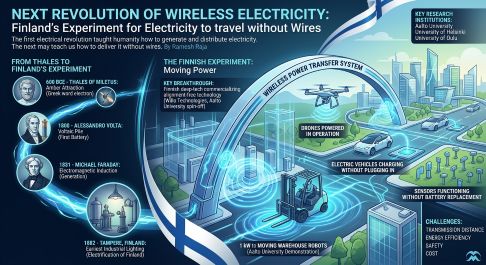
Around 600 BCE, the Greek philosopher Thales of Miletus observed that rubbed amber could attract light objects. The Greek word for amber, electron, later gave rise to the terms electric and electricity.
In 1600, English scientist William Gilbert systematically studied electrical and magnetic phenomena and helped establish electricity as a field of scientific inquiry. In 1752, Benjamin Franklin demonstrated that lightning was an electrical phenomenon. In 1800, Italian scientist Alessandro Volta invented the voltaic pile, the first practical battery capable of producing a continuous electric current.
A decisive breakthrough came in 1831, when Michael Faraday discovered electromagnetic induction, demonstrating that mechanical motion could be converted into electrical energy. This principle remains fundamental to modern electric generators.
During the late nineteenth and early twentieth centuries, scientists, inventors and engineers including Thomas Edison, Nikola Tesla and George Westinghouse transformed electrical discoveries into practical systems for lighting, industry, transportation and domestic use, laying the foundations of the modern electricity grid.
Finland Enters the Electrical Age
Finland’s electrification began in the late nineteenth century, during a period when electricity was spreading across Europe.
One of the country’s earliest electrical lighting installations appeared in Tampere in 1882, where electricity was used for industrial lighting. Tampere was already an important industrial center, and the arrival of electricity strengthened its position as one of Finland’s pioneering industrial cities.
Finland’s first major hydroelectric developments followed as the country began to exploit its abundant rivers and water resources. Electricity gradually expanded from factories and urban centers to wider public and household use.
By the twentieth century, Finland had developed an extensive electricity network, increasingly based on hydropower and later supplemented by nuclear power, thermal generation and other sources.
Today, Finland has one of Europe’s most advanced electricity systems. Its cold climate, industrial economy and growing digital infrastructure have also created strong demand for reliable and efficient electricity. And now Finland is looking beyond the traditional wire.
When Electricity Leaves the Wire
Finnish universities and research institutions have become active in wireless power transfer, a technology that allows electrical energy to move from a transmitter to a receiver without a conventional cable.
Finland’s progress in wireless electricity is not a sudden 2026 invention, but the result of several years of research by Finnish universities and research institutions, particularly Aalto University in Espoo. Research in this field accelerated around 2020, while a significant public demonstration came in 2022, when Aalto researchers developed a system capable of supplying about 1 kilowatt of power to moving warehouse robots without a physical connection.
Researchers including Prasad Jayathurathnage, Yining Liu and Shamsul Al Mahmud have contributed to subsequent developments, including systems that can transfer power even when the receiving device changes its position or orientation.
The principle is based on electromagnetic fields. Instead of requiring electrons to travel through a copper or aluminum wire from one point to another, a transmitter converts electrical energy into an electromagnetic field, and a receiver captures that energy and converts it back into usable electricity.
The concept is already familiar through wireless smartphone charging, but Finnish researchers are working to extend it to much higher power levels and more flexible applications. Potential uses include electric vehicles that charge without plugging in, industrial robots that operate without cables, drones receiving power while in operation, and sensors that can function without frequent battery replacement.
The technology, however, faces major challenges, particularly transmission distance, energy efficiency, electromagnetic interference, safety and cost. Wireless power is therefore not yet a replacement for conventional electricity grids, which remain far more efficient for transporting enormous quantities of electricity over long distances.
Finland’s achievement is better understood as an important step towards a future in which electricity does not always have to be physically connected by wires. After more than a century in which copper, aluminum, poles and transmission towers became the backbone of modern civilization, Finnish research is helping to explore the possibility of electricity crossing the gap between source and machine through electromagnetic fields rather than a cable.
A Future Beyond Cables?
The potential applications are enormous. Imagine an electric car that begins charging when it parks over a charging platform, without the driver connecting a cable. Imagine industrial robots receiving power while moving across a factory. Drones could potentially recharge without conventional plugs, while sensors in difficult locations could receive energy without regular battery replacement.
Wireless power could also reduce some of the physical infrastructure associated with electricity. Today’s networks require enormous quantities of copper, aluminum, steel, concrete and other materials. Transmission towers occupy land, overhead lines can be damaged by storms and accidents, and cables require continuous maintenance.
But wireless electricity will not make conventional grids obsolete overnight. Wires remain extraordinarily efficient for transporting large amounts of electricity over long distances. Wireless transmission becomes more challenging as distance increases because energy can be lost during transfer. The future is therefore likely to be a combination of both systems.
The significance of Finland’s work is not that the age of wires is suddenly over. It is that humanity is beginning to challenge an assumption that has shaped modern civilization for generations: that electricity must always travel through a physical conductor.
The first electrical revolution taught humanity how to generate and distribute electricity. The next may teach us how to deliver it without wires.
From Thales watching amber attract tiny objects, to Faraday generating electricity through electromagnetic induction, to Finland experimenting with wireless power, the journey has taken more than two thousand years. The wire changed the world. Wireless electricity could change it again.
Read: From Landlords to Tech Lords
__________________
 The author of this article, Engr. Ramesh Raja, is a Civil Engineer, visionary planner, PMP certified and literary enthusiast with a passion for art and recreation. He can be reached at engineer.raja@gmail.com