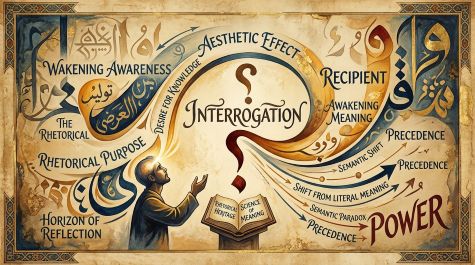
Language, in its highest manifestations, is not merely a vessel for meaning but an ongoing act of creation—one renewed with every new reading and whenever consciousness opens itself to new questions.
- Freeing interrogation from the confines of the narrow concept of “rhetorical purpose” and viewing it as an integrated linguistic entity allows us to approach more closely the secret of aesthetic effectiveness in the literary text.
Souad Khalil | Libya
The linguistic discourse of a literary text constitutes a space in which structure intersects with meaning, and form interacts with the aesthetic effect generated within the consciousness of the recipient. Among the stylistic phenomena that call for profound critical reflection is the interrogative style, which emerges as an expressive force that transcends the limits of a direct request for knowledge, becoming an active instrument in shaping meaning and stimulating intellectual and emotional interaction within the reading experience.
Interrogation does not remain merely a grammatical form or a limited structural pattern. Rather, within the context of the literary text, it reveals itself as a vital element that activates meaning and establishes a dynamic relationship between the text and the recipient. Thus, the question is transformed from a mere request for an answer into a mechanism for awakening consciousness, generating meaning, and intensifying the aesthetic effect.
From this perspective, this article seeks to examine the interrogative style in the light of the Arab rhetorical heritage, exploring its semantic nature, its position within textual structure, and the extent to which it moves from its literal meaning toward its rhetorical dimensions. This is undertaken within a vision that regards language as a living act, renewed with every reading.
The forms of linguistic structures that a reader may encounter within a literary text vary, regardless of the literary genre to which the text belongs. These reflections seek to examine one such form because of its active influence on the shaping of meaning within the text and its capacity to produce an aesthetic effect upon the recipient.
Those who follow the development of literary criticism in recent times cannot fail to notice the growing interest in the language of the literary text. Attention to this language has become a means through which critics seek to uncover the meaning of a text. This approach is based on a fundamental question: How does this linguistic element produce that meaning? Such a linguistic orientation in criticism ultimately leads to identifying the role played by language in its most precise and subtle manifestations: the literary text itself.
The writer Tariq Saad Shalabi, in an article entitled The Aesthetics of Reception, states:
“In these lines, we shall attempt to trace the activity of this language, taking the interrogative style as a model. We seek to draw upon the spirit of the old rhetorical tradition without becoming confined within that tradition by merely repeating its propositions, while at the same time allowing us to grasp its methodology and philosophy in examining the elements of language.”
To begin with, we may state that the study of interrogation has occupied a prominent position within various fields of research. Reflecting upon the nature of rhetorical studies, in particular, enables us to understand the essence of this style, especially when rhetorical analysis focuses—as we see it—on the vitality of interrogation and its active role within the text, a role that takes shape through the relationship between the text and the recipient.
In other words, rhetorical scholarship has approached interrogation as a dynamic expressive force, whereas linguistic scholarship, as represented in the writings of linguists, has approached it primarily as a form or structure whose characteristics can be observed from an external perspective.
Accordingly, shedding light on the position of interrogation within rhetorical studies serves two purposes in our analysis of this particular mode of expression. The first is to reveal the theoretical background underlying such an analysis; the second is to uncover the vitality referred to above, which becomes evident through the aesthetics of reception.
Rhetorical studies place interrogation among the constructive forms of expression within the field of ʿIlm al-Maʿānī (the science of meanings). This discipline is concerned with the conditions of Arabic expression through which utterances correspond to the requirements of context. It encompasses a number of major areas, including the circumstances of declarative predication, the circumstances of the subject, the circumstances of the predicate, the complements of the verb, restriction, constructive expression, separation and conjunction, brevity and elaboration, and equality.
The perspective of classical rhetorical scholarship on interrogation reveals a particular concern with the recipient. This becomes evident in the definitions it formulated and in the relationships it established, through which interrogation is distinguished from other rhetorical structures.
Interrogation is closely connected with the desire for knowledge that removes an unknown. It is a request by the speaker addressed to another person to acquire, in their mind, something that was previously unknown to them concerning the matter about which they are asking. This is accompanied by an intellectual activity stimulated by such a desire. Interrogation, therefore, possesses an inherent capacity to attract the recipient’s attention.
Perhaps this issue requires some clarification. Early Arab scholars recognized that rhetorical constructive forms respond to a particular need on the part of the recipient, and they gave this need an evocative term: request. Taken together, these forms fulfill a request, and the one who makes such a request is the recipient. Interrogation differs from other constructive forms because it is associated with a unique kind of request that resembles a space of the unknown. In interrogation, the scope is broader: one seeks something existing outside oneself so that an image corresponding to it may take shape in the mind.
There can be no genuine interrogation in a text whose meaning or reception is overshadowed by habit, inertia, and monotony. The absence of knowledge is a stimulus that activates the mind, a point from which intellectual vitality emerges in the act of reception. This stimulus, and what results from it, crystallizes in what we call the interrogative style.
Its influence can also be traced in the terminology of classical rhetorical studies concerning interrogation. Al-Suyuti explains the distinction between istikhbār (inquiry) and istifhām (interrogation), stating that inquiry concerns something previously encountered but not fully understood; when one asks about it again, it becomes interrogation.
This semantic vitality, significant as it is, represents interrogation in its simplest form, closest to ordinary, non-artistic language, when it performs a direct function and is intended to convey the literal meaning of a question.
Yet there is a remarkable shift in which this vitality is multiplied many times over. Interrogation moves beyond its familiar role of obtaining simple information and becomes a means of acquiring a new meaning, one in which an emotional dimension and a semantic resonance are added to the basic question. This is what crystallizes as the rhetorical purpose.
 What, then, does the rhetorical purpose mean?
Interrogation, in itself, possesses the richness, activity, and significance we have already discussed for both the questioner and the person addressed. Once interrogation acquires its new rhetorical meaning, the recipient is confronted with a further question concerning the nature of this enormous semantic shift—from ordinary interrogation to rhetorical interrogation.
This question itself possesses a vitality of its own because it depends upon a semantic paradox and transformation: a movement from literal meaning to rhetorical meaning. Thus, rhetorical interrogation becomes a center from which a considerable amount of the recipient’s interpretive activity unfolds.
This semantic transition is expressed by the author of Miftāḥ al-ʿUlūm in a formulation that reveals an intimate engagement with the text and its relationship to context. For him, meaning is determined by the situation and what suits it, as well as by contextual indicators. When it is impossible to apply these forms according to their original meaning, another meaning appropriate to the context emerges.
Thus, when one says, “Do I have an intercessor?” in a context where the existence of an intercessor cannot realistically be assumed, the interrogative cannot be understood in its original sense; through contextual indicators, it acquires the meaning of a wish or longing.
The process does not end there. The recipient takes a further step and discovers that moving beyond the initial, simple meaning does not mean abandoning it completely. A certain residue of the original interrogative meaning remains present.
This creates the paradox we have referred to: the recipient follows the style retrospectively, first perceiving the original meaning and then recognizing that this surface meaning has undergone a deviation in its course. A different unknown then becomes the destination toward which this surface meaning is directed, after the rhetorical context has redirected it from its original significance.
If, for example, we examine interrogative forms that imply negation, we find that the hypothetical answer is “no one,” and the person who supplies that answer is the listener. It then becomes difficult for the listener to retreat from or forget what they themselves have established, because the answer emerges only after mental effort and reflection.
In its original position, interrogation therefore demands an answer that requires thought before it can be properly formulated.
Since the person addressed is expected, after reflection and consideration, to answer these questions negatively, directing the question toward them effectively leads them toward acknowledging the negative answer. This may help us understand why an explicit negative statement remains less powerful than an interrogative that conveys the same meaning: interrogation possesses aesthetic dimensions for the recipient that negation does not.
The same principle can naturally be applied to the other rhetorical purposes of interrogation.
We have previously discussed the vitality of interrogation as manifested through the aesthetics of reception. Yet there is a parallel degree of semantic vitality that emerges within the text itself, and this vitality deserves attention.
We are particularly struck by the insistence of classical scholars on the precedence of the interrogative particle, especially in their discussions of the grammatical operator governing it. They consistently maintained that interrogation is governed by what follows it rather than by what precedes it.
Some may regard this approach, perhaps dismissively, as an old grammatical concern with little relevance to understanding the text. However, such consensus inevitably raises a question about its underlying rationale, particularly since it appears across different scholarly traditions concerned with interrogative style.
The determination of the governing element here is not merely a formal or theoretical grammatical rule. Rather, it emphasizes that interrogation is always accompanied by a distinctive beginning. We regard this view as an expression of the language’s own conception of the philosophy of interrogation.
In other words, the grammatical rule concerning the governing element points to the distinctiveness and status of interrogation within the text, regardless of the level of grammatical construction involved.
We may even argue that identifying the governing element in interrogation reveals something about the semantic role that interrogation performs within the particular context in which it occurs.
Ibn al-Anbari, for instance, one of the early scholars deeply concerned with the meanings of Qur’anic structures, insisted upon the precedence of the interrogative particle. In his commentary on the Qur’anic verse, “See how We have favored some of them over others,” he explains that kayfa (“how”) functions grammatically in the accusative position and is not governed by unẓur (“see”), because kayfa carries the meaning of interrogation, and interrogation has precedence in speech and is not governed by what precedes it.
This suggests that understanding the meaning of interrogation is, in part, achieved by granting its semantic activity a certain degree of independence. Such activity arises from the fruitful interaction among the components of the interrogative sentence.
In the verse mentioned above, a deeper reading of Ibn al-Anbari’s argument shows that the imperative verb unẓur (“see”) directs the mind toward reflection and then stops there; the nature and substance of that reflection, however, emerge from the semantic horizons generated by interrogation itself and from the interaction of its components.
Discussion of the meaning of interrogation, its reception aesthetics, and its position within the text should not distract us from the artistic dimension of the style perceived by the recipient. The stylistic analyst observes this dimension in several forms, following the phonetic and morphological components and the syntactic patterns of interrogative style.
Through this approach, interrogation becomes a vast linguistic entity with multiple, interconnected dimensions, enabling it to establish relationships of interaction with the other units of the text. Ultimately, these relationships contribute to the larger overall meaning achieved by the text.
Although this interaction takes place within the text, it only fully emerges through the sensitive awareness of a recipient endowed with a keen linguistic sensibility.
In conclusion, we hope to have succeeded in presenting the nature of interrogative style within the text in a way that frees us from the dominance of the concept of purpose, which has prevailed in our thinking about interrogation and other constructive rhetorical forms.
As readers and critics, we have become accustomed to expecting a limited meaning called the “purpose” concealed within these forms, even though they are, in fact, complex and substantial linguistic entities.
We also hope that these reflections express a firmly held conviction: that within our linguistic and rhetorical heritage there are elements capable of deepening our understanding of language and bringing us closer to its remarkable power to generate meaning.
This discussion demonstrates that interrogation in a literary text is not merely a grammatical constructive device whose function can be measured syntactically or confined within the limits of what is traditionally called rhetorical purposes.
Rather, it is a dynamic semantic structure, alive within its context and deriving its effectiveness from its ability to stimulate the recipient’s awareness and involve them in the production of meaning.
At its core, the question does not simply seek an answer; it awakens a horizon of reflection and creates a space of cognitive tension that reshapes the relationship between the reader and the text.
Although classical Arabic rhetoric recognized, at an early stage, the centrality of interrogation and the precedence of its particle, this was not merely a formal or technical matter. Rather, it expressed a profound understanding of its distinctive role in semantic construction.
Accordingly, rereading this heritage through the lens of reception aesthetics does not mean simply repeating its formulations; it means treating it as an open horizon for understanding the latent energy of language and its ability to move beyond the direct and the familiar.
Thus, freeing interrogation from the confines of the narrow concept of “rhetorical purpose” and viewing it as an integrated linguistic entity allows us to approach more closely the secret of aesthetic effectiveness in the literary text.
It confirms that language, in its highest manifestations, is not merely a vessel for meaning but an ongoing act of creation—one renewed with every new reading and whenever consciousness opens itself to new questions.
Read: The Arab Heritage and Psychology
_______________
 Souad Khalil, hailing from Benghazi Libya, is a writer, poet, and translator. She has been writing on culture, literature and other general topics.