Noble Prize in Physics opens a New Window into the Universe and a Wake-Up Call for Our Classrooms
By Ramesh Raja
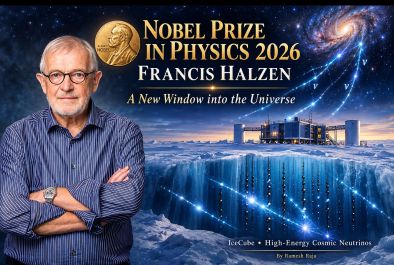
Yesterday’s Noble Prize Announcement, Francis Halzen, winner of the 2026 Nobel Prize in Physics, has helped humanity open another window into the Universe. Through the IceCube Neutrino Observatory, the Belgian-American physicist and an international team established high-energy neutrino astronomy, enabling scientists to investigate cosmic events through particles rather than light alone.
Born in Belgium in 1944, Halzen earned his doctorate at KU Leuven and joined the University of Wisconsin–Madison in 1972. Now 82, he receives the entire Physics Prize of 12 million Swedish kronor for his decisive contributions to IceCube and the discovery of high-energy neutrinos of astrophysical origin.
Neutrinos have very little mass, no electric charge and interact extraordinarily rarely with matter. They usually pass through Earth undetected. Their paths are not bent by magnetic fields, making them valuable messengers from distant cosmic accelerators. Halzen proposed detecting them in Antarctic ice in 1988.
 IceCube’s original array placed 5,160 light sensors across a cubic kilometer of ice, approximately 1.45 to 2.45 kilometers underground. When a neutrino interacts with matter, secondary particles produce faint Cherenkov light. Its pattern helps researchers estimate energy and direction. In 2013, IceCube reported 28 high-energy events supporting an origin beyond our solar system.
Halzen did not discover neutrinos themselves. His achievement helped establish a new way to study their cosmic population. Understanding nature’s energies has already transformed human life through electricity, electronics and medicine. Neutrino astronomy promises deeper knowledge, while its instruments may inspire future applications. A new energy source or medical treatment, however, cannot yet be promised.
This pursuit of knowledge reflects Alfred Nobel’s vision. The Swedish inventor’s will established prizes benefiting humanity, first awarded in 1901. Physics, Chemistry, Physiology or Medicine, Literature and Peace were the original categories; Economic Sciences joined in 1969 as a separate memorial prize. Awards are annual, sometimes withheld, and may be shared.
Through 2025, the six categories had produced 633 awards, involving 990 different individuals and 28 organizations. Halzen’s is the 120th Physics Prize. As of 7 October 2026, Physics has gone to Halzen; Chemistry to Henri B. Kagan and Kenso Soai for nonlinear effects and autocatalysis in asymmetric organic synthesis; and Medicine to Karl Deisseroth, Peter Hegemann and Georg Nagel for light-gated ion channels and optogenetics.
Literature will be announced on 8 October, Peace on 9 October and Economic Sciences on 12 October. Pakistan’s announcement times are 4:00 pm, 2:00 pm and 2:45 pm respectively, with Literature and Economics scheduled at those times at the earliest.
The Royal Swedish Academy of Sciences selects Physics, Chemistry and Economics; the Nobel Assembly at Karolinska Institutet selects Medicine; the Swedish Academy selects Literature; and the Norwegian Nobel Committee selects Peace. Presentation follows on 10 December, Nobel’s death anniversary. Sweden’s King presents five categories at Stockholm Concert Hall; the Norwegian committee’s chair presents Peace at Oslo City Hall.
Celebrated Physics laureates include Marie Curie, honored for radioactivity in 1903; Albert Einstein, particularly for the photoelectric effect in 1921; and Niels Bohr, for atomic structure in 1922. The subcontinent contributed C. V. Raman, winner in 1930 for light scattering; Indian-origin Subrahmanyan Chandrasekhar, honored in 1983 for stellar physics; and Pakistan’s Abdus Salam, who shared the 1979 prize for electroweak theory.
Pakistan’s relationship with scientists deserves reflection. Abdul Qadeer Khan received exceptional honors, but following his 2004 proliferation confession, he was pardoned and confined. He later retracted the confession; his scapegoating claim remains disputed. A court declared him free in 2009, and he received a state funeral in 2021. This controversy should not be equated with punishment for research.
Salam’s experience was different: he resigned from government advisory service after the 1974 constitutional exclusion of Ahmadis. Recognition nevertheless followed, including Nawaz Sharif’s 2016 approval of a center and fellowships bearing his name. Other scientists helped build national institutions, while university disputes, including Pervez Hoodbhoy’s 2020 departure from Forman Christian College, require examination without automatically attributing them to government orders.
 Our deeper challenge is giving evidence authority. The politically promoted water-car claim of 2012 showed the danger of endorsement before verification. Polio misinformation undermines vaccination, although government officially supports it. Antibiotic misuse exposes failures in practice and oversight. Cloud seeding is legitimate experimentation, but cannot replace sustained pollution control.
Public honors matter, but medals cannot substitute for a healthy scientific culture. Supporting researchers means maintaining equipment, protecting intellectual independence and judging claims through reproducible tests. Pakistan needs institutions that welcome difficult questions and reward careful work, rather than expecting discovery to emerge from ceremonial praise.
We use science daily, yet too often teach it through memorization. Where laboratories are absent, outdated or seldom used, students learn definitions without investigation. Functioning laboratories, trained teachers, practical examinations and sustained research funding must become priorities. Scientists deserve fair treatment regardless of faith. Halzen’s long journey reminds us that discovery requires patience, resources and freedom to question. Our classrooms must offer those beginnings.
(All photos provided by the author)
Read: Read History, Not Mythology
_______________
 Hailing from Gambat town of Sindh, Engr. Ramesh Raja, is a Civil Engineer, visionary planner, PMP certified and literary enthusiast with a passion for art and recreation. He can be reached at engineer.raja@gmail.com