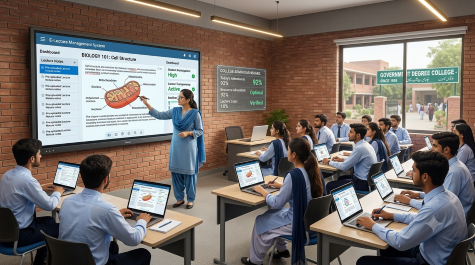
Smart Classrooms with E-Lecture Management Systems can transform colleges into modern learning environments where teachers can prepare and deliver lessons efficiently, students can learn more effectively, and administrators can manage institutions with greater transparency.
By Nuzair Ahmed Jamro
Moving from Traditional Classrooms to Smart Learning Environments
A classroom has always been a place where knowledge is shared, ideas are developed, and future generations are prepared. However, the way students learn and the way teachers deliver knowledge have changed dramatically around the world. Today, technology has become an important partner in education, helping teachers explain concepts better and enabling students to learn beyond the boundaries of a traditional classroom.
Across the globe, educational institutions are adopting smart classrooms, digital learning platforms, and online academic systems to improve teaching quality and institutional management. However, many colleges in Pakistan still depend on traditional methods where teachers rely mainly on textbooks, handwritten notes, printed materials, and manual record-keeping. While these methods have served education for decades, the changing needs of today’s students require a more flexible, interactive, and technology-driven approach.
Therefore, the time has come to rethink our classrooms—not by replacing teachers, but by empowering them with modern tools that make teaching easier, more effective, and more engaging.
Current Challenges in the Existing College Education System
Many public colleges continue to face challenges that affect the quality and efficiency of education. Faculty members often prepare lesson plans manually, carry teaching materials physically, maintain paper-based records, and depend on limited classroom resources. In many cases, valuable teaching content remains stored in personal files or devices, making it difficult to access, share, or reuse.
Similarly, students often depend heavily on handwritten notes and classroom explanations. If a student misses a lecture or needs additional revision, accessing the same learning material becomes difficult. Practical demonstrations, multimedia explanations, and interactive learning activities are also limited in many institutions due to the absence of digital facilities.
From an administrative perspective, monitoring academic progress, syllabus completion, faculty activities, and classroom utilization through manual systems is time-consuming and often inefficient. Without centralized digital platforms, institutions cannot fully utilize data for improving educational planning and decision-making.
These challenges indicate the need for a modern system where technology supports teachers, simplifies administration, and creates better learning opportunities for students.
The Proposed Solution: Smart Classrooms with an E-Lecture Management System
A Smart Classroom integrated with an E-Lecture Management System can provide a practical solution to these challenges. The purpose of this initiative is not to replace traditional teaching but to make it smarter, easier, and more effective.
Under this system, every faculty member would have a personal online account where they can prepare and upload their lesson plans, lectures, presentations, videos, assignments, and other teaching materials at any time. Teachers would not need to wait until they reach the college or classroom to prepare their content. They could access their accounts from anywhere—even from their homes or through a mobile phone.
A teacher travelling outside the city could still update a lesson plan, upload a new lecture, or review teaching material through a secure online platform. This flexibility would allow faculty members to manage their academic content according to their convenience while maintaining organized digital records.
Read: What is a Smart Classroom? The Complete Overview
When entering the classroom, the teacher would simply log into the system and access the required lecture without carrying books, files, USB drives, or printed notes. The entire lesson would already be available through the Smart Classroom platform, allowing teachers to focus more on explanation, discussion, and interaction with students.
Modern Smart Classrooms can also provide wireless connectivity options. Teachers can connect their Android mobile phones, tablets, or laptops directly with smart projectors and interactive displays, allowing them to share presentations, videos, documents, and digital content instantly without complicated wiring or technical difficulties.
This simple and user-friendly approach can make technology a natural part of everyday teaching.
Benefits for Teachers: Making Teaching Easier and More Effective
Teachers are the heart of any education system, and technology should serve as a tool to support them.
Smart Classrooms can reduce the burden of manual preparation by allowing faculty members to maintain their complete academic resources digitally. Lesson plans, course outlines, lecture presentations, and teaching materials can be organized in one place and accessed whenever required.
Instead of spending valuable time searching for files or preparing repeated notes, teachers can focus more on improving teaching methods, interacting with students, and providing practical guidance. Digital platforms also encourage better planning because teachers can prepare lectures in advance and maintain a structured teaching schedule.
Furthermore, faculty members can gradually build their own digital academic libraries containing years of teaching experience, research material, and educational resources.
Benefits for Students: Creating an Engaging Learning Experience
Students are the ultimate beneficiaries of digital transformation in education.
Smart Classrooms make lessons more interesting through videos, animations, digital demonstrations, and interactive presentations. Difficult topics that are challenging to explain through traditional methods can become easier through visual learning.
For example, scientific concepts, engineering processes, historical events, and practical demonstrations can be presented in a way that improves understanding and long-term retention.
Students can also access digital learning material outside the classroom, allowing them to revise lectures according to their own learning pace. This approach supports independent learning and provides equal access to educational resources.
Moreover, regular exposure to digital tools prepares students for modern workplaces where technology skills are becoming increasingly important.
Benefits for College Administration and Governance
Smart Classrooms can also transform the way colleges are managed.
When integrated with digital attendance systems, student information systems, online assessments, and academic dashboards, college administrations can monitor institutional performance more effectively.
Principals and academic managers can view important information such as syllabus progress, classroom activities, attendance trends, and academic performance through centralized digital reports.
This reduces dependence on paperwork, improves transparency, and enables administrators to make better decisions based on accurate information.
Digital records also support accountability by creating a systematic record of academic activities and institutional performance.
Long-Term Impact on Pakistan’s Education System
The introduction of Smart Classrooms is not simply a technology project; it is an investment in the future of education.
A digitally enabled college system can improve teaching quality, reduce administrative workload, strengthen transparency, and prepare students for the demands of a rapidly changing world.
For Pakistan, where millions of young people are entering higher education and the job market every year, improving the quality of learning is essential. Digital classrooms can help bridge the gap between traditional education and the skills required in the modern economy.
Implementation Roadmap: Starting with Pilot Colleges
A practical approach would be to introduce Smart Classroom projects initially in selected government colleges across Sindh. These pilot projects can evaluate effectiveness, identify challenges, and provide a model for expansion across the province.
The initiative should include classroom equipment, internet connectivity, faculty training, technical support, and a centralized E-Lecture Management System. After successful implementation, the model can gradually be expanded to more institutions.
Conclusion: Preparing Classrooms for the Future
The future of education is not about replacing traditional classrooms; it is about enhancing them. Teachers will always remain the most important part of learning, but technology can make their work easier and their impact greater.
Smart Classrooms with E-Lecture Management Systems can transform colleges into modern learning environments where teachers can prepare and deliver lessons efficiently, students can learn more effectively, and administrators can manage institutions with greater transparency.
The question is no longer whether educational institutions should adopt digital transformation. The real question is how quickly we can provide our teachers and students with the tools they need to succeed in the digital age.
Read: Climate Diplomacy in a Warming World
_______________________
 Nuzair Ahmed Jamro, hailing from Shikarpur, Sindh, is a Civil Servant. He writes on governance, public policy, and digital transformation. Email: najamro@gmail.com.