For Pakistan, climate change is not merely a headline in international newspapers; it is an everyday reality that millions experience firsthand.
By Nuzair Ahmed Jamro
“We are the first generation to feel the impact of climate change and the last generation that can do something about it.” Barack Obama
There was a time when climate change was discussed as a distant possibility, something future generations would have to confront. That time has passed. Today, whether it is the relentless heatwaves sweeping across Europe, wildfires consuming forests in North America, prolonged droughts in Africa, or devastating floods in South Asia, the message is unmistakable: climate change is no longer knocking at our door. it has already entered our homes. In an interconnected world, no nation can claim immunity from a crisis that transcends geography, politics, and economic boundaries. The climate emergency has become a shared reality, demanding shared responsibility and collective action.
Europe’s latest heatwave is a powerful reminder that even the world’s most developed economies are struggling to cope with increasingly extreme weather events. Hospitals are overwhelmed by heat-related illnesses, transport systems are disrupted, agricultural productivity is declining, and energy grids are operating under unprecedented stress. For decades, climate vulnerability was often perceived as a challenge primarily facing developing countries. However, nature has rewritten that narrative. As the old proverb reminds us, “Nature always has the last word.” The growing intensity and frequency of climate disasters leave little room for complacency, compelling every nation to rethink how it prepares for an uncertain future.
For Pakistan, however, climate change is not merely a headline in international newspapers; it is an everyday reality that millions experience firsthand. Despite contributing less than one percent of global greenhouse gas emissions, Pakistan remains among the countries most vulnerable to climate-related disasters. From deadly heatwaves in Sindh and prolonged droughts in Balochistan to glacial melting in Gilgit-Baltistan, worsening urban smog in Punjab, and recurring floods across the country, climate change continues to reshape lives, livelihoods, and landscapes. Every disaster leaves behind not only damaged infrastructure but also shattered dreams, disrupted education, weakened healthcare systems, and communities struggling to rebuild. Climate change, therefore, is no longer just an environmental issue. It is fundamentally a human development challenge.
Read: What Is Climate Change?
The catastrophic floods of 2022 painfully illustrated how climate disasters can reverse years of development within weeks. Millions of people were displaced, thousands lost their lives, crops were destroyed, livestock perished, and roads, schools, hospitals, bridges, and irrigation networks suffered enormous damage. The economic losses ran into billions of dollars, placing additional pressure on an already fragile economy. Yet behind these statistics are ordinary families who lost their homes, farmers who lost their livelihoods, and children whose education was interrupted. Climate change is ultimately measured not only in degrees Celsius but also in human suffering. That reality should continue to shape both national policy and global diplomacy.
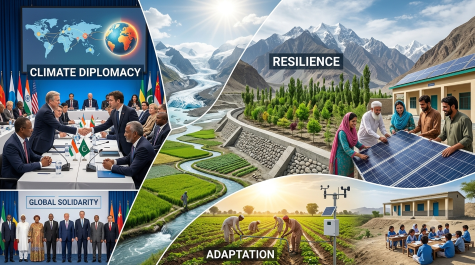
Recognizing these challenges, Pakistan has gradually strengthened its commitment to climate action. At the national level, the government has introduced the National Climate Change Policy, developed adaptation frameworks, promoted renewable energy initiatives, expanded large-scale afforestation programs, and enhanced the institutional capacity of disaster management authorities. Programmes focusing on ecosystem restoration, biodiversity conservation, sustainable agriculture, and water resource management represent important steps toward building resilience. Provincial governments have also begun integrating climate considerations into development planning, reflecting a growing recognition that environmental sustainability and economic development must go hand in hand. These initiatives provide a solid foundation, but much more remains to be done.
Pakistan has also emerged as an increasingly influential voice on the international stage. Through active participation in successive United Nations Climate Change Conferences (COP), the country has consistently advocated the principle of climate justice, arguing that nations least responsible for global emissions should not bear the heaviest burden of climate-induced disasters. Pakistan’s diplomatic engagement contributed significantly to global discussions on the establishment of the Loss and Damage Fund, while the country continues to call for greater access to climate finance, technology transfer, and capacity-building support for vulnerable developing nations. In doing so, Pakistan has transformed its climate vulnerability into a compelling diplomatic narrative that resonates across the Global South. Yet diplomacy alone cannot protect communities from the next flood or heatwave.
Indeed, the greatest challenge lies not in designing policies but in implementing them effectively. Financial constraints, institutional fragmentation, weak coordination among federal and provincial agencies, rapid urbanization, environmental degradation, and limited technical capacity continue to undermine climate resilience. Climate-related information remains dispersed across multiple institutions, while local governments often lack the resources needed to translate national policies into meaningful action on the ground. As the saying goes, “A chain is only as strong as its weakest link.” Unless governance systems become stronger, faster, and more responsive, climate policies will struggle to achieve their intended impact.
This brings us to a fundamental question: How can Pakistan transform climate vulnerability into climate resilience? The answer lies not only in stronger diplomacy but also in bold administrative reforms, digital innovation, scientific research, and effective governance. In an era driven by data and technology, climate resilience must be built as much in control rooms and digital platforms as in forests, rivers, and farmlands. The future belongs to nations that prepare today rather than react tomorrow.
Read: Forest Therapy: Nature’s Silent Medicine
___________________
 Nuzair Ahmed Jamro, hailing from Shikarpur, Sindh, is a civil servant and MS research fellow in Public Administration. He writes on governance, public policy, and digital transformation. Email: najamro@gmail.com.