

The world has already found the solutions. Karachi must now implement them.
By: Ramesh Raja
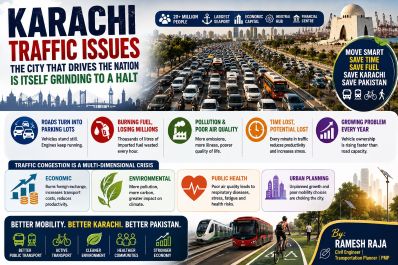
Karachi is Pakistan’s economic capital, its largest seaport, financial center, industrial hub and home to well over twenty million people. Every day, millions of people travel from Korangi, Landhi, Malir, Gadap, Surjani, Orangi, Baldia, Lyari and Clifton towards industrial estates, ports, offices, educational institutions and commercial centers. This daily movement keeps Pakistan’s economy alive.
Yet the city that drives the nation’s economy is itself slowly grinding to a halt.
Every morning and evening, Karachi’s roads become vast parking lots. Vehicles remain stationary for long periods while engines continue running, consuming thousands of liters of imported fuel every hour. Instead of transporting people efficiently, traffic congestion burns foreign exchange, increases transport costs, pollutes the environment and wastes valuable human time. The result is a city where economic productivity is increasingly lost on the roads.
Traffic congestion is therefore no longer merely a transportation issue. It has become an economic, environmental, public health and urban planning crisis.
Every minute spent in congestion reduces productivity. Every liter of fuel wasted increases Pakistan’s import bill. Every kilogram of carbon emitted contributes to climate change. Every hour spent in traffic increases stress, fatigue and respiratory diseases caused by deteriorating air quality.
The problem is becoming more serious every year because vehicle ownership is increasing much faster than road capacity.
Why Karachi Keeps Becoming More Congested

The traditional response to congestion has been simple: widen roads, construct flyovers and build underpasses.
These projects certainly improve traffic flow at specific locations, but international experience shows that they rarely provide permanent relief. New road capacity soon attracts additional traffic, a phenomenon transport planners describe as induced demand. Within a few years, congestion returns, often worse than before.
This explains why many cities that invested billions in roads eventually shifted towards integrated public transport systems instead.
Cities such as Singapore, London, Tokyo, Seoul, Hong Kong, Copenhagen and Stockholm did not solve congestion by building endless roads. They solved it by moving people rather than vehicles.
Karachi must now adopt the same philosophy.
Karachi Has Somehow Begun the Journey
Contrary to common perception, Karachi is not starting from zero.
The city has already taken important steps towards sustainable urban mobility. The Green Line and Orange Line Bus Rapid Transit (BRT) systems are operational, while the Red Line and Yellow Line BRT corridors are under development. The People’s Bus Service has expanded modern bus operations across the city, Pakistan’s first fleet of electric public buses has entered service, and dedicated Pink Bus and Pink Taxi services have improved mobility for women. These initiatives show that Karachi has already begun its transition towards modern public transport, although they remain isolated projects rather than parts of a fully integrated network.
The next challenge is integration.
Instead of treating every transport project as an independent scheme, Karachi must develop a single metropolitan transport system where buses, BRT, Karachi Circular Railway (KCR), future metro lines, tramways, feeder buses, ferries, cycling infrastructure and pedestrian facilities operate as one coordinated network.
A commuter should be able to leave home, walk a short distance to a nearby station, board a feeder bus, transfer seamlessly to BRT or KCR using a single ticket, and reach the workplace comfortably, safely and on time.
That is how successful mega cities operate.
The First Principle: Reduce Dependence on Private Vehicles
Every developed megacity follows one basic principle:
People abandon private vehicles only when public transport becomes a better alternative.
The objective is not to make life difficult for motorists. Rather, it is to make public transport so efficient, reliable and comfortable that people voluntarily choose it.
Transport planners describe these choices as alternative transportation modes or sustainable urban mobility. They provide citizens with practical alternatives to driving alone.
A modern city should provide a complete range of mobility options, including:
- Metro and subway systems
- Bus Rapid Transit (BRT)
- Karachi Circular Railway and commuter rail
- Light Rail Transit (LRT)
- Modern tram and streetcar systems
- High-quality public bus networks
- Shared taxis and minibuses
- Park-and-ride facilities
- Walking and pedestrian corridors
- Protected cycling infrastructure and bicycle sharing
- Carpooling and ride sharing
- On-demand shuttle services
- Ropeways and cable cars where suitable
- Water transport through ferries and water buses
- Electric scooters and micro-mobility
- Autonomous shared shuttles
- Passenger drones and future air taxis
The purpose of providing multiple transport choices is simple: citizens should not feel compelled to own or drive a private vehicle simply because no practical alternative exists.
 Discouraging Unnecessary Private Vehicle Use
Around the world, successful cities use balanced policies to reduce excessive dependence on private vehicles while simultaneously investing in public transport.
Some of the most successful measures include:
- Congestion pricing in busy commercial districts, as practiced in London and Singapore.
- Rational parking policies where parking is priced appropriately instead of being virtually free.
- Regulation of vehicle ownership through controlled registration systems.
- Fuel and environmental taxation to encourage efficient travel.
- Low-emission zones restricting highly polluting vehicles.
- Temporary odd-even vehicle management during periods of severe congestion.
- Car-free commercial districts prioritizing pedestrians.
- Dedicated bus lanes giving priority to public transport.
- Safe walking and cycling infrastructure.
- Reallocation of road space from cars to buses, bicycles and pedestrians.
- Promotion of carpooling, ride sharing and flexible office timings.
- Registration and annual road taxes linked to vehicle size and emissions.
These measures are not punitive. Their purpose is to ensure that limited road space is used efficiently while encouraging commuters to shift towards cleaner and more sustainable modes of transport.
However, these measures can only succeed when citizens are offered transport that is punctual, comfortable, affordable, safe and easily accessible.
That is where Karachi’s next transformation must begin.
Building a World-Class Public Transport System
The success of every modern megacity rest on one fundamental principle: move more people with fewer vehicles. Roads alone cannot achieve this objective. Public transport must become the backbone of urban mobility.
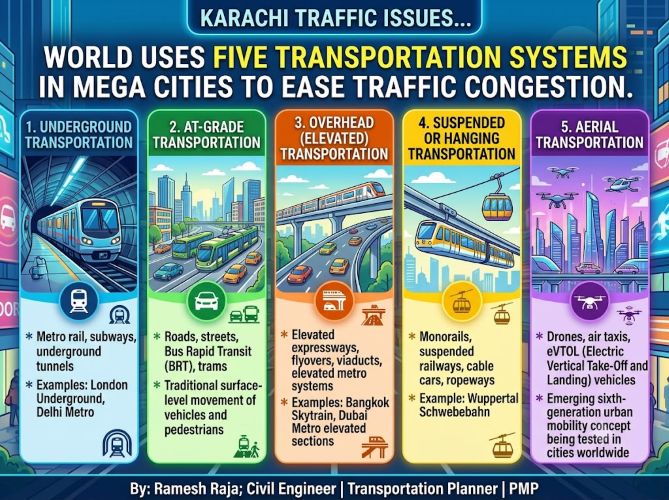
Around the world, cities have developed transportation systems on multiple levels, using every available space above, on and below the ground.
The Five Levels of Urban Transportation
The future of megacity transportation lies in integrating five transportation systems into one seamless network.
- Underground Transportation
The most efficient use of limited urban land is beneath the surface. Metro rail and subway systems in London, Tokyo, Delhi, Seoul and Shanghai move millions of passengers every day without occupying valuable road space.
Although expensive to construct, underground transport provides the highest passenger capacity, shortest travel time and least interference with road traffic.
Future expansion of Karachi should reserve major corridors where underground metro systems may eventually become feasible as population and travel demand continue to increase.
- At-Grade Transportation
Surface transportation remains the backbone of every city.
This includes Bus Rapid Transit (BRT), Karachi Circular Railway (KCR), Light Rail Transit (LRT), Trams, Public buses, Shared taxis, Pedestrian facilities, Cycling infrastructure etc.
Karachi has already initiated this transformation through Green Line and Orange Line BRT, while Red and Yellow Lines are progressing. The People’s Bus Service has significantly improved the quality of bus transport, while electric buses have introduced environmentally friendly mobility. These initiatives should now be expanded into every district of the metropolitan area rather than remaining isolated corridors.
- Elevated Transportation
Bangkok, Dubai and many Chinese cities successfully separate long-distance traffic from local traffic through elevated metro systems and elevated expressways.
Elevated transport is particularly suitable where underground construction is expensive or utilities make tunnelling difficult.
Future expansion corridors connecting Karachi Airport, Port Qasim, SITE, Korangi Industrial Area and Northern Bypass should be evaluated for elevated mass transit wherever economically justified.
- Suspended Transportation
Cable cars, ropeways and suspended monorails are increasingly being used in mountainous cities and across rivers.
Although Karachi’s terrain is generally flat, ropeways may become useful for tourism, waterfront connectivity and specialized urban corridors in the future.
- Aerial Transportation
Urban air mobility is no longer science fiction.
Electric Vertical Take-Off and Landing (eVTOL) aircraft, autonomous passenger drones and cargo drones are already undergoing commercial trials in several countries.
While Karachi’s immediate priority remains conventional public transport, long-term planning should reserve space and regulatory frameworks for future aerial mobility technologies.
Karachi Circular Railway: The Missing Backbone
No modern megacity depends solely on buses. The Karachi Circular Railway (KCR) should become the backbone of Karachi’s transportation system.
The railway already possesses an established alignment connecting many residential and commercial areas. Modernizing and fully integrating KCR with BRT, feeder buses and future metro systems can transform daily commuting for millions of citizens.
Every KCR station should function as an integrated transport hub where commuters can transfer conveniently between buses, taxis, ride-sharing services, cycling facilities and pedestrian routes without unnecessary delays.
The Return of Trams
Many cities removed tram systems during the twentieth century, believing buses and private cars would replace them.
Today the opposite is occurring. Cities such as Melbourne, Istanbul, Strasbourg, Amsterdam and Dubai have invested heavily in modern tram systems because they are environmentally friendly, energy efficient, comfortable and capable of moving large passenger volumes through dense urban corridors.
Karachi once had trams. Their reintroduction along major commercial corridors could significantly reduce dependence on private vehicles while improving accessibility and stimulating economic activity.
One Ticket, One Journey
The greatest strength of successful transport systems is not individual projects but integration.
A commuter should never need separate tickets for buses, BRT, KCR, ferries or future metro services.
One smart card or mobile application should allow travel across the entire metropolitan transport network.
Similarly, transport schedules should be synchronized so that passengers spend minimum time waiting during transfers.
Last-Mile Connectivity
One of the biggest reasons people avoid public transport is inconvenience.
If a commuter must travel several kilometers simply to reach the nearest station, the private car becomes the preferred option.
Every neighborhood should therefore be connected through feeder buses, neighborhood shuttle services, shared bicycles and safe pedestrian routes.
Ideally, every resident should reach a public transport station within ten to fifteen minutes from home.
Park-and-Ride: Completing the Journey
Public transport succeeds when it serves both city residents and suburban commuters.
Large park-and-ride facilities should therefore be developed near KCR stations, BRT terminals and major transport interchanges.
Commuters travelling from peripheral areas can safely park their vehicles and complete their journey using public transport.
This reduces congestion in commercial centers while making public transport more attractive.
Parking Should Be Planned Before Buildings
One of Karachi’s greatest planning deficiencies is the absence of long-term parking policy.
Every new commercial district attracts thousands of vehicles, yet parking provision rarely keeps pace with development.
The government should prepare a metropolitan parking master plan covering city centers, transport hubs, business districts, hospitals, universities and shopping areas.
Where economically justified, obsolete, structurally unsafe and underutilized buildings should be identified through engineering surveys. Subject to legal procedures and heritage considerations, these sites should be acquired for multi-story public parking, transport terminals, parks and civic amenities instead of permitting indiscriminate high-rise development that further increases traffic demand without supporting infrastructure.
Intelligent Transport Systems
Modern traffic management depends increasingly upon technology rather than additional road construction.
Karachi should gradually introduce Intelligent Transport Systems (ITS) incorporating:
- AI-based adaptive traffic signals
- Real-time traffic monitoring
- CCTV-assisted traffic management
- Automatic incident detection
- Digital variable message signs
- Smart parking guidance systems
- Mobile journey planning applications
- Integrated traffic control centers
These technologies improve traffic flow, reduce delays and enable faster emergency response without constructing additional roads.
Traffic engineering in the twenty-first century is no longer confined to asphalt and concrete. It increasingly depends upon digital intelligence, integrated planning and efficient management.
 Moving Freight Without Choking the City
Karachi is not only a residential city but also Pakistan’s largest commercial and industrial center. Every day thousands of trucks, trailers, oil tankers and container carriers move between Karachi Port, Port Qasim, industrial estates and the national highway network.
Freight transport is essential for the economy, but when heavy vehicles mix with commuter traffic during peak hours, congestion increases dramatically.
The solution is not to ban freight movement but to manage it intelligently.
Major logistics parks should be established near the city’s outskirts where containers can be consolidated before entering the urban road network. Heavy trucks should be encouraged to operate during designated off-peak hours, while dedicated freight corridors should connect the ports directly with industrial zones and national highways. Intelligent scheduling and digital freight management systems can reduce unnecessary truck movements and improve supply chain efficiency.
Water Transport: Karachi’s Untapped Opportunity
Few cities possess the natural advantage that Karachi enjoys.
With its long coastline, Karachi Harbour, Manora, Kemari and Korangi Creek, the city has enormous potential for water-based public transport.
Many world cities including Istanbul, Sydney, Hong Kong, Bangkok and Dubai successfully use ferries and water buses to reduce pressure on roads.
Karachi should explore regular ferry services connecting Kemari, Manora, Clifton, DHA, Port Qasim and future coastal developments. Water transport is environmentally friendly, energy efficient and can significantly reduce travel time along selected corridors.
Walking and Cycling Must Become Respectable Modes of Transport
A surprising proportion of daily urban trips are less than five kilometers. Such distances do not always require motor vehicles.
Unfortunately, Karachi’s footpaths are frequently encroached upon, discontinuous or poorly maintained, while dedicated cycling facilities are almost non-existent.
A modern city must first become walkable. Continuous pedestrian footpaths, shaded walkways, safe crossings, pedestrian bridges where necessary, cycling tracks and bicycle-sharing systems should become integral parts of every road improvement project. Good transport planning begins with pedestrians, not automobiles.
Universal Accessibility
Transport systems must serve everyone. Women, senior citizens, children and persons with disabilities should be able to travel independently and safely.
Every bus stop, railway station, footpath, pedestrian crossing and transport terminal should provide ramps, tactile paving, lifts where necessary, adequate lighting, surveillance cameras and universal accessibility standards. An inclusive city is also a more efficient city.
Public Transport Must Compete with the Private Car
Many people assume that citizens prefer private vehicles. In reality, most people prefer whatever is faster, safer, more comfortable and more reliable.
Public transport should therefore meet five essential standards:
- Reliable and time-bound services.
- Comfortable seating and air conditioning where appropriate.
- Affordable fares.
- Safe travel for women, children and elderly passengers.
- Easy access from residential neighborhoods through feeder services.
When these conditions are met, the shift from private vehicles occurs naturally.
Integrating Transport with Urban Planning
Transport planning cannot succeed in isolation. Every new housing scheme, apartment complex, shopping mall, hospital, university, office tower and industrial estate generates additional traffic.
Unfortunately, urban expansion in Karachi has often occurred without adequate consideration of transport capacity.
Future development approvals should therefore require comprehensive Traffic Impact Assessments prepared by qualified transportation engineers.
Road capacity, parking demand, pedestrian movement, public transport accessibility and emergency access should all be evaluated before granting planning permission.
Urban planning should encourage Transit-Oriented Development (TOD), concentrating residential, commercial and mixed-use developments around KCR stations, BRT corridors and future metro lines. This reduces travel distances, promotes public transport and limits urban sprawl.
Environmental Sustainability
Transport policy is also climate policy. Cleaner transport reduces greenhouse gas emissions, improves air quality and protects public health.
Karachi should continue expanding electric buses while encouraging electric taxis, charging infrastructure and renewable energy for transport facilities. Tree plantations along transport corridors, green buffers and climate-resilient road designs should become standard engineering practice.
Every commuter who shifts from a private car to public transport contributes to cleaner air and lower fuel consumption.
Intelligent Governance
One of Karachi’s greatest challenges is fragmented institutional responsibility.
Roads, buses, railways, traffic management, parking and land use are administered by different organizations with overlapping responsibilities.
The city requires a single metropolitan transport authority responsible for integrated planning, policy formulation, project implementation, operations, traffic management and long-term mobility planning.
Transport decisions should be based on engineering studies, traffic modelling, environmental assessments and public consultation rather than short-term administrative considerations.
Financing the Future
Developing a world-class transport system requires sustained investment.
Fortunately, international experience demonstrates that transport infrastructure can finance itself through innovative mechanisms.
Potential funding sources include:
- Public-private partnerships.
- Congestion pricing revenues.
- Paid public parking.
- Land value capture around transport stations.
- Commercial development of transport hubs.
- Climate finance for low-carbon transport.
- International development financing.
- Municipal transport bonds.
Investment in public transport should not be viewed as expenditure but as a long-term investment in economic productivity, public health and environmental sustainability.
A Vision for Karachi 2050
Karachi now stands at a decisive moment in its history.
It can continue expanding roads while congestion grows worse each year, or it can embrace the planning principles that have transformed the world’s leading megacities.
The city has already taken encouraging steps through the Green and Orange Line BRT systems, the People’s Bus Service, electric buses and the ongoing Red and Yellow Line projects. These achievements provide a strong foundation, but they must now evolve into a fully integrated metropolitan transport network.
The revival of the Karachi Circular Railway should become the backbone of commuter transport. Modern tram systems should return to major commercial corridors. Future metro lines, ferries, feeder buses, cycling infrastructure, pedestrian facilities and park-and-ride terminals should all function as one coordinated system supported by intelligent traffic management and unified ticketing.
Equally important, Karachi must gradually discourage unnecessary dependence on private vehicles through balanced policies that improve mobility rather than restrict it. The objective is not to wage war against motorists but to provide public transport that is so efficient, reliable and comfortable that it becomes the preferred choice.
The true measure of a modern city is not the number of flyovers it builds, but the ease with which its people move.
Every liter of fuel saved reduces Pakistan’s import bill. Every commuter shifted from a private vehicle to public transport reduces congestion. Every minute saved increases national productivity. Every reduction in emissions protects public health and strengthens climate resilience.
Karachi deserves more than temporary traffic relief. It deserves a comprehensive mobility revolution founded on engineering excellence, scientific planning, environmental responsibility and visionary leadership.
The solutions are already known. Many of them have already begun. What remains is the determination to integrate them into a single master plan that places people, not vehicles, at the center of Karachi’s future.
If this vision is pursued with consistency and commitment, Karachi will not merely overcome congestion. It will emerge as one of South Asia’s most sustainable, connected and globally competitive megacities.
Read: Pakistan’s Highways Under Pressure
______________________
 Ramesh Raja is a civil engineer with a Master’s in Transportation Engineering, a PMP, and an independent writer. He can be reached at engineer.raja@gmail.com


