With responsible integration of NADRA/B-Form, Union Council and education data, the province can begin planning today for the classrooms, teachers and schools that its children will need tomorrow. That would be more than digitalization. It would be a shift from counting children to planning for their future.
By Nuzair Ahmed Jamro
Every child born in Sindh represents a future student. Yet, when we plan our government schools, we often look at the children who are already sitting in classrooms rather than those who will enter them in the years ahead. This is where digital technology can offer Sindh a practical opportunity.
If birth registration, NADRA’s B-Form records, Union Council data and the Sindh government’s school information systems are carefully connected, the government could begin planning schools before classrooms become overcrowded. It could anticipate where new admissions are likely to increase, where additional classrooms will be needed and where more teachers will eventually have to be appointed. In other words, instead of simply counting students after they enter school, Sindh can start planning for children before they reach the school gate.
A child’s record can become a planning tool
Today, a child’s birth and registration are primarily administrative matters for the family and the state. However, with appropriate safeguards, this information can also help government planners understand how communities are changing.
When a child is registered through the Union Council and later receives a NADRA B-Form, the government gains an important demographic indicator. If thousands of children are being registered in a particular Union Council, it is reasonable to expect that many of them will eventually need access to a government school.
This does not mean that NADRA should simply hand over personal information to the education department. Children’s data must be protected. Rather, the relevant government institutions should establish a secure and legally authorized mechanism for sharing limited information, particularly aggregated data needed for planning.
For example, education planners may not need to know the names or CNIC details of individual children. They may simply need to know that a particular Union Council has 1,200 children who are likely to reach primary-school age within the next three years.
That information alone could be extremely valuable. From admission to prediction. At present, admission is largely the point at which a child enters the formal education system. We should think beyond that. Suppose a Union Council has recorded a growing number of births over several years. As these children receive B-Forms and approach school age, the government could estimate how many are likely to seek admission to nearby government schools.
The information could then be connected with existing school data. For example:
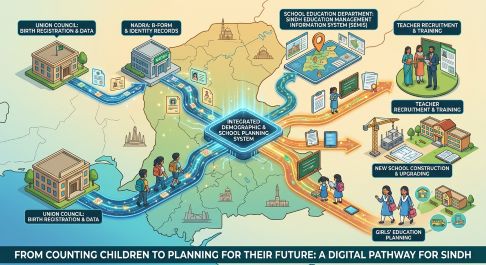
Birth registration → B-Form → school-age projection → expected admissions → existing school capacity → classroom requirement → teacher requirement → future school development.
This simple chain could change the way Sindh plans education. Instead of discovering a shortage after hundreds of children arrive at a school, planners could identify the shortage years in advance.
The Union Council can become the starting point
The Union Council is particularly important because it provides a local geographical picture. A district-level figure can tell us that the population is increasing. However, it does not necessarily tell us where the increase is happening. One UC may have a declining population, while another nearby UC may be experiencing rapid growth because of new settlements, migration or expanding residential areas.
Therefore, Sindh’s education planning should increasingly operate at the UC and school-cluster level. A digital dashboard could show planners how many children are already of school-going age and how many are likely to enter school in the coming years.
This could help answer very practical questions:
Where will new admissions increase?
Which government schools are likely to become overcrowded?
Where additional classrooms should be constructed?
Which schools need upgrading?
Where will additional teachers be required?
And, perhaps most importantly, where is a completely new government school likely to be needed?
Planning teachers before the shortage appears
The issue is not only classrooms. A new classroom without a teacher does not solve the education problem. Sindh’s government schools already face challenges related to teacher availability, uneven distribution and changing enrolment patterns. Therefore, future student projections should also become part of teacher planning.
If demographic data suggests that a particular area will gain hundreds of new students, the Education Department can estimate its future teacher requirement according to approved staffing standards. This would allow the government to prepare recruitment, posting and rationalization plans in advance. Consequently, teacher management could become more responsive to actual and expected demand rather than relying only on existing vacancies.
School construction should follow evidence
School development is not a process that can be completed overnight. Identifying land, preparing feasibility studies, developing PC-I proposals, allocating funds, completing procurement and constructing buildings all take time.
Therefore, waiting until a school becomes severely overcrowded before starting expansion is not good planning. Imagine that government data shows that a UC currently has 600 children enrolled in government primary schools but another 400 children are expected to reach school-going age over the next few years.
That information should trigger a planning discussion today. Perhaps the existing schools can accommodate the additional children after adding classrooms. Perhaps a nearby school has spare capacity. Perhaps a girls’ school is required because distance is preventing girls from attending. Or perhaps a new school is genuinely necessary because settlements are too far from existing facilities. Digital data cannot make all these decisions automatically, but it can give planners the evidence they need to make better decisions.
From SEMIS to a predictive education system
Sindh already has an important foundation in the form of the Sindh Education Management Information System (SEMIS). School-level information about enrolment, teachers and infrastructure can provide a picture of the existing education system. The province also has geographical information about schools, which can help planners understand where educational facilities are located.
The next step should be to connect this existing information with demographic trends. In simple terms, SEMIS can tell government what exists today. NADRA and Union Council data, when appropriately aggregated and securely shared, could help indicate what the future demand may look like. Together, these systems could give planners a much more complete picture.
A digital dashboard for every UC
Imagine a government education dashboard where an officer can select any Union Council in Sindh. The dashboard could show:
- Existing number of government schools;
- Current student enrolment;
- Available classrooms;
- Current teacher strength;
- Children approaching school age;
- projected new admissions;
- expected gender-wise enrolment;
- Distance from settlements to existing schools;
- projected classroom requirements;
- projected teacher requirements; and
- Whether the area may require expansion, upgrading or a new school.
Such a system would be particularly useful for district education officers, school planners, the School Education Department and development authorities. It could also improve the preparation of the Annual Development Program (ADP) by providing stronger demographic evidence for proposed school schemes.
It could also help girls’ education
This approach could be especially valuable for improving girls’ access to education. In many parts of Sindh, distance, safety, availability of girls’ schools and social conditions influence whether families send daughters to school. If demographic data shows that a UC has a growing population of school-age girls but nearby girls’ schools have limited capacity, planners could identify the problem much earlier.
The answer might be additional classrooms, a new girls’ school, and an upgrade from primary to middle level, transport arrangements or additional female teachers. Thus, better data could support not only more schools, but more appropriate schools.
Privacy must come first
However, digitalization must not come at the cost of children’s privacy. NADRA records and children’s B-Form information are sensitive. Therefore, any integration between NADRA, Union Councils and the School Education Department should operate under clear legal authority and strict data-protection arrangements. For planning purposes, most information should be aggregated and anonymised. There is no need for an education planner to see the personal details of every child in a UC simply to determine that 700 children may require primary-school places in three years. The principle should be simple: Use data to plan services, not to unnecessarily expose people.
Access should be restricted, systems should maintain audit trails, and information should only be shared for clearly defined government purposes. A different way of looking at education planning. The real value of this proposal is not the technology itself. Technology is only a means. The real objective is to make Sindh’s government education system more responsive to the people it serves. For decades, education planning has often focused on existing shortages: not enough classrooms, not enough teachers, not enough schools. We should now ask a different question:
Where will the next shortage emerge?
If we can answer that question before the shortage becomes a crisis, government planning will become more efficient. A growing settlement should not have to wait until children are sitting three to a bench before additional classrooms are sanctioned. Parents should not have to travel long distances because a girls’ school was not planned in time.
Teachers should not be transferred or recruited only after enrolment has already increased beyond the capacity of a school. And children should not become statistics only after they enter a classroom.
From counting children to planning for them
Sindh has a valuable opportunity to bring together institutions that already hold different pieces of the population and education picture.
Union Councils know about births and local population changes. NADRA provides a national identity and B-Form framework. The School Education Department knows about schools, teachers and enrolment. SEMIS provides an important education information base.
The missing step is to connect these pieces in a responsible and secure manner so that they can support long-term planning. The goal should not be to create another complicated database. Instead, Sindh needs an integrated system that can turn existing government information into practical decisions.
A child’s registration today could help predict tomorrow’s school demand. Tomorrow’s school demand could help determine the classrooms required. The number of classrooms could help determine teacher requirements. And together, these projections could guide future school development and public investment. This is how digital governance can become meaningful for ordinary citizens.
The success of digitalization should not be measured by how many databases government creates. It should be measured by whether a child finds a school when he or she reaches school age, whether there is a classroom available, whether a qualified teacher is present and whether that school is close enough for the family to use it.
Sindh should not wait for tomorrow’s children to arrive before planning for them.
With responsible integration of NADRA/B-Form, Union Council and education data, the province can begin planning today for the classrooms, teachers and schools that its children will need tomorrow. That would be more than digitalization. It would be a shift from counting children to planning for their future.
Read: From Water Scarcity to Water Security
__________________
 Based in Shikarpur, Sindh, the writer is a civil servant and MS research fellow in Public Administration. He writes on governance, public policy, and digital transformation. Email: najamro@gmail.com.