A newly appointed official’s first taste of systemic corruption thrusts him into a profound moral crisis, leading him into the city’s dark underbelly to abandon what remains of his innocence. There, an unexpected encounter with another kind of “first time” forces him to confront the true cost of compromise and the enduring weight of his conscience.
By Mohammad Ehsan Leghari
It was not easy for Hassan. Yet the truth was that the question had not descended upon him suddenly. For a long time it had been twisting inside the depths of his soul like a snake, only refusing to appear in the shape of words. When he looked into the lifeless eyes of the clerk in the office and asked, “What is this?” his voice carried not only surprise but a hidden longing: if only the man in front would say something that would shatter the idol of doubt inside him. But the answer was simple, clear, and in that very simplicity lay its heaviest weight: “Sir, this is your share… three percent.”
“My share?” Hassan repeated the words as though tasting something unknown on his tongue. Share; the word sliced through him like a blade. At that moment everything arrived at once inside him — his father’s medicines, Zeenat’s marriage, the leaking roof of the village house, and the books of justice he had read in the university library. None of it willing to yield to the other.
“I need a cigarette,” he said.
While lighting it he realized he had now become a “Sahib”; the title for which his father had spent his entire youth rolling in the mud of the fields, for which he had sold the good years of his back so that a son might one day stand upright in an office and carry a pen instead of a plough. The first drag did not strike his lungs but landed straight on his conscience, and he began to cough violently.
In the evening he phoned Zahir. They had been friends since university; the kind of friendship built not on sameness but on opposition, each one a mirror that showed the other what he had chosen not to become. Zahir came. There was laughter and banter, and during that casual talk Hassan finally opened what he had been carrying like a stone. “Zahir,” he said quietly, “I’m still a virgin.”
Zahir looked at him a moment, then laughed; not the laughter of someone mocking, but of someone who genuinely cannot locate the problem. “Hassan, yaar. You’re a full Sahib now.” He shook his head the way you shake it at a child afraid of the dark. “It’s not innocence you’re holding onto. It’s just something that hasn’t happened yet.”
That was the thing about Zahir. He wasn’t entirely wrong. He simply lived in a world where certain losses had no name.
And perhaps that was why Hassan did not refuse when Zahir stood and nodded toward the door. He had taken the envelope. He had held it, counted what it meant, and put it in his pocket. If the threshold had already been crossed in that office; if the first virginity was already gone, then what exactly was he still protecting?
Zahir led him through the dark lanes where life was weighed and sold only in exchange for money.
In that alley even the air had dried up. There was only the filthy water of the drain and the dim light of broken bulbs. Outside an old house, Masi was bargaining with Zahir over the price in a low, fast voice.
But Hassan’s eyes fell on the old woman sitting completely silent just outside the room. Her face looked like a withered tree whose roots had long lost every drop of life. She was not crying. She was not praying. She was simply sitting; the way people sit when they have finished with all the things sitting can be for.
When Hassan drew closer, the woman looked up. There was no complaint in her eyes. Only a hollowness that had no bottom. In a very faint voice she said, “Son… please take care of her. Today is her first time.”
‘Son’. The word landed somewhere it could not be moved from.
He looked at the broken house, the ageing furniture, her face far older than her years. People called this a profitable trade. Yet profit had clearly never reached this woman. He did not know what to do with that thought, so he carried it inside with him.
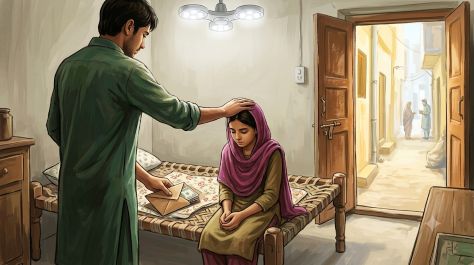
The girl sat on the edge of the charpoy, silent, hands folded in her lap. Her dupatta was slightly crooked. Nobody had straightened it. She was looking at a point near his feet; not at his feet, but near them, the way you look when you are trying to be somewhere else entirely.
Hassan stood in the middle of that small room. In her stillness he saw something he recognized without being able to name it — the particular stillness of someone who has learned to make herself small, the way Zeenat used to go quiet whenever their father’s voice rose in the next room. His hands were trembling. He took out the envelope from his pocket — the first “share” he had received from the clerk. He began to count the notes. First, second, third. Then he stopped. The money had come from a system that bled people like this woman, the money had come from somewhere beyond this room. Somewhere that had quietly made rooms like this possible.
But it was the only direction his hands could move. Without another word he placed the entire amount on the bed. He placed his hand briefly on the girl’s head — not the way he had come there to touch her, but the way an older brother lays a hand on a younger sister without words.
He did not know, walking out, whether what he had just done was honesty or cowardice or simply the fear of his own Zeenat. Perhaps all three were the same thing with different faces.
Without a word he descended the stairs quickly. Outside, Zahir was calling after him, confused. Hassan did not stop.
The alley was still dark. The stench still there. The same broken bulbs burning above the same filthy drain. He walked toward the main road without looking back. He had left the envelope behind and felt, for a moment, strangely clean. But the office would be there tomorrow. The clerk would be there tomorrow. And the envelope — the next one, and the one after that — would find its way to his desk with the same quiet, patient certainty as before. He did not know how a man walked back into that room and remained, in any meaningful sense, himself. He walked on, and did not know.
Read: The Pain of Being Progressive
_________________
 The author is a water expert, former Sindh member of Indus River System Authority (IRSA), and a prolific writer