Stories of Karachi’s Taxi Drivers from 1993 to 2000
Zaffar Junejo
[Author’s Note: I joined a non-government organization in mid-1993. In those days, we were frequent travelers to other Asian countries, and during that period I maintained a diary. I once showed the notes to Muhammad Ibrahim Joyo — the legendary scholar, translator, and intellectual giant of the Sindhi world — who suggested categorizing the entries by theme and getting them published. He recalled that long ago, perhaps in 1955, the Sindhi journal Mehran had launched a similar idea titled ‘Hik Deenh Ji Ghaleh’ (The Story of a Day), even offering a prize for it. He himself had submitted the first story, he told me with a smile, just to set a standard for other writers. Later, Maulana Ghulam Muhammad Girami, a scholar of high standing and journalist; Shamsher ul Haidri, a distinguished Sindhi poet, journalist, and playwright; and Siraj ul Haq Memon, an iconic novelist, linguist, and journalist, all contributed their observations of a single day. These writings were published until 1968.
I agreed with Joyo Sahib that I would group the write-ups by subject and get them published, but I failed to do so. Recently, I sat down to organize my notes. I found various entries about the taxi drivers of Karachi city. Some were very brief and incomplete; others were short but held a finished truth. I have chosen five stories from each year, all of them gathered from the drivers of those cars. In total, there will be thirty-five stories covering the period from 1993 to 2000.
On the surface, these pieces appear to be simple narratives. However, beneath the prose, they depict the complex socio-political and cultural landscape of Karachi during those turbulent days. They are the echoes of a city in motion.]
Of Jugaarr and Kabaarr
The sun had dropped behind the buildings, but the heat stayed in the asphalt. It was a Wednesday. I came out of the Karachi Theosophical Society building, opposite Radio Pakistan on MA Jinnah Road—the old Bandar Road. Inside, Dara Mirza, the president of the Society, had just finished the weekly study class. We had talked of spirituality, comparative religion, and the ethics of life. My mind felt clear, but the street was noisy and thick with exhaust.
I walked down to the Thomas & Thomas bookshop. I took a quick round of the shelves and bought Bertrand Russell’s In Praise of Idleness. It felt heavy and good in my hand.
Outside, the yellow taxis were lined up against the curb. I went to the first one.
“Gulshan-e-Iqbal,” I said.
The driver was an old man, somewhere in his fifties. He was bulky, his shoulders wide against the seat. We negotiated. He wanted more, but he settled for four hundred and fifty rupees.
“Get in, Janab,” he said.
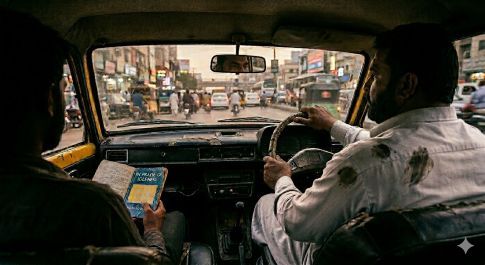
I sat in the back. He put the car in gear.
“How is your health, Sahib?” he asked.
“I am fine,” I said. It was what one always said.
He did not reply. He made a long pause, then turned left onto Aga Khan III Road. He took the round at the crossing and joined MA Jinnah Road again. The traffic was a solid mass of metal and horns. Then the road widened, the engines became more distant, and the noise lowered.
“Nowadays,” the driver said, looking straight ahead, “I beg God for only two things.”
“What are they?”
“That the price of gas does not rise, and that the Shershah market does not close.”
He turned right at the Cosmopolitan Society cut. The car bounced over a rut.
“There should be many more places like Shershah,” he said, “and they should sell every item a man needs.”
“Why do you say that?” I asked. “In Shershah, most of the things are secondhand. They are used, smuggled, or stripped from stolen cars.”
He remained silent. He drove with both hands heavy on the wheel. He let my words hang in the hot air of the cab until they meant nothing.
“If there is no Shershah,” he said finally, “no taxi driver can survive. How else can we buy parts? A new item—a grease pack or a dhaba pack—is beyond us. An ordinary man cannot touch them. The prices are too high.”
He glanced at me in the rearview mirror. His eyes were tired.
“So,” he said, “what do you think?”
I looked up from the Russell book in my lap.
“I think you are right,” I said. “But how long can a country work that way?”
We reached the crossing at Hasan Square. The driver shook his head.
“Sir, yeh mulk jugarr aur kabarr pe to chal raha hai,” he said. “This country survives only on tricks and scrap.”
He looked at me in the mirror. I nodded to let him know I agreed.
We fell silent again. The engine whined as we crossed the National Institute of Public Administration.
“My stop is coming,” I told him. “Two or three minutes.”
He nodded. “If my conversation hurt you, Sahib, please forgive me.”
“It was fine,” I said.
We approached the Sindh Technical Board office. I told him to pull over. He stopped. I paid him his fare and thanked him. He went back into the traffic.
***
Lata, Love, and Jamshoro
The terminal at Karachi was cold. A sharp winter wind blew off the Arabian Sea, cutting through the concrete walkways. It was the first day of the Eid holidays. The airport was crowded with people carrying heavy bags, their breath pluming white in the morning air.
I walked past the long, miserable queue of people waiting for airport taxis. They stood with their collars turned up against the chill. I did not want to wait in line. I remembered the scrap of paper in my pocket. A friend from an NGO in Hyderabad had given it to me a month ago in Islamabad. “Call him with my reference,” he had said. “The manager is Sultan. He is a good man.”
I stepped into a quiet corner near the brick wall and dialed.
The phone rang twice. A deep, clear voice answered. “Sultan speaking from Hyderabad.”
“My name is Asif,” I said. “Joyo Sahib from the NGO gave me your number.”
“Yes,” Sultan said. “Sahib told me about you. Your number is in my book. Where are you, Saeen?”
“I am at Karachi airport. I need to go to Hyderabad.”
“Hold,” Sultan said.
The line went quiet. I watched the clouds moving low over the parking lot. Then his voice came back.
“My driver is already in Karachi. He has just dropped a passenger. He will call you in ten minutes.”
“Thank you,” I said.
The call came in eight minutes. The voice on the other end was young and respectful. He told me he was waiting in the main parking lot.
I walked through the cold air to the cars. A young man stepped forward from a white sedan. He was about twenty years old, wore a neat sweater, and carried himself with a quiet humility.
“Assalam-o-Alaikum, Saeen,” he said. “I am Khadim. I am your driver.”
“Walaikum-as-Salam, Khadim,” I said.
He took my travel bag and placed it gently in the backseat. It was an old gesture, a polite invitation. It meant the front seat was mine. I climbed into the passenger side, and he shut the door against the winter wind.
He started the engine and drove toward Malir Cantonment to bypass the city traffic. The heater began to blow warm air against my boots.
“I know your work, Saeen,” Khadim said, keeping his eyes on the road. “You work for the NGO. Joyo Sahab told us.”
“Yes,” I said. “We do what we can.”
He reached toward the dashboard. “May I play the tape recorder?”
“You may.”
“What kind of music do you prefer, Saeen?”
“Old Indian songs,” I said.
Khadim smiled. It was a genuine smile that warmed his young face. “Lata,” he said simply.
He pushed a cassette into the slot. I saw the black plastic and the distinct DTK label. The tape hissed for a moment, and then the acoustic guitar and the clean, timeless voice of Lata Mangeshkar filled the warm cabin of the car. It was “Aaj Phir Jeene Ki Tamanna Hai.”
The car smoothed out onto the Super Highway. The landscape turned into hills and dry winter scrub. The songs changed with the miles. “Lag Jaa Gale” played, followed by “Tujhe Dekha To” and “Ek Pyar Ka Naghma Hai.” The recording was clear and the bass was deep.
“This is a good selection,” I said. “The sound is very good.”
“Thank you, Saeen,” Khadim said, his voice proud. “It is my personal choice. I chose each song myself and had them recorded.”
“Where did you get it done?”
“A small shop opposite the Reshan-Bazar Charrhi, on Station Road,” he said. He looked at me sideways to see if I knew it. “Perhaps you do not know the spot. It is near the Goal Building in Hyderabad.”
He spoke about the songs with a quiet intensity. His eyes brightened as he explained the transitions between the tracks.
Near the edge of the hills, he pulled the car off the highway without asking. He stopped in front of the Quetta Darbar Hotel. It was a roadside dhaba made of concrete blocks, with wood smoke rising from the back.
“Just have a cup of tea, Saeen,” Khadim said gently. “You have traveled from Islamabad. You must be tired. I also feel the need for tea.”
“All right,” I said.
He got out into the cold wind, his shawl wrapped tight around his shoulders. He ordered two cups of strong, sweet mixed tea from the boy at the stove, then came back to my window.
“If you want to have your tea inside the car where it is warm, it is okay,” he said.
“I will stay here,” I said.
I drank the hot tea from the small glass cup inside the warm car. Khadim stood outside by the hood, drinking his and looking out over the grey highway. We stayed there twenty minutes—long enough to break the fatigue of the road.
He came back inside, collected the empty glasses, and started the engine. He looked at me.
“Do you want anything else to eat, Saeen?”
“No,” I said. “The tea was good.”
He shifted into gear and whispered, “Bismillah.”
We drove on. The road was straight and empty. The warm air and the steady rhythm of Lata’s voice made me heavy-eyed. I leaned my head against the glass and slept.
When I woke, the terrain had flattened. We were passing Nooriabad. The air outside looked colder now as twilight approached. The cassette was still playing; Lata was singing “Ajib Dastan Hai Yeh.”
I looked at the young driver, wanting to show him that I appreciated his company.
“Do you watch Indian films, Khadim?”
“Yes, Saeen,” he said.
“What do you like in them?”
He kept his hands firm on the wheel. “Saeen, a film is just a film. It is entertainment. But I like the songs, and I like the dialogues.”
“Do you remember the dialogues?”
He nodded once.
“Can you say them?” I asked.
Khadim sat up straighter. He adjusted his grip on the steering wheel and fixed his eyes intently on the asphalt ribbon ahead. He reached out and pressed the stop button on the tape player. The music died. The only sound left was the hum of the tires on the cold road.
In a voice that was low, clear, and surprisingly melodic, he spoke:
“Pyar, mohabbat, aashiqui sirf lafzon ke sivah aur kuch nahi… par jab woh mili… in lafzon ko mainne mil gaye.”
He glanced at me quickly. I raised my thumb. He looked back at the road and continued, his voice softer now:
“Tumhe dekhne ke liye mujhe in aankhon ki zaroorat nahin hai… Main toh tumhe band aankhon se bhi dekh sakti hun.”
He paused and cleared his throat. When he spoke the lines from the next dialogue, his voice carried a heavier weight, louder and full of an old sorrow:
“Mujhe usse jitna pyaar tha, usse kahin zyada usko apne khwabon se tha. Usne kabhi mudke nahi dekha aur maine kabhi intezar.”
He stopped. He cleared his throat again and looked over to see if I understood.
“Is that your favorite quote?” I asked.
“Yes, Saeen,” he said.
We went on in silence for some miles as the winter dusk settled over the plains. Khadim reached out and pressed the play button again, turning the volume up. The speakers vibrated with the opening notes of “Sheesha Ho Ya Dil Ho.”
“You are a young man, Khadim,” I said, looking at his profile. “Why do you prefer these old, sad songs?”
He did not answer. He looked straight ahead at the dark road.
“Drop me at the Jamshoro Railway Phatak,” I told him as the lights of the Hyderabad Toll, near Mehran University, appeared in the distance. “I can catch a bus for Dadu from there.”
“Ji, Saeen.”
“How much do I owe you for the trip?”
“Twelve hundred rupees,” he said.
He stopped the car. The air outside was bitter now. He turned off the engine and said, “Saeen, pardon me if I have done anything wrong during the journey.”
“There is nothing to pardon, Khadim,” I said. “I enjoyed the journey with you very much.”
He looked out at the dark sky. “Saeen, Faqeer ahyoon, Ishq porho kare chadio aa,” he said in a low, turning Sindhi cadence. “We are dervishes, Saeen. Love has made us old.”
He sighed. “Na dil the manjhee na yar tho manjhee, bas, Asan Porrha Thee Wayasee. Neither my heart is in my control, nor does my beloved listen. We have just grown old before our time.”
He got out of the car and lifted my bag with care. He walked with me to the roadside where the private cars for Dadu were parked, ensuring I secured a good front seat in a departing vehicle.
“Thank you, Khadim,” I said, handing him the money.
He took the notes and put them into the side pocket of his Qameez.
“Dua kajo, Saeen,” he said. “Ya dil majhee, ya yar manjhee. Pray for me. Either this heart should understand, or the beloved should hear.”
“Sure,” I said. “And you have a fine taste in music.”
He smiled his humble smile, turned back toward his car, and was swallowed by the winter night.
_________________
 Dr. Zaffar Junejo has a Ph.D in History from the University of Malaya. His areas of interest are post-colonial history, social history and peasants’ history. He may be reached at junejozi@gmail.com