By embracing digital monitoring, Pakistan can build a more transparent, efficient, and citizen-focused system of public administration, one that delivers sustainable development and earns the trust of the people it serves.
By Nuzair Ahmed Jamro
Development projects are far more than bricks, concrete, and steel. They represent a government’s commitment to improving people’s lives by building schools, hospitals, roads, water supply schemes, and other essential public services. However, even the best-designed projects can fall short of their objectives if they are not monitored effectively. Delays, cost overruns, poor-quality work, and weak coordination continue to challenge development initiatives across Pakistan.
In today’s digital age, governments can no longer rely solely on paper files, manual inspections, and delayed reports. Instead, they must embrace digital monitoring systems that provide accurate, timely, and transparent information. By using modern technology, public institutions can make better decisions, strengthen accountability, and ensure that development projects deliver real benefits to citizens.
Why Traditional Monitoring Needs to Change
For many years, project monitoring has depended largely on manual reporting and periodic field visits. Although these methods have served an important purpose, they often consume significant time and resources. Moreover, by the time reports reach senior officials, the information may already be outdated, making it difficult to address problems promptly.
As a result, decisions are frequently based on incomplete or delayed information. Consequently, project delays continue, budgets increase, and opportunities for timely intervention are lost. Therefore, governments need a more responsive and efficient approach that supports informed decision-making.
The Digital Shift in Project Monitoring
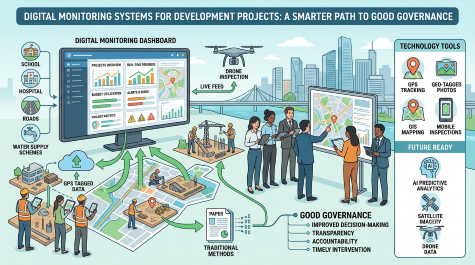
Digital monitoring systems are transforming the way governments supervise development projects. Instead of waiting for monthly reports, decision-makers can now access real-time information through centralized online platforms. This allows them to monitor physical progress, financial performance, project timelines, and implementation challenges from a single dashboard.
More importantly, digital systems help administrators identify issues before they become major obstacles. Whether a project is behind schedule, exceeding its budget, or facing operational challenges, the information becomes immediately available, allowing timely corrective action.
In this way, monitoring evolves from a routine reporting exercise into a proactive management tool that supports better governance.
Technology That Strengthens Accountability
One of the greatest advantages of digital monitoring is its ability to promote transparency. Every inspection, progress update, and financial record is stored electronically, creating a reliable and verifiable record of project activities.
Furthermore, technologies such as GPS, geo-tagged photographs, digital inspection forms, and Geographic Information Systems (GIS) make it easier to verify whether work has actually been completed at the project site. These features significantly reduce the possibility of inaccurate reporting while increasing confidence in official records.
When information is transparent and easily accessible, public institutions become more accountable, and citizens gain greater trust in government initiatives.
Better Decisions through Real-Time Information
Effective governance depends on timely and reliable information. Senior officials cannot manage hundreds of development projects by relying solely on paper reports or occasional meetings. Instead, they need clear and up-to-date data that supports quick and informed decisions.
Interactive digital dashboards provide exactly that. They present complex information in a simple visual format through maps, graphs, and performance indicators. As a result, policymakers can instantly identify delayed projects, monitor budget utilization, compare district performance, and prioritize corrective actions where they are needed most.
Rather than reacting to problems after they occur, governments can prevent many challenges through continuous monitoring and early intervention.
Making Field Monitoring More Effective
Technology has also transformed the way field inspections are conducted. Today, monitoring officers can use smartphones or tablets to submit inspection reports directly from project sites. They can upload geo-tagged photographs, record GPS locations, complete digital checklists, and submit observations instantly.
This not only reduces paperwork but also saves valuable time. More importantly, senior officials receive inspection reports immediately instead of waiting several days or weeks. Consequently, communication between field teams and decision-makers becomes faster, smoother, and more effective.
Building Stronger Public Institutions
Digital monitoring is not simply about adopting new software; it is about strengthening public institutions. Planning and Development Departments, implementing agencies, finance divisions, and district administrations all benefit when they have access to accurate and consistent information.
Moreover, integrated digital systems improve coordination among different government departments. Instead of working in isolation, institutions can share information, monitor common objectives, and solve implementation challenges collectively. This collaborative approach leads to better planning, more efficient resource utilization, and improved project outcomes.
Challenges That Must Be Addressed
Despite its many advantages, digital transformation is not without challenges. Successful implementation requires investment in technology, reliable internet connectivity, skilled human resources, and continuous capacity building. At the same time, governments must establish clear standards for data management while ensuring cybersecurity and protecting sensitive information.
Perhaps the greatest challenge, however, is not technological but institutional. Digital systems can only succeed when public organizations embrace a culture of accountability, transparency, and evidence-based decision-making. Technology is an enabler, but committed leadership remains the driving force behind meaningful reform.
Looking Towards the Future
The future of development monitoring is becoming increasingly intelligent. Emerging technologies such as Artificial Intelligence (AI), satellite imagery, drone-based inspections, predictive analytics, and GIS mapping are opening new possibilities for project management.
These innovations can help governments identify potential risks before they become serious problems, forecast implementation delays, monitor infrastructure remotely, and allocate resources more efficiently. As these technologies continue to evolve, public sector institutions will be better equipped to deliver high-quality services while ensuring greater value for public investment.
Conclusion
Digital monitoring systems are no longer a luxury they have become a necessity for modern governance. They enable governments to move beyond traditional reporting methods by providing real-time information, strengthening transparency, and improving institutional accountability.
For Pakistan, where development projects play a critical role in economic growth and social progress, investing in digital monitoring systems is an investment in better governance itself. When public officials have access to reliable information, they can make better decisions, respond more quickly to challenges, and ensure that every development project achieves its intended purpose.
Ultimately, the success of development is not measured by the number of projects approved but by the quality of projects completed and the positive impact they create in the lives of ordinary citizens. By embracing digital monitoring, Pakistan can build a more transparent, efficient, and citizen-focused system of public administration, one that delivers sustainable development and earns the trust of the people it serves.
Read: Listening to People, Strengthening Governance
_________________
 Based in Shikarpur Sindh, the writer is a civil servant and MS research fellow in Public Administration. He writes on governance, public policy, and digital transformation. Email: najamro@gmail.com.