The People Behind the Stereotype
Rethinking Society, Resistance, and Inequality in Pakistan

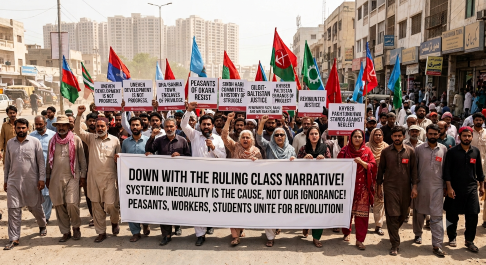
This article challenges the middle-class narrative that blames ordinary citizens for their own socio-economic deprivation. It highlights systemic class inequalities and celebrates a rich history of popular resistance, from tenant farmers to regional movements, demonstrating that working people are active drivers of social change rather than passive victims.
By; Sufi Laghari
Over the past few years, through my involvement with the National Students Federation (NSF) and various organizational and political activities, I had the opportunity to travel across different regions of Pakistan and interact with activists, students, peasants, and working-class communities. These journeys did not merely introduce me to new places; they also offered a different lens through which to understand society from the perspective of ordinary people. I gradually realized that a much deeper understanding of society emerges from walking through it, sitting among its people, and listening to their lived experiences than from books, television debates, or social media commentary alone.
Whether it is the towering mountains of Gilgit-Baltistan, the towns and villages of Khyber Pakhtunkhwa, the former FATA and Waziristan region, the valleys of Kashmir, the Potohar plateau, the fertile plains of Central Punjab, the belt stretching from Lahore to Khanewal where workers and peasants are often displaced in the name of development and infrastructure, or the deprived and feudal social structure of Southern Punjab, each region carries its own history, contradictions, and political realities.
Sindh, too, presents multiple social realities within a single province. In the upper districts, particularly from Ghotki to Larkana and Dadu, feudal power and wadero dominance continue to exist in different forms. This entire belt also reflects strong cultural and geographical influences from Balochistan and Southern Punjab. However, as one moves towards Nawabshah, Sanghar, Mirpurkhas, and Badin, the landscape begins to change. Here one encounters a rich history of resistance politics, progressive literature, and popular struggles. Then there is Tharparkar, a region with its own distinct social character, which is often portrayed by sections of the Urdu media through a narrow and sensationalist lens, whereas the ground reality is far more complex.
Throughout these travels, one observation repeatedly emerged that the problems of this society cannot simply be explained through public ignorance, cultural backwardness, or a lack of education. The reality on the ground is far more complex, diverse, and contradictory.
For instance, when one moves from the organized and well-resourced spaces of DHA and Bahria (بھیڑیا) Town in Karachi and Cant areas of Hyderabad into the neighborhoods where ordinary people live, or when one leaves Lahore’s DHA and travels through Shahdara, Anarkali, Androon Lahore, Ichhra, Chungi, Ghazi Chowk, and onwards to Gajju Mata, it becomes evident that two entirely different worlds coexist within the same city. One is a world where resources, planning, and state attention are concentrated and the other is where the majority of people live, facing inadequate infrastructure, sanitation problems, transport crises, and administrative neglect as part of their daily lives.
Yet the explanation offered for this situation is often completely inverted. When public spaces are dirty, the people are blamed. When poverty is visible, the poor are declared incapable. When cities face structural problems, responsibility is shifted onto ordinary citizens. Instead of questioning the economic, political, and class structures that produce these conditions, the blame is placed on those who are themselves victims of these realities.
As a result, a peculiar form of intellectual arrogance emerges. Sections of the middle and upper-middle classes living in DHA, Bahria Town, Gulberg, and other gated communities begin to view these spaces as the ultimate symbols of progress and civilization. From within these enclaves, the hardships of public neighborhoods are often interpreted as evidence of public ignorance, cultural backwardness, or a lack of civic sense. In other words, those who have been deprived by the system are simultaneously held responsible for their own deprivation.
A similar pattern can be observed in rural areas. Peasants are often dismissed as passive subjects of feudal landlords, and the discussion ends there. Yet history tells a far more complex story. These same peasants have repeatedly emerged as agents of resistance. They appear in the struggle of the Anjuman Mazareen in Okara. They appear in the peasant movements of Hashtnagar, Charsadda, Hazara, and Peshawar against local khans and powerful elites. In Sindh, they appear through the Sindh Hari Committee, Mai Jindo, Mai Bakhtawar, and figures such as Fazil Rahu, challenging the power of influential families and dominant classes, including Mehrs, Zardaris, Jamalis, Sarhandis, Syeds, and Bhuttos.
This raises an important question that if ordinary people are truly as politically unconscious and passive as they are often portrayed, then where did the region’s peasant movements, labour struggles, student movements, national liberation struggles, and democratic resistance movements come from? The truth is that it is often easier to repeat preconceived assumptions about the people than to genuinely understand them.
These experiences have convinced me that it is not enough to understand this society merely by calling it “Pakistan.” To grasp its contradictions and crises, one must examine its underlying political and economic structure. It is a society where feudal relations have not been fully dismantled, where capitalism has developed unevenly and incompletely, and where state and economic institutions remain connected, in different ways, to broader imperial and global capitalist interests.
This is why modern housing schemes, corporate sectors, and new forms of capital continue to expand on one side, while older structures of power maintain their control over land, water, and resources in rural areas on the other. There are islands of development alongside vast oceans of deprivation. There are shining gated communities alongside public neighborhoods that have been systematically neglected.
Therefore, when people attribute these problems to the culture, morality, or ignorance of ordinary citizens, they overlook the economic, political, and class relations that continuously reproduce these conditions. The problem is not the people but the problem lies within a system that generates inequality and then normalizes it.
During these travels, I did not encounter the people merely as victims. I encountered them as a historical force of resistance. Whether it was the people of Waziristan, the tenant farmers of Okara, the haris of Sindh, the peasants of Khyber Pakhtunkhwa, or activists involved in various national and class-based movements, their struggles demonstrate that history is not shaped solely by ruling classes. It is also shaped by those who resist domination and strive to transform their conditions.
It is easy to dismiss ordinary people as ignorant. It is far more difficult to recognize the history, consciousness, and resistance that exist within them. Yet without taking that more difficult path, it is neither possible to understand this society nor to transform it.
Read: How Honest Are We?
________________
 Suffyan Laghari (Sufi Laghari) is researcher and activist pursuing an MPhil at NIPS (National Institute of Pakistan Studies), Quaid-I-Azam University. With background in Anthropology from the University of Sindh, his research focuses on left-wing student politics, social movements, politics of marginalized communities, in and the Sindhi Nationalism