The Arc of Existence: Reconciling Cosmological Idealism, Pessimism, and Cosmic Process
By Noor Muhammad Marri advocate |Islamabad
“To view the universe solely through the prism of absolute beauty or unyielding suffering is to isolate two fragments of a single, vast, and unfolding reality.”
Throughout the history of human thought, scholars, jurists, and philosophers have wrestled with a fundamental conundrum: what is the true moral and structural nature of the cosmos? When we examine our world—marked so vividly by both exquisite natural order and profound human suffering—how do we construct a coherent, deeply felt narrative of our shared existence?
Philosophical tradition generally divides this deep inquiry into three prominent worldviews: the idealist vision of a perfect universe, the heavy pessimism of Arthur Schopenhauer, and the dynamic perspective of process metaphysics.
The first vision, rooted in classical rationalism and spiritual traditions, holds that the universe is inherently good, purposeful, and perfect. In this view, what we perceive as evil or discord is merely a limitation of our own finite perception, akin to misinterpreting a single dark brushstroke on a vast, magnificent canvas. Evil possesses no independent substance of its own; rather, it is simply the absence of light, much as cold is merely the absence of heat. For those of us engaged in the practice of justice and mediation, this idealist foundation offers an enduring anchor, suggesting that fairness and moral law are not arbitrary human constructs, but quiet alignments with a pre-existing cosmic order. Yet, when we stand face-to-face with raw human tragedy, pure idealism can feel distant and unpersuasive, failing to honor the weight of real grief.
Standing in sharp, unyielding contrast is the penetrating vision of Arthur Schopenhauer. Rejecting any notion of a benevolent cosmic architect, Schopenhauer argued that the underlying reality of the universe is a blind, insatiable, and irrational force he termed the Will. In his philosophy, every living entity is caught in a relentless struggle for survival, driven by desires that can never be permanently satisfied. Existence becomes a continuous pendulum swing between the pain of unfulfilled want and the empty stagnation of boredom. For Schopenhauer, suffering is not an illusion or a temporary shadow; it is the fundamental baseline of conscious life. Yet, even within this dark portrait of existence, he offered a profound moral rescue. He recognized that through art, deep contemplation, and above all, genuine compassion—the realization that another’s suffering is identical to our own—we can pierce the illusion of individual isolation and soften the cruel demands of the Will.
Between these two extremes lies a third perspective, process metaphysics, which reframes reality not as a finished masterpiece or a hopeless tragedy, but as an ongoing journey. This view suggests that the universe is actively unfolding, incomplete, and still in the delicate process of perfecting itself. Here, good and bad naturally coexist because creation itself remains unfinished. Imperfection is not a permanent curse, nor is it an illusion to be ignored; it is the necessary friction of an evolving universe. Goodness becomes the organizing force that consciously works to bring harmony out of lingering chaos, turning existential struggle into the very engine of moral and spiritual maturation.
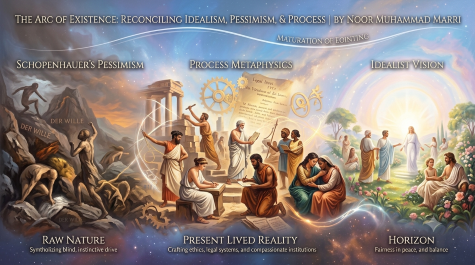
When we bring these three distinct threads together, they cease to contradict one another and instead reveal themselves as sequential dimensions of a single cosmic narrative. Schopenhauer captures our raw starting point: the unrefined, instinctive drive of nature left to itself. Process metaphysics describes our present lived reality: the dynamic arena where human consciousness wrestles with that raw nature, gradually crafting ethics, legal systems, and compassionate institutions to tame the friction of existence. Finally, the idealist vision provides our horizon: the ultimate state of balance and wholeness toward which we are continually striving.
This unified synthesis carries profound personal significance for how we navigate our responsibilities in the world. If the universe were already complete and perfect, our moral efforts would be unnecessary; if it were irredeemably dark and broken, our struggles would be futile. It is precisely because the world is imperfect yet capable of growth that our individual actions carry genuine weight. Every dispute we mend, every act of empathy we offer, and every small measure of order we introduce into chaos actively participates in this cosmic evolution. We acknowledge the reality of human suffering, yet we choose to labor steadily against it—guiding our developing universe, step by step, toward its ideal horizon.
Read: The Architecture of Domination
___________________
 Noor Muhammad Marri, Advocate and Mediator, Islamabad