Stories of Karachi’s Taxi Drivers from 1993 to 2000
Zaffar Junejo
[Author’s Note: I joined a non-government organization in mid-1993. In those days, we were frequent travelers to other Asian countries, and during that period I maintained a diary. I once showed the notes to Muhammad Ibrahim Joyo — the legendary scholar, translator, and intellectual giant of the Sindhi world — who suggested categorizing the entries by theme and getting them published. He recalled that long ago, perhaps in 1955, the Sindhi journal Mehran had launched a similar idea titled ‘Hik Deenh Ji Ghaleh’ (The Story of a Day), even offering a prize for it. He himself had submitted the first story, he told me with a smile, just to set a standard for other writers. Later, Maulana Ghulam Muhammad Girami, a scholar of high standing and journalist; Shamsher ul Haidri, a distinguished Sindhi poet, journalist, and playwright; and Siraj ul Haq Memon, an iconic novelist, linguist, and journalist, all contributed their observations of a single day. These writings were published until 1968.
I agreed with Joyo Sahib that I would group the write-ups by subject and get them published, but I failed to do so. Recently, I sat down to organize my notes. I found various entries about the taxi drivers of Karachi city. Some were very brief and incomplete; others were short but held a finished truth. I have chosen five stories from each year, all of them gathered from the drivers of those cars. In total, there will be thirty-five stories covering the period from 1993 to 2000.
On the surface, these pieces appear to be simple narratives. However, beneath the prose, they depict the complex socio-political and cultural landscape of Karachi during those turbulent days. They are the echoes of a city in motion.]
Nobody Knows When
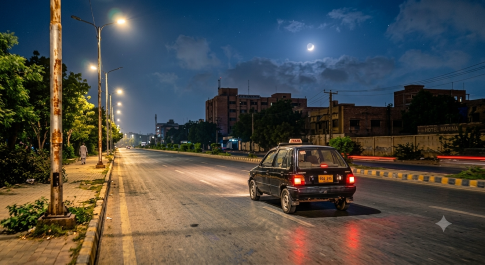
Midnight choked the Karachi streets. Sweat slicked the palms. No cabs prowled the curb. Boots pressed the road toward the Abdullah Shah Ghazi Mazar stand. Emptiness met the gaze. Dust swirled under the dead lamps.
A lone Suzuki FX crouched by the broken curb, its engine silent. Knuckles rapped the glass. Inside, the shadow froze. The glass stayed rolled up. A harder rap rattled the frame.
The lock clicked. The door swung outward. A face emerged from the dark, lined with years and grey stubble.
“Gulshan-e-Iqbal,” the mouth formed the words.
“Seven-fifty,” the driver spat out.
The price stung. The clock ticked toward two. A nod sealed the deal.
The driver shifted the gear stick. The high fare brought no grin to his weathered cheeks; his eyes stayed flat. The driver’s hand reached out, flicking the dome light switch. Yellow glare filled the cabin. His eyes darted sideways, scanning the passenger seat.
“Put the sack back,” the driver commanded, gesturing toward the heavy laptop bag wedged between the knees. “Too cramped up front.”
The hands lifted the nylon strap, tossing the weight onto the vinyl rear bench.
“Which road?” the driver asked.
Silence filled the space between the seats.
“Which road?” the voice grew sharper.
“Shahrah-e-Faisal keeps it smooth,” the mouth replied.
The driver twisted the wheel hard left. “M.A. Jinnah, the Mazar, then the Jail flyover. Safer.”
The tyres hummed down Abdullah Haroon Road, past the dark Karachi Electric Supply Corporation building. The driver’s shoulders loosened. The rigid posture melted.
“You looked spooked back there,” the tongue loosened. “Now you breathe easy. Why?”
The driver stared straight ahead at the black tarmac. “Saeen, times change.”
“How so?”
“Old days, a driver worried about the meter. We argued over rupees.” The tires thudded over a pothole. “Now the mind counts different things.”
“What things?”
“A long list,” the driver grunted. “We judge the blood. Sindhi, Muhajir, Pashtun, Punjabi, Afghan. We scan the face.”
“Why the face?”
“The nationality dictates the survival rate.”
The meaning hung in the humid air, thick and heavy. “Explain that.”
“The Afghan passenger brings the most sweat to the spine,” the driver said, his hands gripping the plastic wheel tighter. “Then the destination blocks the path. You shout Sohrab Goth, Liaquatabad, or Gulshan-e-Hadeed, the clutch stays down. We don’t roll. A passenger or his pack waits in the dark. They take the car. They take the life.”
The headlights sliced the gloom.
“Before, a stop for a leaf of paan or a Gold Flake meant nothing,” the driver continued. “Now, a passenger asks to relieve his bladder, the heart hammers the ribs. We smell a trap.”
“That tense?”
“The eyes used to watch the white lines,” the driver said, his gaze shifting rhythmically. “Now the eyes hunt the side lanes. The dark alleys. We look for the ambush.”
The car sped past the Federal Urdu University campus. The concrete walls glowed pale under the moon.
“The knocking back at the stand,” the driver muttered. “The glass stayed up while the eyes took the measure. The bag on the back seat? A precaution.”
“How?”
“A pistol or a blade stays out of reach when the steel rests in the back,” the driver smiled, showing stained teeth. “The route question? Another test. A bad man fights for his path. A straight man yields.”
Silence reclaimed the cabin. The engine whined.
“When does the fear stop?” the driver asked the windshield. He did not wait for an answer. “Nobody knows. We survive in fragments.”
The NIPA flyover loomed ahead, a concrete giant in the night.
“Stop here,” the voice commanded.
The driver pushed the brake pedal past the dark patch, rolling the Suzuki until the roof caught the full glare of a functional street lamp.
The hand extended the agreed-upon notes. The driver took the cash. The gears ground into reverse, the car backing away instantly into the Karachi night, leaving the pavement behind as it retreated toward Crescent Square.
_____________________
 Dr. Zaffar Junejo has a Ph.D in History from the University of Malaya. His areas of interest are post-colonial history, social history and peasants’ history. He may be reached at junejozi@gmail.com