

“Imtidad 61”: When Art Becomes a Space for Questions Along the Pilgrimage Route
On the Arbaeen Pilgrimage, Cultural Stations Turn Service Into a Journey of Ideas
Report by Aziz Al Yahya — Iraq
Each year, millions of pilgrims travel to Karbala, Iraq, to mark Arbaeen, the 40th-day commemoration of the martyrdom of Imam Hussein, the grandson of the Prophet Muhammad. Along the long routes leading to the city, pilgrims encounter countless forms of service provided by volunteers, religious institutions and community groups
These services extend beyond food, water, accommodation and other basic needs. Cultural and educational initiatives have also become part of the pilgrimage experience, seeking to create spaces for knowledge, reflection and dialogue alongside its spiritual dimension
Among these initiatives is “Imtidad 61,” a cultural camp established by the volunteer team Raqeem on the Baghdad–Karbala road during the Arbaeen commemoration. The camp presents a different approach to cultural engagement, using conceptual art and interactive installations to explore ideas inspired by the uprising of Imam Hussein and the thought of prominent scholars
Through a series of interactive stations, the camp addresses issues including women, resistance, identity, family, society and contemporary intellectual challenges, bringing together visual design, ideas and direct participation
 Why “Imtidad 61”?
To a visitor unfamiliar with the history of Karbala, the number 61 may initially appear to be simply a number. Within the context of the exhibition, however, it refers to the year 61 AH, when the Battle of Karbala took place and Imam Hussein and his companions were killed
The name “Imtidad 61,” meaning “The Extension of 61,” reflects the organizers’ idea that the significance of the Karbala event did not end with its historical moment but has continued to influence thought, values and practice across generations
The title therefore presents the idea of continuity as a responsibility, asking how the principles associated with the legacy of Imam Hussein can continue to be expressed through culture, awareness and everyday conduct
The number 61 is deliberately presented without the abbreviation “AH,” despite referring to the Islamic Hijri year. According to the concept behind the camp, this omission is intended to leave the title open to interpretation and encourage visitors to ask what the number means
The name itself consequently becomes the first part of the experience, inviting the visitor to begin with a question before entering the exhibition
Bringing Culture to the Pilgrimage Route
“Imtidad 61” responds to what its organizers see as a need for greater cultural and intellectual engagement along the routes used by Arbaeen pilgrims
While the pilgrimage route is known for its extensive forms of hospitality and service, the camp seeks to contribute to another dimension of the journey by providing opportunities for reflection and dialogue
Its interactive stations address religious, political and social issues, as well as identity, family, women and contemporary intellectual challenges
The project is based on the idea that serving people is not limited to meeting their physical needs but can also include contributing to their intellectual development and strengthening their awareness
Inside the Camp: When an Idea Becomes an Experience
Rather than relying on conventional forms of exhibition, “Imtidad 61” uses conceptual art through a series of interactive cabins designed to encourage visitors to stop, reflect and ask questions
Each station carries a specific message, while the sequence of installations is intended to create a broader intellectual experience
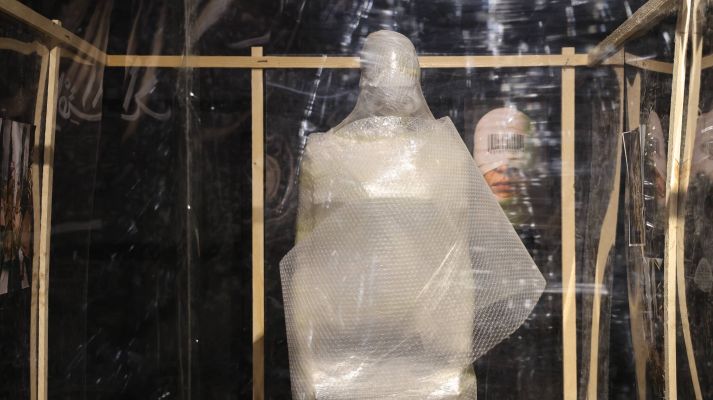
The “Commodification” Cabin
The visitor’s journey begins with the “Commodification” cabin, which examines contemporary social and value transformations and the pressures faced by women within a culture shaped by consumption and cultural confusion
The installation explores the commodification of women, the pressure of appearance, distorted standards and the loss of meaning
Its purpose is to create what the organizers describe as a moment of cognitive disruption, encouraging visitors to reconsider their position within the surrounding social environment
The “Resistance” Cabin
The next cabin is dedicated to “Resistance” and carries the central statement
“Resistance is not limited to military action; it is a system of roles”
It poses a direct question to the visitor
“If you had no weapon, how would you resist?”
Visitors are presented with several options, including solidarity-based publishing, conscious positioning, raising children committed to resistance, boycotting and prayer
After selecting one of the options, the participant receives a card carrying the message that struggle and resistance are not limited to weapons or military front lines and that an individual can contribute to a cause through different roles
The cabin’s design also incorporates olive trees, widely associated with the land of Palestine.
 The “What Remains?” Cabin
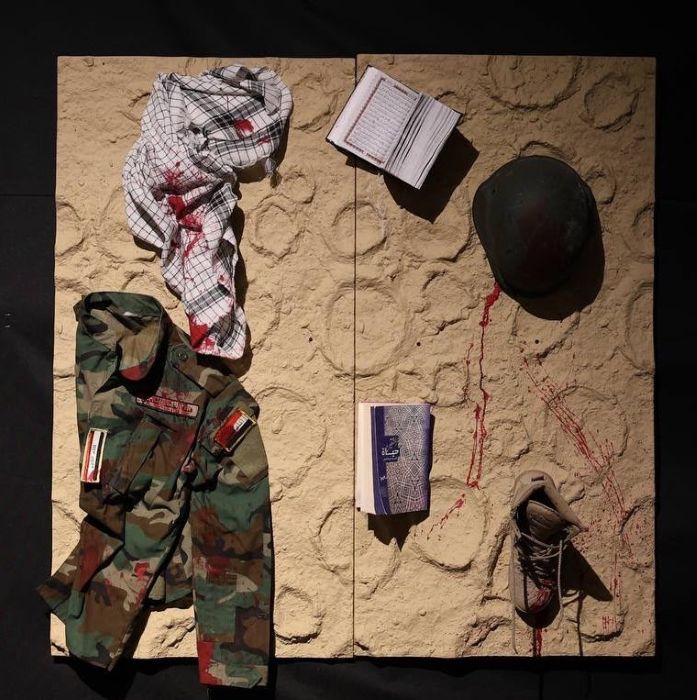
Another station is titled “What Remains?”
Viewed from above, the installation presents the remains of a martyr’s belongings, including a bloodstained boot, a damaged helmet and torn clothing
Alongside them are a copy of the Quran and the book Hayat al-Muttaqin by Imam Martyr Khamenei, presented as having remained intact amid the debris
The installation uses these objects to explore the idea that while bodies perish, ideas, beliefs and knowledge can endure
It also presents the concept that genuine continuity is created by ideas and that martyrdom, in this interpretation, is not exclusively a military phenomenon but can also emerge from a broader system of knowledge and educated individuals who regard learning as a path toward a higher objective
The “Among Them Are Fifty Women” Cabin
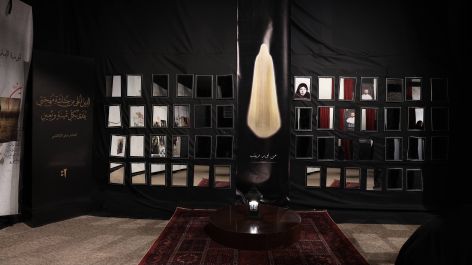
The “Among Them Are Fifty Women” cabin explores the role of women in preparing for the Imam Mahdi, according to the religious framework presented by the organizers
The installation consists of fifty frames. One contains a photograph of the martyr Bint al-Huda, Amina al-Sadr, presented as a contemporary model of a woman committed to supporting the Imam of her time
The remaining frames contain mirrors reflecting the face of the female visitor
The installation therefore asks
“Could I be one of these leaders?”
At the center of the wall is a luminous structure symbolizing Lady Zaynab, presented as the role model and foundation from which this tradition of female leadership was inspired
The “Continuity” Cabin
The “Continuity” cabin explores the idea that the Karbala uprising has continued to resonate throughout history
A visual line connects a series of historical milestones, beginning with the uprising of Imam Hussein in 61 AH, followed by the Iraqi Revolution of 1920, the Islamic Revolution in Iran led by Imam Khomeini in 1979, the issuance of the religious ruling on defensive jihad by Grand Ayatollah Ali al-Sistani in 2014, the victory of the Popular Mobilization Forces and Iraqi resistance over ISIS in 2017, and the victory of the Islamic Republic of Iran in the 2026 war against the United States and Israel
The distances between the points on the visual timeline were designed to reflect their actual chronological intervals, creating a visual representation of the organizers’ idea that this continuity has not been interrupted but has taken different forms across the centuries
The installation seeks to present the Karbala narrative not only as a tragedy but also as an uprising against an adversary, with its broader project understood as something whose manifestations can reappear in different historical contexts
 The “Platforms of Today” Cabin
The “Platforms of Today” cabin revisits the traditional concept of the pulpit as a place for shaping awareness and influencing society
The installation suggests that while the pulpit was once associated primarily with the wooden structure from which a preacher addressed an audience, today it can exist in every person’s hand through smartphones and social media platforms
Every account can become a pulpit, every post can become a speech and every interaction can leave an impact on the awareness of others
The cabin emphasizes that likes, follows, shares and reposts are not necessarily insignificant actions. They can contribute to shaping public opinion, supporting a cause or helping an idea spread
The “Alive Within Us” Cabin
The visitor’s journey concludes with the “Alive Within Us” cabin, which serves as an emotional station centered on sacrifice and steadfastness
The installation uses the symbolism of paradise as the outcome of sacrifice and remaining committed to a principle
It includes photographs of Iraqi martyrs who were killed in American-Israeli bombardment alongside martyrs from different arenas of the Axis of Resistance
The installation seeks to convey the idea that the martyrs remain present in collective memory and that their influence continues through public consciousness even after their deaths
Together, the cabins take visitors through a sequence of themes beginning with social and value transformations and the role of women, then moving through resistance, martyrdom, women’s leadership, the historical continuity of the Karbala narrative and responsibility in the digital media space, before concluding with remembrance of the martyrs
Raqeem: A Project Focused on Building the Individual
Behind the initiative is Raqeem, a volunteer youth team working in culture, media, training, research, content creation and community initiatives as part of a broader cultural project focused on intellectual and educational development
According to the team, the name “Raqeem” was inspired by the term “al-Raqeem” mentioned in the Quran and by the clay tablets of ancient Mesopotamia on which knowledge and sciences were recorded
The name is intended to bring together the ideas of preserving a message, safeguarding knowledge and creating lasting impact
The team’s work is based on four pillars: thought, organization, education and fieldwork
It emphasizes that knowledge should precede action, impact should be valued over visibility, responsibility should come before position and collective work is essential to achieving goals
Its activities extend beyond cultural events to training, media, writing, content production and community initiatives, as well as an interest in heritage and archaeology
This interest reflects the team’s belief that Iraq’s archaeological heritage represents a form of civilizational memory that preserves identity and documents the history of its people
When Service Becomes a Space for Awareness
“Imtidad 61” offers a different model of cultural engagement along the Arbaeen pilgrimage route by combining conceptual art, visual storytelling and direct interaction with visitors
Rather than simply presenting information, the experience places visitors before questions related to identity, women, resistance, martyrdom, media, awareness and historical continuity
Through the design and sequence of its cabins, Raqeem attempts to transform a visitor’s passage through the camp into an experience that begins with a question and moves toward an idea and ultimately a message
In this sense, “Imtidad 61” forms part of a growing range of initiatives accompanying the Arbaeen pilgrimage with cultural and intellectual activities alongside its many other forms of service
The experience suggests that the pilgrimage route can function simultaneously as a space for worship, service, knowledge and dialogue
For those behind the project, commemorating Imam Hussein is not limited to remembering the events of the past. It also involves drawing on their values and attempting to translate them into contemporary awareness and an ongoing sense of responsibility.
________________

