Stories of Karachi’s Taxi Drivers from 1993 to 2000
Zaffar Junejo
[Author’s Note: I joined a non-government organization in mid-1993. In those days, we were frequent travelers to other Asian countries, and during that period I maintained a diary. I once showed the notes to Muhammad Ibrahim Joyo — the legendary scholar, translator, and intellectual giant of the Sindhi world — who suggested categorizing the entries by theme and getting them published. He recalled that long ago, perhaps in 1955, the Sindhi journal Mehran had launched a similar idea titled ‘Hik Deenh Ji Ghaleh’ (The Story of a Day), even offering a prize for it. He himself had submitted the first story, he told me with a smile, just to set a standard for other writers. Later, Maulana Ghulam Muhammad Girami, a scholar of high standing and journalist; Shamsher ul Haidri, a distinguished Sindhi poet, journalist, and playwright; and Siraj ul Haq Memon, an iconic novelist, linguist, and journalist, all contributed their observations of a single day. These writings were published until 1968.
I agreed with Joyo Sahib that I would group the write-ups by subject and get them published, but I failed to do so. Recently, I sat down to organize my notes. I found various entries about the taxi drivers of Karachi city. Some were very brief and incomplete; others were short but held a finished truth. I have chosen five stories from each year, all of them gathered from the drivers of those cars. In total, there will be thirty-five stories covering the period from 1993 to 2000.
On the surface, these pieces appear to be simple narratives. However, beneath the prose, they depict the complex socio-political and cultural landscape of Karachi during those turbulent days. They are the echoes of a city in motion.]
Snatched Roads and Bread
The winter air in Karachi was thin and grey. It was Thursday, and the cold came off the sea, heavy with the smell of salt and fish. The next day was not a holiday, but the MQM had called a strike. The city was tightening like a fist.
I needed books before the shops barred their doors. It was not safe to go toward Khori Garden or the Light House area, so I chose Saddar.
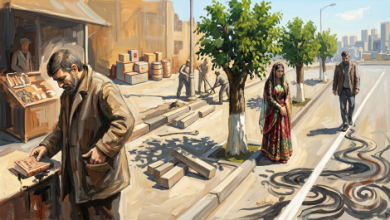
An old taxi sat by the curb. The driver was an old man with leathered skin and a faded shawl draped over his shoulders. His hands were large and calloused from the heavy steering wheel.
“I need to go to Saddar first, near the Parsi Fire Temple,” I told him. “Then to Defence Extension, Phase Two. Will you take me?”
“The city is bad today,” he said. His voice was low and rough.
“I will pay the fare. And fifty rupees extra for the wait at the shop.”
The old man looked down the street, then nodded. “Get in.”
We drove into Saddar. The shops were already putting up their wooden shutters, the iron bars clanging in the cold. He stopped the taxi near the Fire Temple. I left him in the idling car and walked fast to the Tit Bits Book Stall. I wanted a copy of Lady Chatterley’s Lover, but the shelves were bare of it. Instead, my eyes found Thomas Paine’s The Rights of Man. Professor Zafar Hasan Syed had introduced that book to me back in 1987. A friend had borrowed my old copy and never brought it back. I paid the shopkeeper and went back to the taxi.
I climbed into the front seat. The old man shifted into gear and plunged the car into the knot of Saddar traffic.
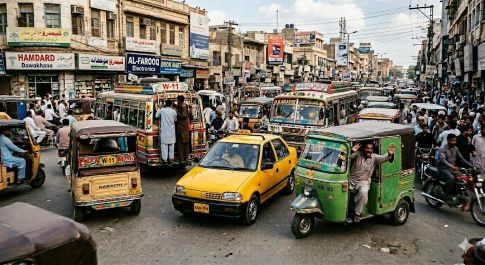
It was bad driving. Large, colorful mini-buses cut across the lanes without warning. Auto-rickshaws darted like beetles between the bumpers. Every few yards, a bus would slam its brakes or a rickshaw would swing into our path, forcing the old man to stomp on the pedal. The taxi rattled.
Each time the car lurched, the driver’s face grew dark. His lips moved quickly. He muttered sharp, bitter curses at the bus drivers and the rickshaw men. I sat turning the crisp pages of the new book, trying to catch the words, but the roar of the engines swallowed them.
He found a gap, steered away from the main bazaar, and drove toward the Dow Medical College grounds. The road opened up. The traffic became thin, and the old man relaxed his grip on the wheel. The tension left his shoulders.
“How are you?” I asked him.
“Allah ka shukr hai,” he said. He did not look at me. “Bus chal rahe hain. We survive.”
“Why were you cursing those drivers back there?”
The old man remained silent for a long time. The tires hummed against the asphalt.
“Those people,” he said finally, “they have made life difficult for the common man. Even for us.”
“The traffic is always bad,” I said.
“Not like this,” the old man said. He spat out the window into the wind. “In the old days, it was different. The buses had fixed routes. The wide streets and the connected roads belonged to the taxis. A man could make a living. Then General Zia came. Then came the mini-buses, and the rickshaws multiplied like locusts. Now they roam everywhere.”
He paused, his eyes tracking a green rickshaw ahead.
“The rickshaw drivers are bad men,” he muttered. “Bastards. Bare harami hain. If they see a gentleman walking toward a taxi, they start their engine and pull right in front of him to block his path. How can a big car compete with that? How can we reach the passenger?”
“They are fast,” I said.
“They are reckless,” he said. “And the mini-bus drivers are their fathers. Unke baap hain. They take sharp turns. They blow those loud pressure horns and drive like rockets. They think they own the dirt we drive on.”
The silence came back into the car. It stayed with us as we passed the grey concrete structures of the Naval Housing Society, which was still under construction. The afternoon was fading into a cold evening twilight.
“So, what can be done?” I asked. “What can a taxi driver do?”
The old man did not look at me. He kept his eyes on the grey ribbon of the road.
“Nothing,” he said. “They have not just taken our roads. They have snatched our rozi roti. They have taken the bread from our tables.”
We reached the bridge near Phase Two. I looked out at the bleak winter landscape.
“Stop here,” I said.
He pulled the taxi over to the side of the road and pressed the brake. The engine idled with a heavy, metallic throb. I paid him his fare with the extra fifty rupees. He took the notes with his rough hand, nodded once, and watched me get out into the cold wind with my book.
***
A Street in the Pocket
The winter sun was low and pale over Karachi. It was Monday, the first day of the week, but the desks in the office were mostly empty. The air felt heavy with a quiet expectation. At lunch, a clerk brought in a copy of Awam, the Urdu evening newspaper. On the front page, inside a thick black border, was the news: the MQM had called for a strike the next day.
I left the office early. I stood on the shoulder of 26th Street near the shrine of Abdullah Shah Ghazi. The wind blew cold off the sea, kicking up fine grains of sand. No empty cars passed. I crossed the street and walked toward the edge of Neelam Colony, waiting where the road narrowed.
A yellow taxi finally pulled over. The driver was a small man with sharp, watchful eyes and a thin mustache. He nodded when I gave him my destination. He shifted gears, took the first cut, and directed the car toward Jahangir Kothari Parade.
We drove in silence. The shadow of tomorrow’s strike was in the air, making the streets feel tight and hurried.
By the time we reached Punjab Chowrangi, the traffic jammed. The driver pulled a small, embroidered Namazi cap from the side pocket of his kameez and placed it flat on his head. Then he reached over and opened the dashboard cubby. He pulled out his National Identity Cards and the vehicle registration papers, sliding them beneath a thick, decorative plastic piece on the dash.
He paused, pulled one of the identity cards back out, examined it closely, pushed it into the front pocket of his kameez, and pushed the remaining papers back under the plastic piece.
He caught me watching him in the glass and smiled. It was a clever, knowing smile.
“What are you doing with the cards?” I asked. “Why check them now?”
“I carry two identity cards, Saeen,” he said. He did not look away from the road. “They are color photocopies. Very refined. Plastic-coated. Even a policeman on the street cannot tell they are fake.”
“They are both fake?” I asked.
“Both,” he said, shifting into third gear. “My real card stays at my dera, safe with the boys.”
I laughed. “If they are both fake, why do you need two of them?”
“Every driver has two now,” he said. “Taxis, rickshaws, commuters. Everyone who works the roads.”
“But how are they different from each other?”
The driver laughed, a short, dry sound. “The first one has my address listed at Al-Asif Square. The other one says North Nazimabad.”
“So they have a particular use,” I said.
“Yes,” he said. “Tomorrow is an MQM strike. So I must be a man from North Nazimabad. I keep that card in my pocket. If the boys stop the car, I show them the neighborhood they want to see.”
“And if it is a Pathan strike?”
“Then I am a man from Al-Asif Square,” he said simply.
“So just a moment ago, you were making sure you had the right locality in your pocket for tomorrow,” I said.
“Exactly so, Saeen.”
“And the cap?” I asked, looking at the embroidery.
“The cap is good for both,” he said. “Nobody fights a man wearing a prayer cap.”
The car smoothed out as we neared the College of Physicians and Surgeons Pakistan. The concrete buildings looked cold under the fading winter sky.
“Take the service lane here,” I told him. “Drop me near the mosque.”
“Ji, Saeen.”
He brought the taxi to a halt by the curb. The engine idled with a loose rattle. I counted out the rupees and paid him his fare. He took the notes, nodded once with a brief touch to his embroidered cap, and watched me step out into the chill.
I walked toward the vegetable shop near the corner to buy what I needed before the shutters went down for the strike.
_________________
 Dr. Zaffar Junejo has a Ph.D in History from the University of Malaya. His areas of interest are post-colonial history, social history and peasants’ history. He may be reached at junejozi@gmail.com