Literature is considered a fine art distinguished by the material through which it expresses itself: words and language. This corresponds to forms in sculpture, movement in dance, melodies in music, and colors and lines in painting.
Souad Khalil | Libya
When we speak of literature in its creative framework, we consider it one of the five fine arts, alongside painting, sculpture, dance, and music. Like all of these arts, literature is an artistic craft through which beautiful and moving expression conveys the intentions of the human soul in all its states of turmoil, thoughts, and emotions. In this respect, it does not differ from the other fine arts in terms of the emotional and aesthetic impact that every art seeks to achieve.
In other words, literature is considered a fine art distinguished by the material through which it expresses itself: words and language. This corresponds to forms in sculpture, movement in dance, melodies in music, and colors and lines in painting. There is no need here to elaborate on the characteristics that place literature at the forefront of the fine arts, as we have already discussed them in detail elsewhere.
What we mean by the art of literature is an aesthetic expression, through words, of the author’s experience and suffering. The writer embodies his or her feelings through a language characterized by artistic and suggestive qualities in its vocabulary, structures, semantic meanings, and creative forms.
In this regard, we may draw upon a simplified reading of Dr. Michel Asi’s book Art and Literature. He states that if art, in its aesthetic construction, requires subjective and visionary truths rather than objective truths, then everything that corresponds to and reproduces the facts of objective existence must be excluded from the sphere of the fine arts. Thus, art has no content other than subjective truths, whereas objective truths constitute the content of intellectual and scientific work rather than artistic work.
 Upon this distinction between subjective, psychological content and objective, rational content rests the difference between art and science. When the creative human being encounters the external world and experiences existence, there are two possible responses.
The first is that reason prevails and is influenced by cosmic phenomena, seeking to investigate their truths through causes and effects and through the relationships among them. The individual then expresses what has become clear to him or her, reflecting it through intellectual abilities and powers of thought. In this way, the hidden truths of objective existence are transformed into an intellectual and expressive formulation containing objective factual content that has been revealed through the activity of the mind. This is the position of the thinker and the scientist, and the result is scientific work.
The second response belongs to a human being who, like the first, is affected by the visible world around him, but whose self transforms existence within its own world. Objective facts become subjective truths, and when the artist returns them to the outside world through clear expressive forms, he does not reproduce them in their original form as they exist in objective reality. Rather, he recreates them after they have passed through his psychological structure, according to what his own self wishes them to become, as though he were creating them anew. Thus, he constructs an objective world based on subjective truths that he has imposed upon it.
This is the artist’s position toward things and his expression of them. His work constitutes the content of authentic artistic creation.
The issue of literary art, which concerns us here, requires us to consider it in order to clarify the interrelationship between the literary artistic work and the intellectual and scientific literary work through the medium of language. This interrelationship can lead those who overlook it to erroneous concepts when examining and properly evaluating different forms of literary art.
Opinions have long differed, and continue to differ, regarding the artistic nature of literary works written in prose. There has also been considerable uncertainty in the criteria used to evaluate the artistic value of a literary work whose content lies somewhere between artistic vision and the truths of thought and science, between the realm of subjective truths and that of objective truths, as is the case, for example, with works dealing with historical subjects.
People have often asked: Is a particular writer a literary artist, or should we regard him as an intellectual? Because of this misconception, many have restricted fine art in literature to poetry alone, excluding prose. Others, by contrast, refuse to deny the artistic nature of prose works, whatever their form may be.
Dr. Michel Asi asks in his book: Why is the artistic criterion applied so strictly to literature alone, unlike the other fine arts? How can we move beyond this problem? And, ultimately, what is the criterion of aesthetic artistry in literature?
There would be no room for confusion or overlap between literary artistic works and intellectual works in general if the literary artist and the intellectual thinker did not both use the same expressive medium in literary art and scientific thought: language.
The material of artistic expression in music is melody alone; no other form of human creative activity shares this particular medium. If melodies are beautiful, they constitute musical art; if they are not, they are merely meaningless humming. The same applies to dance, painting, and sculpture: they are either fine arts or they are not.
They may be practical or utilitarian works serving everyday needs, but they are not, in such a case, necessarily elevated rational works. The matter is entirely different in literature. When artistic form and content become concentrated and richly developed within literature, a literary work may become a utilitarian, everyday form of communication that circulates among people and eventually loses even the distinction of being called literary, despite the fact that it uses words and language, the very medium of literature.
Conversely, it may become an intellectual, scientific, or philosophical work belonging to the highest forms of rational thought, because the words of language then carry truths about life and existence.
Thus, it becomes clear to us that, with the exception of literature, the fine arts, according to the degree of artistic intensity in form and content, range between the lowest utilitarian level and the highest level of artistic creativity. In other words, they rise progressively from the lowest artistic boundaries to the highest possible limits of artistic creation.
In literature, however, the matter is different, because the verbal material of literature allows for a duality in both form and content. Words necessarily carry semantic meaning, and this meaning may be aesthetic, dominated by subjective truths, imagination, and emotion, when purely aesthetic content is intended. It may also be purely intellectual or scientific, dominated by objective truths. Alternatively, verbal meaning may combine subjective and objective truths, containing elements of both without being exclusively one or the other.
This is a brief reading of a book that explores the relationship between literature and the arts and raises the question: Is literature a form of art?
It becomes clear that there is an ancient relationship connecting literature with the other arts, including poetry, prose, music, theater, and others.
Literature and music, for example, share a close relationship that becomes apparent in the rhythm underlying both poetry and music, particularly in ancient times. Meter was an essential element of classical poetry and was considered an integral part of musicality. In addition, poems were often set to music and sung. This had a strong influence on poetry, as music became an accompanying element. An example of this can be found in Andalusian muwashshahat, which became one of the distinctive forms of Arabic poetry and were adapted to suit music and singing.
 There is also an interaction between literature and music through theatrical works, in which music is used to express certain dramatic situations. Poetry, too, despite increasingly relying on reading rather than listening, cannot dispense with rhythm, which accompanies the poet in the performance and recitation of a poem.
Literature also has a relationship with sculpture. This can be seen in the way poets and writers describe statues and sculptures, as well as in the way sculptors create works inspired by literary texts. This is particularly evident in European literature and culture, which have paid greater attention to sculpture than many other literary traditions, owing to their revival of Greek culture, which placed particular importance on this art.
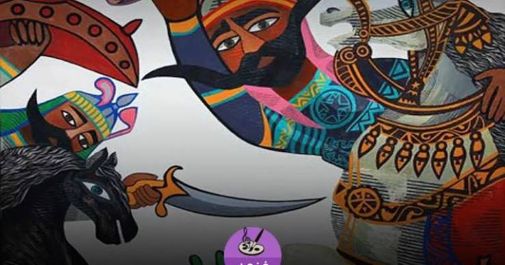
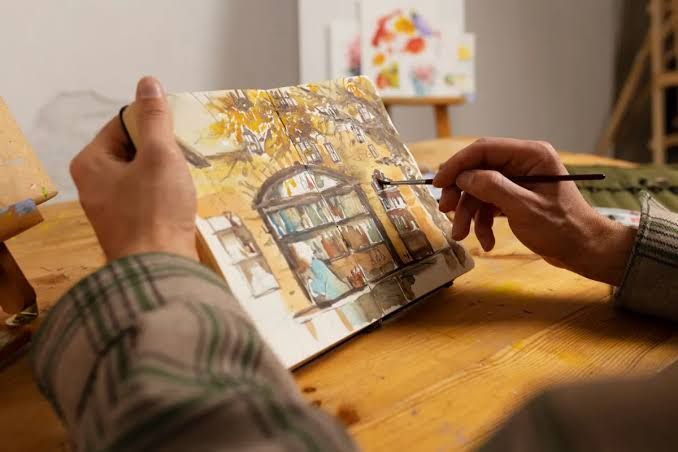
Paintings, too, have inspired poets, just as poetry has inspired painters. One need only consider the thousands of illustrations created to express particular poems, especially the illustrations accompanying certain poetry collections, such as Rana Jaafar Yassin’s collection Al-Madhoun Bima La Na’rif (Painted with What We Do Not Know) and Muhammad Bennis’s Kitab al-Hubb (The Book of Love), among many others.
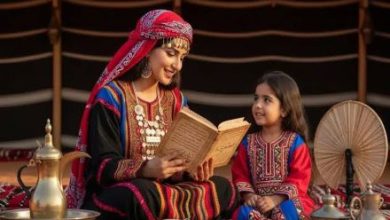
Here, we also discover novels for which publishing houses commission artists to create interior illustrations inspired by the novels’ settings and characters. Indeed, some classical literary texts are also accompanied by such illustrations. In addition, hundreds of oil paintings have been inspired by literary texts.
Let us return to a few lines from this valuable book, where it discusses poetry, prose, and the artistic quality of literature.
Dr. Michel Asi states that traditional scholars who restrict fine art to poetry alone, excluding prose, do so because poetry was the only form of elevated literary art known among the Arabs. Prose, by contrast, rarely rises to the level of the fine arts, except when it takes the form of poetic prose or prose poetry.
With regard to the aesthetic quality of literature, it may be more appropriate to move away from discussing it solely from the perspective of poetry and prose and instead approach the issue from another angle—one that does not consider form alone but examines both form and content. Focusing on the nature of artistic content as opposed to intellectual and scientific content can lead us not only to a decisive resolution of the problem of literary aesthetics but also to a comprehensive understanding of what is meant by poetry and prose, given that convention has traditionally divided literature into these two categories.
Thus, we find that for literature to be considered a fine art, it must possess both artistic content and artistic form, whether it appears in the form of poetry or prose.
Aesthetic value in a literary work is not merely a matter of poetry versus prose. Rather, it is a matter of an artistic vision embodied through a suggestive and expressive style that reveals the vision of the content and the artistry of its substance. The more intensely this artistic quality is concentrated in both content and form, the closer the literary work comes to the realm of the fine arts, reaching its culmination when the work achieves completeness.
Poetry and prose are both creative products, as are ideas and other forms of intellectual expression. Together, they constitute the various forms of literature, which, because of their shared medium of language, are inevitably directed toward an intellectual dimension in addition to their aesthetic and artistic dimension. This results from the convergence of artistic and intellectual activity through the same verbal medium of expression.
Thus, the sphere of literature expands to encompass two types of works: artistic and aesthetic works, and intellectual and conceptual works.
From here, I would argue that literature cannot be separated from the arts in all their forms and varieties. Dramatic literature, in particular, represents the highest practical manifestation of creative activity in literature, because it is a narrative work that takes shape on the stage, or theatrical space, as though it were a living circle of social life.
There is no intermediary between the audience and the event or its protagonists. They are not presented through narration or description; rather, they are directly within the reach of sight and hearing. They are characters driven by a particular event: they love, hate, suffer, and experience happiness, and the audience observes them through the full range of human emotions.
Accordingly, we can say that theater involves two artistic activities rather than one.
The first is literary and artistic activity, whose task is to create the appropriate verbal expression. This is the responsibility of the literary artist.
The second is the artistic activity of performance, undertaken by directors and actors, who are responsible for embodying the characters and creating their environments and atmospheres.
These two activities are not separate from one another. The second completes the first and is built upon it, while the first is connected to and shaped by the possibilities and requirements of performance. Nevertheless, they remain two artistic practices, each with its own principles.
Playwriting is a creative literary art based on constructing a narrative event that is presented through dialogue among characters on stage and performed before an audience.
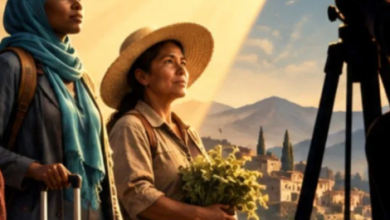
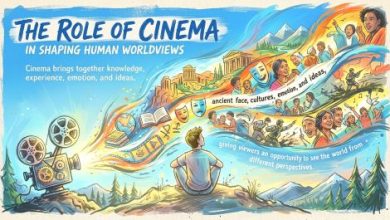
There is also a relationship between literature and cinema. Cinema is a complex audiovisual expressive art that brings together image, movement, and language. It is a narrative art that uses moving images and sound as its means of expression, unlike other arts that depend on masses and volumes, colors, sounds, words, or movements, as is the case with sculpture and other forms of artistic expression.
The relationship between literature and cinema is characterized by communication and mutual influence. This is what Dr. Jihad Na’isa discusses in his study entitled The Novel and Audiovisual Narratives: The Novel and Cinema. We can establish a balance between the novel and cinema, rather than simply compare them.
Both of these art forms are based on fictional narrative. Each takes the human being as its central focus or axis, and each maintains a strong connection with reality according to the nature and scope of imagination and its references. Both also celebrate the historical dimension of narrative.
Narrative fiction in the novel relies on written language, whereas cinema relies on audiovisual language that is subject to a dynamic structure. The time devoted to description is extended in the novel but shortened in cinema.
Unlike cinematic creativity, which cannot be realized without actors, cinematographers, and directors, the creation of a novel can take place independently through the writer’s imagination and language.
There is also a considerable difference between the ability of the novel and cinema to explore inner consciousness. Cinema generally focuses on conveying the external image and is not always able to penetrate deeply into the psychological and intellectual depths of the human being. The novel, by contrast, can achieve this with remarkable effectiveness.
Cinema has nevertheless succeeded in presenting novels and their themes in compelling ways by transforming narrative into dramatic form through the screenplay.
Here, I would like to emphasize that the relationship between literature and all the arts is a strong and enduring one. Each art draws inspiration from the other, and the examples of this mutual influence are numerous.
References
Michel Asi, Art and Literature.
Al-Rashid Bousheir, The Relationship Between Literature and Other Arts.
Read: The Concept of Space in Theatre
______________________
 Souad Khalil, hailing from Benghazi Libya, is a writer, poet, and translator. She has been writing on culture, literature and other general topics.