A Novel of the Bronze Age World
“The Fires of Meluhha” reveals that the Meluhhans neither vanished nor were lost to time; instead, they endure across the landscape, culture, rituals, arts, technology, history, festivities, and genetics of the people of the subcontinent.
Dr. Nisar Ahmed Solangi
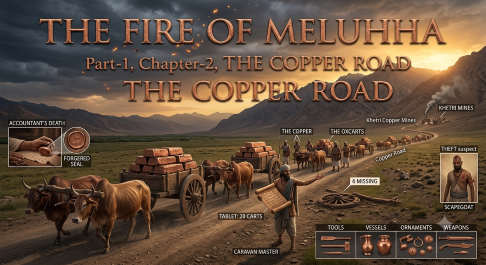
On the Ravi’s banks, a tally comes up short, and six vanished oxcarts of copper carry more than metal — they carry the first crack in an empire that has never needed walls. A caravan-master counts twice, disbelieving, then understands: he has not stumbled upon a theft, but been chosen as its scapegoat.
Part1
Chapter 2
The Copper Road
Three hundred leagues to the north, on the second morning after the barley had been cut, a man called Temural was watching a caravan die.
It was not a violent death. It was an accountant’s death — slow, methodical, absolutely deliberate. He stood in the shade of a thorn-acacia on the eastern bank of the Ravi River and counted the oxcarts as they crossed the ford, and what he counted did not match what his clay tablet told him should be there.
He had twenty-eight oxcarts on his tablet. He counted twenty-two.
Six carts missing. Six carts carrying copper ingots from the mines at Khetri, copper worth more than a craftsman would earn in five years, copper destined for the workshops and smiths of Mohenjo-daro, Harappa, and the hundred smaller settlements that threaded along the river plains. Copper that the entire civilization required to make its tools, its vessels, its ornaments, and — he now suspected — its weapons.
Weapons. There was a word that the polite society of the Indus valley did not use.
Temural was thirty years old, dark-haired, of medium height, with the wiry build of someone who walked long distances and ate irregularly. He had been a caravan-master for seven years, which meant he had been cheated, robbed, threatened, bribed, flattered, and lied to in approximately fourteen languages. He was not easily surprised. But six missing oxcarts of copper ingots surprised him.
“Amar.” He called to his assistant, a boy of sixteen with enormous ears and excellent recall. “Count again.”
Amar counted. “Twenty-two, master.”
“Did any carts turn back at the mountain pass?”
“No, master. I watched the pass myself. Twenty-eight carts entered the Ravi valley.”
“And twenty-two are crossing the ford.”
“Yes, master.”
Temural looked north. The river plain stretched brown and ochre to the edge of sight, broken by the dark smudges of distant villages. He looked south, where the ford shallowed and the remaining carts were splashing through knee-deep water, their ox drivers clicking their tongues in the particular way that Indus valley herdsmen used to keep their animals calm in water.
Six carts did not vanish. Carts were large. Oxen were large. Copper ingots were extremely large. Somewhere between the mountain pass and this ford, someone had turned six oxcarts aside, unloaded their copper, and sent the empty carts — where? Back to the hills? Into some tributary valley?
He could go back and look. He had fourteen-armed men in his caravan — not soldiers (the Indus valley had no soldiers, officially) but road-guards, men with stout copper-tipped spears and the look of individuals who had resolved difficult disagreements before. He could backtrack, ask questions in the river villages, make inquiries.
And he would find nothing. Because whoever had done this had planned it carefully, and careful people did not leave oxcarts sitting in fields to be found.
No, he needed to think further along the chain. The copper came from Khetri mines. The mines were operated under a charter from the Assembly of Harappa, the northern sister-city. The charter specified quantities, transit dates, and the identity of approved caravan masters. Temural’s name was on that charter. Which meant that if the copper went missing and the Assembly asked questions — and it would, because the bronze-smiths’ workshops of the lower cities would eventually notice the shortfall — his name was on the document.
He was not just witnessing a theft. He was being set up to take responsibility for it.
He turned to Amar. “Ride ahead to the next waystation. Send a message-runner south to Mohenjo-daro — to the workshop district, to a seal-maker named Ranjhan. Tell him the copper road runs short. He will understand.” Temural paused. “Also tell him that the problem began at the charter level. He will understand that too.”
Amar frowned — not questioning, just puzzled. “Master, why a seal-maker?”
“Because seal-makers know who made which seal,” Temural said. “And someone put a false seal on a false charter. And I intend to know whose mark it was.”
He clicked his tongue at his own horse and rode down to the ford. The remaining twenty-two carts were already across, their drivers wringing river-water from their wraps. The copper ingots — brick-shaped, blue-green at the corners where the oxidization had begun, heavy enough that each ox could carry only two on a padded back-frame — were safe, stacked and roped.
Twenty-two carts worth. When there should have been twenty-eight.
The mathematics of theft, Temural thought, were always very clean.
He patted his horse’s neck and turned south toward the great river plain, toward the cities that had been civilizing this land for five hundred years without ever building a wall against each other, and wondered how much longer that extraordinary, unprecedented, possibly fragile fact would hold.
Click here to read Chapter 1,
_________________________
Dr. Nisar Ahmed Ali Nawaz Solangi is a distinguished Public Health Specialist with over 28 years of experience in primary healthcare, health management, and policy development. Throughout his career, he has served in leadership capacities, He holds MBBS from the University of Sindh and a Master of Public Health from Griffith University, Australia. He is a dedicated polymath committed to the intersection of ancient civilization and emerging technology. He is deeply engaged in the study of the Indus Valley Civilization—focusing on its maritime history, trade networks, and egalitarian governance. Currently based in Saudi Arabia, Dr. Solangi is a tireless advocate for the digital preservation and global dissemination of the Sindhi language and culture. He is actively involved in pioneering initiatives on social media” Our Digital World”. By bridging the gap between historical heritage and digital innovation, he aims to create a new paradigm for cultural representation in the AI era.