A Novel of the Bronze Age World
“The Fires of Meluhha” reveals that the Meluhhans neither vanished nor were lost to time; instead, they endure across the landscape, culture, rituals, arts, technology, history, festivities, and genetics of the people of the subcontinent.
Dr. Nisar Ahmed Solangi
Chapter 1
 The Seal-Maker’s Daughter
The city breathed before dawn.
Pariya had learned to listen for it — that collective exhale of thirty thousand sleeping souls, the groan of fired-brick walls still warm from yesterday’s sun, the whisper of the Sindhu River carrying its silt-brown secrets south toward the sea. She stood on the roof of her father’s workshop on the second tier of the Lower City, her bare feet on cool brick, and watched the eastern sky blush copper above the grain warehouses.
She was seventeen years old, and she had never left Mohenjo-daro. She did not need to. The world came to her.
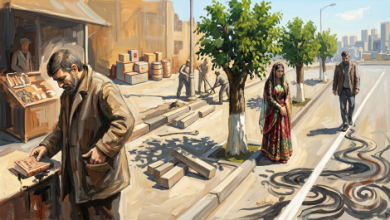
Below, the city was already stirring. The great straight avenues — her father called them the veins of civilization — ran north to south and east to west in their perfect grid, broad enough for two ox-carts to pass without argument. The drainage channels that ran beneath every street hummed with night-water. The public wells were already drawing their first visitors: potters, dyers, the women who ran the bead workshops on the eastern quarter. This city was not ruled by kings, as the river-lands of Sumer were. It had no single palace, no god-king’s ziggurat clawing the sky. It had something stranger and more powerful — it had order.
Her father, Ranjhan the seal-maker, called it the gift of the Unseen Ones.
Pariya called it a prison with very clean streets.
She turned from the view and descended the narrow stair into the workshop. The smell of steatite dust hit her first — that chalky mineral bite that had lived in her nose since childhood. Her father was already at his workbench, his obsidian-tipped graver moving in tiny precise strokes across a new seal blank, his oil lamp throwing trembling shadows across the finished seals hanging in rows along the wall. Unicorns. Tigers. The sacred fig tree. The three-headed beast that no living creature resembled but that every merchant from the Zagros to the Deccan recognized as the mark of Mohenjo-daro quality.
“You watched the sunrise again,” Ranjhan said, without looking up.
“The sky was interesting.”
“The sky is always interesting. The work is what changes.” He set down his graver and turned. He was fifty, lean and dark, with deep-set eyes that had squinted over seal-work for thirty years. His fingers were permanently grey with steatite. “Sit. I want to show you something.”
She sat on the opposite stool and he pushed a clay tablet across the bench — not one of his seals, but something different. A pressed rectangle, smaller than his palm, covered in the tiny pictographic script that the merchants and officials used to keep accounts. She could read it: everyone in the workshop district could read, it was as basic as knowing how to count.
But this tablet said something that made her breath catch.
“Where did you get this?”
“It arrived yesterday, wrapped in a piece of dyed cotton, delivered by a man I have never seen. He wore the dust of the north road.” Ranjhan’s voice was careful. “Read it aloud.”
Pariya read: “‘The Council of Weights stands corrupted. The measures at the north granary run short by one-eighth. The cheating has continued for three harvest seasons. Seven hundred families receive less grain than their bronze tokens promise. The Inspector of Measures knows. He does not act. The Unseen Ones sleep.'”
She set the tablet down. The oil lamp flame wavered as if it too had heard.
“Someone wants you to know this,” she said.
“Someone wants a seal-maker to know this,” Ranjhan corrected. “Which is peculiar. I am not the Inspector of Measures. I am not on the Assembly. I make seals for merchants and record-keepers. But I am also—” he paused. “—known to certain people as someone who does not throw tablets into the smelting furnace.”
“Who are these certain people?”
He picked up his graver again. “Eat your breakfast. We have a commission from a lapis merchant from the north — three trade seals before midday. And, Pariya—” He looked at her directly. “Tell no one about the tablet. Not Meena, not Munash the copper trader, not anyone.”
She should have agreed immediately. She didn’t.
“Father,” she said quietly, “if the granary measures have been short for three seasons, and no one acts — someone is stealing the food of seven hundred families. In a city of ten thousand, that means one family in fourteen is hungry. Do you know that children on the eastern tier—”
“I know what I know.” His voice was not unkind. “And what I know is that we are small people. The Assembly is not small people. The Inspector of Measures is not a small person. And the man who commissioned the false weights—” He stopped.
“You know who it is.”
He did not answer. He bent over his work. The graver scraped softly against steatite, carving the tiny sacred unicorn that had been Mohenjo-daro’s mark since before her grandfather was born.
Pariya ate a flatbread she didn’t taste, drank water from the household jar, and went to open the workshop for the day’s first customers.
But she kept the tablet in her memory, every word of it, pressed into her mind as cleanly as a seal pressed into wet clay.
She did not know, that morning, that by nightfall a man would be dead, that she would be running through the drainage tunnels beneath the city with a stolen sack of evidence, and that everything she thought she knew about Mohenjo-daro’s famous, perfect order was about to shatter like fired clay dropped from the citadel wall.
The city breathed before dawn. But cities, like people, could also hold their breath — just before they screamed. (Continues)
Read: Lessons from the Indus Valley Civilization
_______________________
Dr. Nisar Ahmed Ali Nawaz Solangi is a distinguished Public Health Specialist with over 28 years of experience in primary healthcare, health management, and policy development. Throughout his career, he has served in leadership capacities, He holds MBBS from the University of Sindh and a Master of Public Health from Griffith University, Australia. He is a dedicated polymath committed to the intersection of ancient civilization and emerging technology. He is deeply engaged in the study of the Indus Valley Civilization—focusing on its maritime history, trade networks, and egalitarian governance. Currently based in Saudi Arabia, Dr. Solangi is a tireless advocate for the digital preservation and global dissemination of the Sindhi language and culture. He is actively involved in pioneering initiatives on social media” Our Digital World”. By bridging the gap between historical heritage and digital innovation, he aims to create a new paradigm for cultural representation in the AI era.