Calligraphy is the art and design of writing that employs the Arabic script.
- The art of calligraphy is closely associated with Arab ornamentation and has long been used to decorate mosques and palaces, as well as to embellish manuscripts and books, particularly copies of the Holy Qur’an.
Souad Khalil | Libya
Arabic calligraphy is the art and design of writing that employs the Arabic script. The Arabic writing system is distinguished by its connected letters, which allow for a wide variety of geometric forms through elongation, curvature, angularity, interlacing, overlapping, and composition. The art of calligraphy is closely associated with Arab ornamentation and has long been used to decorate mosques and palaces, as well as to embellish manuscripts and books, particularly copies of the Holy Qur’an. This field attracted great interest from Muslim artists, partly because Islamic tradition discouraged the depiction of human and animal figures, especially in sacred places and Qur’anic manuscripts.
This is the definition we commonly encounter whenever Arabic calligraphy and its aesthetics are introduced.
 If Arabic calligraphy remains the fundamental pillar upon which Islamic art rests to this day, its true essence lies in the asceticism and purity that spring from the spirit of Sufism. There exists a profound connection between the worshipper and the spirit of this ancient art. Arabic calligraphy requires a unique form of retreat and contemplation on the part of the Muslim artist, enabling him to create an atmosphere imbued with sanctity through a transparent spiritual communion with the Creator.
What Mohammed Abu Aziz wrote about the principles and rules of calligraphy allows us to perceive the visual repetition inherent in Arabic script and in decorative motifs of all kinds, which appear throughout the works of numerous Arab and Muslim artists.
The visual repetition of Arabic calligraphy and ornamental forms found in Islamic art reveals a harmonious rhythm that carries both visual and musical resonance. This rhythm becomes evident in poetic meter, architectural symmetry, the balanced cadence of painting and music, as well as in talismans, miniatures, and arabesque patterns.
Islamic art relied upon a distinctive palette of colors. Foremost among them is gold, a color abundantly used despite its rarity in nature. It possesses sacred religious connotations. Oswald Spengler considered gold to be the dominant color of the Arab style—a color heralding Paradise. It is a supernatural color symbolizing the hidden powers that govern the material world within the cosmic cave of existence.
 This symbolism appears clearly in the Dome of the Rock in Jerusalem and on the walls of the Umayyad Mosque in Damascus, adorned with marble and magnificent gilded mosaics. Some scholars even suggest that the eight-pointed star first appeared in Islamic art within the decorations of the Dome of the Rock, alongside Arabic calligraphy inscribed upon its walls.
Such artistic choices invite us to delve into the depths of color in order to reach the essence of faith itself. Color becomes a source of light, elevating the viewer from earthly reality toward transcendence and eternity. Other prominent colors—blue, green, and turquoise—evoke the heavens, open horizons, and the abundance bestowed by fertile landscapes. Together they inspire reflection on the infinite structure of the universe and encourage contemplation of the Creator.
The Muslim artist distanced himself from figurative representation, yet he never distanced himself from texture—the language of surfaces and one of the most distinctive visual elements. He handled texture with remarkable craftsmanship, recognizing its powerful visual impact upon the eye. Texture guides the gaze like a symphony unfolding before the observer, revealing the harmony embedded within creation itself. There is rhythm even within the pores of the human body, and the fingerprint stands as clear evidence of this uniqueness, expressing the tangible truths of our existence.
Among the finer aspects of Islamic artistic expression are those linked to Sufi practices. Earlier, we referred to the spiritual dimension of Islamic art; here we may pause before certain Sufi rituals such as whirling, chanting, and devotional recitations. These practices are characterized by recurring phonetic patterns whose repetition acquires both auditory and visual significance. Rhythm manifests itself in movements that seem endless, while the circle becomes a symbol of infinity. Through continuous repetition, a delicate spiritual bond emerges, reaching its highest point in the relationship between the Creator and the created.
Visual and musical repetition appears in many references, including studies of Sufi terminology in the writings of the great mystic Ibn Arabi. Expressions such as “The Secret of Secrets,” “King of Kings,” and “Father of the Essence” represent verbal formulas that embody profound spiritual meanings and reveal the hidden depths of the Sufi soul. Their repeated use preserves layers of symbolism and contemplation that resonate beyond the literal meaning of words.
This reveals the uniqueness of the Islamic artistic system. One may also consider the criteria established by Abu Hayyan al-Tawhidi for beautiful handwriting. He stated that the scribe requires several qualities: precision in execution, elegance in refinement, harmony in composition, beauty in ornamentation, excellence in detailing, mastery in accuracy, and distinction in differentiation.
If we regard calligraphy as a point moving through the space of the written composition, we discover an intricate network of linear relationships. The calligraphic form engages the viewer aesthetically while simultaneously conveying meaning. Though the points themselves remain fixed, they suggest movement and continuity. In this way, calligraphy becomes a mirror reflecting psychological and spiritual meanings, introducing the viewer into a visual music of forms.
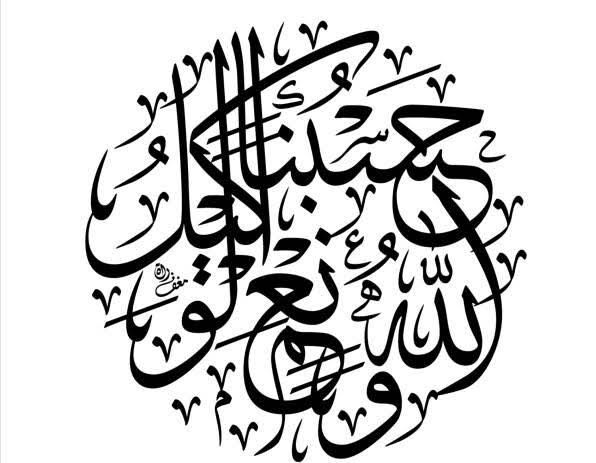 Rhythm in Islamic art depends upon symmetry, balance, exchange, and repetition. It is expressed through both flowing and geometric lines, as well as through the distribution and variation of spaces. The resulting visual rhythm conveys harmony and delight while also producing a sense of wonder.
A striking example may be found in the illustrations depicting Ramadan celebrations in manuscripts of Al-Hariri’s Maqamat. The rhythmic quality emerges through the arrangement of lines, masses, light and dark areas, and the positioning of figures and horses. Such compositions create movement within the image and achieve a rich variety of aesthetic harmonies.
In addition to rhythm, place occupies a central position within Islamic artistic consciousness. Nothing exists independently of place, for place completes existence itself. It is therefore no surprise that the celebration of place became a defining characteristic of poets throughout the ages. In Sufi thought, spiritual perfection grants one a “station” or spiritual place attained through traversing states and stages of inner development.
As one poet expressed:
“Your place within my heart is the whole heart itself,
Leaving no room for anything but you.”
Classical Arabic poetry, with its balanced structure of hemistiches, established a direct relationship with place. Poetry itself became a dwelling for emotions—a house that shelters memory, longing, and imagination. Through poetic language, vast worlds filled with the mosaics of life unfold before us
The eloquence of Arabic poetry provides abundant examples of the intimate relationship between image, language, and artistic expression. In praising Sayf al-Dawla al-Hamdani, the great poet Al-Mutanabbi wrote:
“If mankind possesses fragrance and you are among them,
Then musk is but a portion of the gazelle’s blood.”
Through this powerful metaphor, Al-Mutanabbi elevates his subject above all others, employing a refined balance of meaning, comparison, and rhetorical elegance. The image creates a tangible emotional and intellectual effect, demonstrating the poet’s mastery in shaping language into beauty.
Elsewhere, Al-Mutanabbi offers another remarkable visual image when he likens the crescent moon to a silver letter nun floating in a blue page of sky:
“The crescent seemed a silver nun,
Immersed within a page of blue.”
The image evokes a curved white form suspended against a vast azure background, revealing how Arabic literary imagination transforms language into visual art.
From the pre-Islamic poetic tradition to the sublime text of the Holy Qur’an, the spread of Islam and its interaction with neighboring cultures marked a decisive turning point in the development of the Arabic language. The Qur’an endowed Arabic expression with a distinctive character and enriched its linguistic structure with unparalleled eloquence, organization, and rhetorical power.
While this is not the place to discuss the linguistic and spiritual dimensions of the Qur’anic text in detail, Qur’anic manuscripts remain among the most significant artistic and cultural sources in Islamic civilization. Their documentation and study across different historical periods provide valuable insights into the evolution of Arabic calligraphy and Islamic aesthetics.
In Islamic art there exists an intimate relationship between the string, the pen, and the brush. The same reed from which the calligrapher fashions his pen is also used to create the flute, while the Arabs’ discovery and refinement of the oud emerged from careful observation of natural forms and structures.
What we wish to emphasize is that Arabic calligraphy is among the arts most deeply connected to music. The beautification of sound, the melodious recitation of the Qur’an, and the chants performed in gatherings of remembrance all point to a profound relationship between what is heard and what is seen. When letters harmonize in graceful rhythms, they flow like the murmur of water.
The attempt to reconcile the audible word with the visible form reflects a pursuit of nature itself. Yet nature, in turn, follows the traces of the soul. What we call intuition may therefore be understood as the continuous bond linking material sound, artistic form, nature, and the inner self. Artistic creation is ultimately a sensory and spiritual act rooted in human consciousness.
This relationship becomes particularly evident in the Andalusian muwashshahat, where poetic language merges with melody and movement. The muwashshah derives its name from its ornamented structure, whose varied rhymes create a delightful musical resonance welcomed by both ear and heart. The rhymes function like jewels adorning a necklace, giving the poem its distinctive beauty and elegance.
Among the most celebrated Andalusian muwashshahat is that of Lisan al-Din Ibn al-Khatib, who begins:
“May the rain bless you whenever rain falls,
O time of union in Andalusia.”
Here, place itself becomes a poetic element that lends purity and legitimacy to interpretation. A hidden order governs the relationship between context and expression, between the universal and the particular.
Arabic calligraphy serves as a vessel that embraces the expressions of life itself. This unique quality has endowed it with a distinctive identity fashioned by generations of masters. Even today, its letters retain a fragrance of purity and spiritual refinement, for they emerge from a realm deeply rooted in contemplation and transcendence.
 A Legacy of Rules and Innovation
Arabic calligraphy is governed by an inherited system of principles and rules that preserve its structural integrity. These principles are interconnected through precise relationships that determine proportions, elevations, and alignments, thereby achieving visual harmony and balance.
Yet despite its adherence to tradition, calligraphy has never ceased to evolve. The awareness and creativity of master calligraphers have expanded its possibilities through sophisticated explorations of mass and space, symmetry and balance. As a result, letters have acquired greater cohesion and expressive power while continuing to inspire innovation.
Originally developed to serve humanity as a means of communication, Arabic script gradually transcended its functional role to become one of the most celebrated artistic achievements of world civilization. Its geographical expansion enabled it to flourish across cultures, displaying remarkable expressive capabilities in both form and meaning.
Modern innovations have further opened new horizons for Arabic calligraphy. Calligraphers have experimented with geometric arrangements based on circles, pyramids, and squares, while also creating compositions inspired by human figures, birds, animals, and other living forms. Through these endless transformations, Arabic calligraphy continues to affirm its vitality, demonstrating its ability to unite tradition and creativity, spirituality and beauty, in a single artistic language.
Read: Between the Theatre and Heritage
__________________
 Souad Khalil, hailing from Benghazi Libya, is a writer, poet, and translator. She has been writing on culture, literature and other general topics.